VML is a creative company that combines brand experience, customer experience, and commerce to create connected brands and drive growth. VML is celebrated for its innovative and award-winning work for blue chip client partners including AstraZeneca, Colgate-Palmolive, Dell, Ford, Intel, Microsoft, Nestlé, The Coca-Cola Company, and Wendy’s.
The agency is recognised by the Forrester Wave™ Reports, which name WPP as a “Leader” in Commerce Services, Global Digital Experience Services, Global Marketing Services and, most recently, Marketing Measurement & Optimization. As the world’s most advanced and largest creative company, VML’s global network is powered by 30,000 talented people across 60-plus markets, with principal offices in Kansas City, New York, Detroit, London, São Paulo, Shanghai, Singapore, and Sydney. VML is a WPP agency.
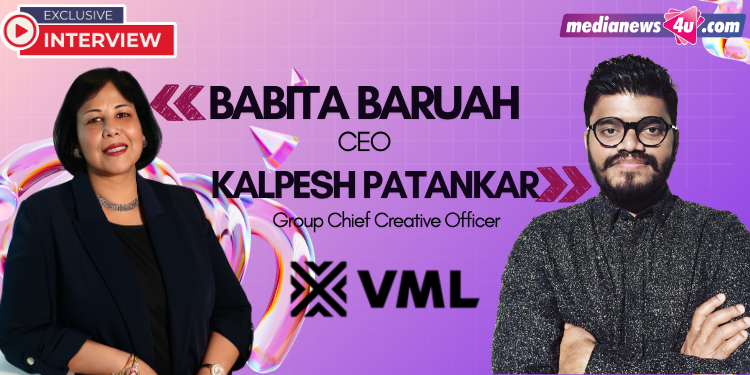
Medianews4u.com caught up with Babita Baruah, CEO, VML India and Kalpesh Patankar, Group Chief Creative Officer, VML India
Q. How are structural changes within the advertising business going to shape creativity in 2026?
Babita Baruah: Creativity is always about deep rooted cultural and behavioural insights that a brand can solve for in a way that is relevant and engaging, provoking action. Structural changes in the industry are primarily around data, technology and customer experience. Driven by deeper data-led insights, making ideas more resonant, credible and impactful.
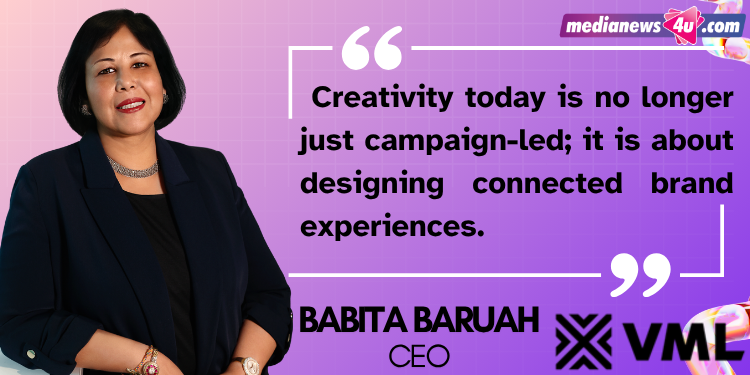
Creativity is also increasingly about designing connected brand experiences, going beyond campaigns. Agility is key as brands respond to culture and performance. The ‘Human Centricity and Connected Brand’ philosophy for us is about orchestrating the creative thread between brand experience, customer experience, and commerce as a single, unified ecosystem.
 Q. VML focusses on authentic storytelling. What tactics will be adopted in this regard and is the importance of authenticity in advertising and marketing growing as that is what Gen Z prioritises?
Babita Baruah: VML’s Human Centricity is about what human truth can we resolve or unlock. It goes beyond demographics into motivations, culture and context. Uses imagination, storytelling, experiences and commerce to make it meaningful and authentic.
We continue to focus on advanced data analytics, AI, cultural immersion, and qualitative research for a connected brand solution. The importance of authenticity is growing exponentially, and Gen Z is a major driver of this. They are digital natives who demand transparency, align with brands that reflect their values, and value honesty over perfection.
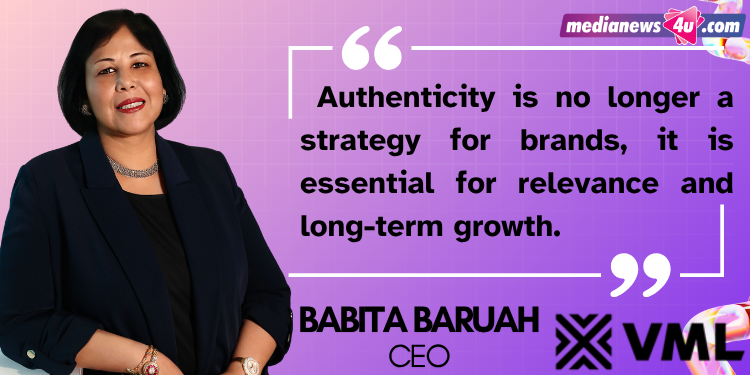
For them, a brand’s actions speak louder than its words. If a brand isn’t authentic, they will simply disengage. So, for VML, authenticity isn’t a strategy; it’s fundamental to maintain brand relevance and growth.
Q. What goals has VML India set for 2026 and what is the gameplan to get there?
Babita Baruah: Our vision for VML India in 2026 is to be an indispensable growth partner for brands navigating an increasingly complex and connected world. We aim to unlock the full potential of our integrated capabilities by bringing together creativity, customer experience and technology, while delivering measurable business impact.
At the same time, we are focussed on building a strong, inclusive culture that attracts top talent, and staying ahead of the curve by leveraging emerging technologies to create meaningful, future-ready brand solutions. We have had a great start already with some incredible campaigns.
Q. Are we in a period where no creative work will start without a clear line of sight to business outcomes?
Babita Baruah: Today, creative work rarely exists in isolation from business outcomes. Every campaign or experience needs to begin with a clear understanding of the business challenge, the desired outcome, and how success will be measured, whether that’s driving sales, building brand preference, or strengthening customer loyalty.
This doesn’t limit creativity; it sharpens it. When ideas are aligned with clear objectives, they become more purposeful and effective, from driving action, building equity, to delivering real impact. It’s an exciting time for the industry, and at VML India, we’re constantly striving towards the opportunity to create work that is both meaningful and measurable.
 Q. Has the traditional marketing funnel collapsed? If so, how is this informing VML’s approach to creating work that hooks the consumer’s attention to drive conversion?
Babita Baruah: The structure of the funnel has shifted significantly. Consumer journeys today are rarely linear. People move between discovery and purchase in ways that can be spontaneous, recursive and platform-native. A consumer might encounter a brand through a creator post, evaluate through a review thread and convert through a quick commerce app, all within the same session. Awareness, consideration and conversion are no longer sequential stages with clear boundaries between them.
For VML, this shapes how we build and brief our work. We approach brand experience, customer experience and commerce as a single connected ecosystem rather than distinct stages to be addressed separately. When that integration is right, every touchpoint earns both attention and intent. A piece of content can create desire and invite action in the same moment. A commerce interaction can reinforce brand affinity even as it converts.
The question we ask is not which stage of a funnel a piece of work addresses, but what role it plays in the full brand ecosystem and how clearly it moves the audience forward from wherever they are. That clarity of purpose, built into every executional decision, is what connects creative quality to commercial outcomes.
Q. How will VML balance AI with human intuition?
Babita Baruah: The question of balancing AI with human intuition is, at its heart, a question of values. What do we believe the purpose of creative work is? For us, it is to create a genuine human connection and that belief shapes how we deploy technology. Human intuition brings what AI cannot generate on its own, be it lived experience, cultural empathy or simply the instinct to recognise what will resonate before any data confirms it. These qualities give creative work its distinctiveness.
AI, on the other hand, accelerates exploration and enables personalisation at a scale that was simply not feasible before. When both work in tandem, teams can move further and faster without sacrificing depth or originality. The balance comes from a human-first approach. Technology supports the process, but it is people who shape the insight and guide the narrative. AI can sharpen thinking, but it should not replace human judgment.
Q. The deadline for compliance with the Digital Privacy Act (DPDP) is November. How is VML gearing up for this?
Babita Baruah: The DPDP Act brings important clarity to how personal data is collected, processed and used. It places a strong emphasis on consent, purpose limitation and accountability, all of which are critical in building long-term trust.
Preparation is both structural and cultural. Structurally, it involves reviewing data practices, strengthening governance frameworks and ensuring that systems align with regulatory requirements. Equally important is building awareness within teams and with partners. Responsible data use cannot sit with one function. It has to be understood across strategy, media, technology and creative.
From a broader perspective, this is certainly an opportunity. As data becomes more regulated, the focus shifts to first-party relationships and meaningful engagement. Trust becomes a differentiator here.
Q. To create work that becomes a part of culture instead of just being memorable for a day, what mistakes should be avoided?
Kalpesh Patankar: The most common misstep is attempting to hijack culture instead of meaningfully contributing to it. Brands that show up purely to leverage a time-sensitive cultural moment tend to reflect as transactional in nature. The work that endures is the kind that genuinely adds something, a perspective, a feeling, or a story that people want to carry with them long after the campaign has ended.
To create something lasting you must start with a human-first approach. You need to understand what people care about, what makes them laugh or what truly moves them. When you design work that solves a real problem or touches a genuine emotion, it naturally weaves itself into the cultural fabric. The key is to prioritise authenticity over temporary trends.
 Q. Is the importance of vanity metrics going down rapidly as a result?
Kalpesh Patankar: We are certainly seeing a strategic shift away from a focus on pure visibility. Metrics like reach and view counts have established their place in the process, but they do not automatically translate to brand love or sustainable business growth.
The industry is now having a more honest conversation about what actually changed as a result of the work, whether it shifted perception, built preference, or deepened the relationship between a brand and its audience. These are harder questions to answer but they are the right ones to be asking. The most progressive clients are already there, and that is raising the quality of briefs considerably.
Q. Are brands now focusing more on long term brand building as opposed to falling in the trap of focusing too much on performance marketing?
Kalpesh Patankar: The industry is finding a much healthier balance today. For a period, there was an intense focus on performance marketing because it offered immediate gratification and easily measurable returns. But optimising purely for immediacy came at the cost of long-term brand equity and the effects of that are now visible across many categories.
Marketers today acknowledge that brand building and performance are complementary forces rather than competing priorities. The brands getting this right are investing in emotional platforms that build desire and preference, while using performance mechanics to convert that desire further down the funnel. You need strong storytelling to build emotional equity alongside a robust performance strategy to drive the final transaction.
Q. What role does data analytics play for VML? Today, is a data driven approach a must for any campaign to succeed?
Kalpesh Patankar: Data is central to how VML operates. Our approach is human-first and technology-empowered, and data is a significant part of that technological foundation. It informs the insight process, sharpens targeting and personalisation, and helps us understand how work is performing and where it can be refined in real time.
That said, data on its own is just cold information. It takes sharp creative intuition to translate that information into a compelling cultural insight. A data-driven approach is essential for precision, but a human-first approach is mandatory for persuasion.
 Q. Is doom scrolling the biggest challenge for digital marketers and their agencies?
Kalpesh Patankar: Doom scrolling is not the core challenge itself. It is simply a symptom of an audience that is bored and overwhelmed by an endless feed of predictable content. People instinctively scroll
past things in search of something that genuinely feels worth their time. The response cannot simply be making things faster, louder, or more frequent.
Audiences today are remarkably discerning. They reward work that feels genuinely created for people rather than platforms. The real work lies in creating things that command your attention, work that is useful, resonant, and meaningful enough that people actively choose to pause.
Q. The idea for The Slooowest Vending Machine in the World came from a collaboration between VML Netherlands and VML India, with design and engineering brought to life by The Other Half. Will we see a lot more collaboration in 2026?
Kalpesh Patankar: ‘The Slooowest Vending Machine’ is a perfect example of what becomes possible when different creative perspectives work together. Working together with VML Netherlands, we brought the conceptual sensibility, cultural grounding to the idea and The Other Half brought the physical craft to life.
The combination produced something no single team could have arrived at working alone. That is the real promise of a global network operating as a connected creative force. In 2026, we are hoping to collaborate at large and see more of this.
The challenges brands face these days grow increasingly complex and the best solutions will draw on expertise from across the network, wherever it lives, without geography becoming a barrier.
Q. Is AI helping deliver work quicker as routine tasks get automated?
Kalpesh Patankar: AI is undoubtedly a fantastic tool for speed and efficiency. It is helping us automate routine tasks, process research data much faster and visualise early concepts with incredible agility. However, efficiency is not necessarily the same as creativity. While AI can generate multiple options at scale it still requires human taste, empathy, and cultural context to give it a distinct voice.
We use technology to clear the runway, so that our creative teams have more time to focus on the actual craft. Technology effectively handles the automation, but people will always handle the emotion.
Q. Does the brand’s CMO often sit at the table during VML’s creative process to provide inputs and ensure that both the agency and client are on the same page?
Kalpesh Patankar: The best creative work consistently emerges from deep and early collaboration. When a CMO sits at the table during the creative process they bring invaluable business context and a thorough understanding of the specific challenges their brand faces.
This shared environment transforms the dynamic into a true partnership where we co-create solutions together. This level of shared ownership is incredibly beneficial. It ensures that the final creative product is highly and fiercely aligned with the brand’s core business objectives.