Mumbai: Platform metrics should be treated as tools, not the final measure of brand success. Measurement in advertising is ultimately about trust and validating platform claims, which is why independent third-party verification is essential instead of relying only on platform-defined metrics. Platforms should act as partners aligned with brand objectives, where different platforms solve different business use cases and cannot fulfil every objective equally
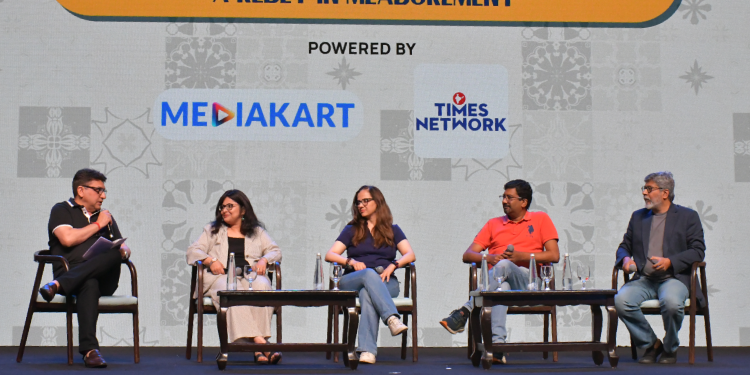
The conversations on the third day of Goafest 2026 included measurement and accountability with a session called ‘From Platform-Defined to Brand-Aligned: A Reset in Measurement’, powered by Mediakart & Times Network. The panel featured Aditi Mishra, Chief Executive Officer, Lodestar; Dhiraj Gupta, Co-Founder & Chief Technology Officer, mFilterIt; Neha Markanda, Chief Business Officer, ShareChat; and Shahad Anand, Business Head, Mediakart. The discussion was moderated by Ashish Sehgal, Chief Executive Officer – Times TV Network, CGO – Times Media & Entertainment.
Talking about the limitations of relying solely on platform-driven metrics in brand building, Mishra said, “Platform metrics should be treated as tools, not the final measure of brand success, since performance data alone cannot define long-term growth. Brands must balance data with instinct and consumer understanding, as there is no single source of truth in measurement today. Ultimately, consumers buy products, not algorithms, and strong brand building requires contextual storytelling, emotional connection, and collaboration across agencies, marketers, and multiple measurement frameworks.”
Underscoring the importance of independent validation in advertising measurement,Gupta noted that measurement in advertising is ultimately about trust and validating platform claims, which is why independent third-party verification is essential instead of relying only on platform-defined metrics. “Advertisers need proof of audience quality and delivery, and measurement must support business outcomes and shareholder value. As the saying goes, ‘the maker cannot be the checker, and the checker cannot be the maker,’ making transparency and accountability non-negotiable in building advertiser confidence.”
Markanda emphasised the need for platform-agnostic thinking and culturally grounded measurement. “Platforms should act as partners aligned with brand objectives, where different platforms solve different business use cases and cannot fulfil every objective equally. User participation, culture, and context matter as much as impressions, and brands must triangulate platform data, user behaviour, and business outcomes rather than rely on a single metric. Ultimately, success is reflected when ‘user truth’ and ‘brand truth’ align through engagement, sales, and meaningful cultural relevance beyond demographics”.
Talking about the importance of keeping measurement tied to real business impact rather than treating it as the end goal, Anand, said, “Brands focus on efficiency, money and growth, where measurement exists to support business objectives rather than become the objective itself. Metrics like CAC, ROAS and conversions matter only when they drive real outcomes, as brand building, acquisition and sales each require different approaches. In an environment where every piece of content can be monetised, trusted third-party verification is critical to ensure transparency and validate whether campaigns are creating real behavioural impact.”