Nutty Gritties earlier this year unveiled its latest campaign with the launch of Daily Date, a date-based indulgent aiming to redefine sweet indulgence by owning the post-meal craving moment as a mindful daily ritual. Moving beyond a product launch, the brand is driving a shift—from routine indulgence to more conscious, everyday choices.
The campaign is rooted in a simple, relatable insight: the instinctive need for something sweet after meals. While this often means reaching for laddoos or chocolates, the idea behind Daily Date draws from a familiar childhood moment—siblings debating treats, with their mother suggesting a date instead. This everyday nudge now evolves into a larger narrative of replacing habitual indulgence with a more mindful ritual.
Through this campaign, Nutty Gritties is repositioning dates from a festive staple to an everyday, accessible Daily Date is positioned as a convenient, portion-controlled option for regular cravings—whether post meals, during mid-day slumps, or on the go.
With just 49 calories per serve, no added refined sugar, and the natural sweetness of dates and honey, Daily Date delivers a satisfying, guilt-free sweet fix in a convenient, bite-sized format—making mindful indulgence an easy daily habit.
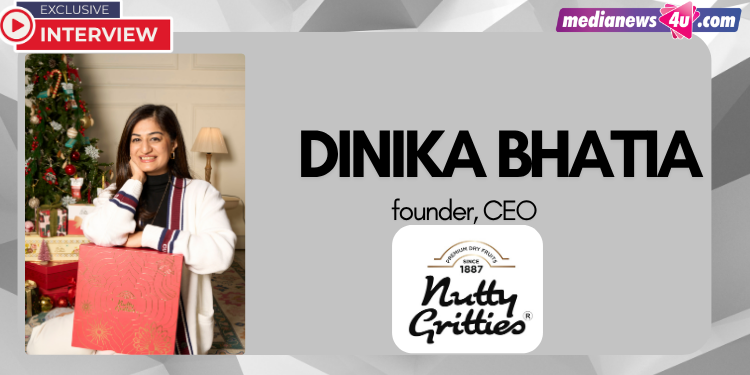
MediaNews4U.com caught up with Dinika Bhatia founder, CEO Nutty Gritties
Q. The company has a 130-year legacy in dry fruits and went into D2C in 2009. What was the market gap seen at a time when D2C was at an early stage in the country?
When we entered the D2C space in 2009, the healthy snacking category in India was still extremely underdeveloped. Dry fruits were largely viewed as a commodity purchase — unbranded, inconsistent in quality, and mostly restricted to festive or gifting occasions.
What we saw early on was a shift in urban consumer behaviour. Consumers were becoming more conscious about health, quality, hygiene, convenience, and packaging, but there were very few brands building trust and premiumisation in this category.
We identified a clear gap in creating a branded, high-quality, lifestyle-led healthy snacking company that could make nuts, dry fruits, and functional snacking more accessible and aspirational for everyday consumption. The larger vision has always been to build a healthier and happier world through better everyday food choices.
Going D2C early also gave us direct access to consumer behaviour and insights. It helped us understand consumption occasions, repeat behaviour, flavour preferences, gifting trends, and emerging health-conscious habits much earlier than traditional retail models.
That foundation has played a major role in shaping the business we are building today.
 Q. It has been growing 30–40% organically over the last several years and has been profitable for many years. What have been the key learnings from this?
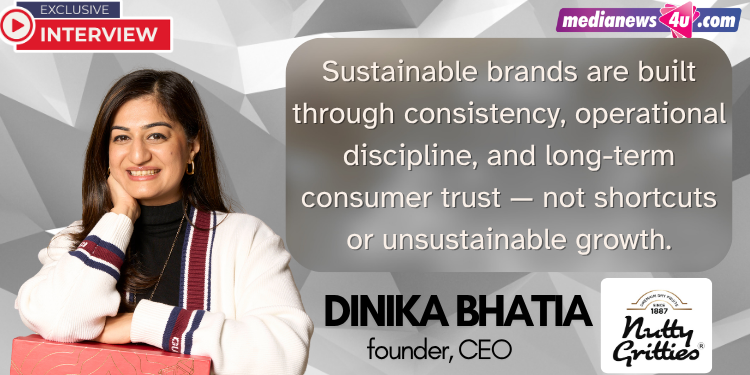
One of the biggest learnings has been that sustainable brands are built through consistency, not shortcuts.
From the beginning, our business has been built around three core pillars — health, quality, and trust. We focused heavily on product quality, operational discipline, clean and honest communication, and long-term consumer trust instead of chasing unsustainable growth. In categories like healthy snacking, repeat behaviour matters far more than one-time trials.
Another key learning has been the importance of building strong fundamentals before scaling aggressively. We strongly believe in the idea of deep work, focused execution, and not spreading ourselves too thin across too many directions at once. Over the years, we invested deeply in sourcing, manufacturing, packaging, distribution, and understanding consumer behaviour.
We also learnt that innovation works best when it solves real consumption moments. A large part of our approach is inspired by the Pareto Principle and the idea of dominating meaningful niches before expanding further. Instead of trying to be everything to everyone, we focus on solving a few high-frequency consumption occasions extremely well. Consumers don’t necessarily want to completely change habits — they want better alternatives within existing habits. That insight has become central to our product strategy today.
Finally, profitability gives businesses clarity and resilience. It allows you to take sharper long-term decisions without constantly reacting to short-term pressures.
Q. The brand is driving a shift—from routine indulgence to more conscious, everyday choices. How will this be reflected in both product innovation and the marketing strategy in 2026?
Consumers today are no longer looking to eliminate indulgence completely. They are looking for smarter, more balanced ways to indulge.
That philosophy is shaping both our innovation pipeline and our marketing direction. One thing we strongly believe is that we would never launch a product that we ourselves would not consume or confidently recommend to our own families.
From a product standpoint, we are evolving from a premium nuts and dry fruits brand into a broader healthy snacking platform rooted in health, quality, trust, and everyday consumption-led innovation. Daily Date is a strong example of that shift. It was built around one of the most universal consumption moments — post-meal sweet cravings.
Instead of asking consumers to give up indulgence, we wanted to offer a date-based, portion-controlled, guilt-free alternative that fits naturally into daily life.
On the marketing side, the focus is shifting towards habit-led consumption moments rather than just product communication. We are building narratives around real everyday occasions — post-meal cravings, office snacking, travel, pre- and post-workout consumption, and mindful indulgence.
The idea is to build products that integrate seamlessly into routines rather than products that feel restrictive. We believe authentic innovation comes from understanding real consumer behaviour deeply and building around those insights with consistency and focus.
Q. Pepsi is reducing sugar in its colas in a huge way. Does that show that for all snack majors having a rigorous focus on the healthy snacking space is non-negotiable today?
Absolutely.
Consumers globally are becoming far more ingredient-conscious and informed. Whether it is sugar, preservatives, artificial additives, or processed ingredients, people today are reading labels much more actively than before.
Health and indulgence are no longer viewed as completely separate categories. Consumers now expect brands to deliver both.
For the industry, this shift is no longer optional — it is structural. Consumers today expect far greater transparency from brands, and we believe clean, honest labeling and communication are non-negotiable.
At the same time, healthy snacking cannot come at the cost of taste or convenience. Consumers today expect brands to deliver indulgence, transparency, and functionality together. The brands that will succeed are the ones that can balance nutrition, functionality, indulgence, and accessibility in a way that feels effortless for consumers.
That is where we believe the category is headed.
 Q. Could you talk about the brainstorming with the creative agency that led to the campaign with the launch of Daily Date?
The entire campaign started with one simple but powerful consumer insight — post-meal sweet cravings are universal.
Across age groups and lifestyles, almost everyone looks for something sweet after meals. Traditionally, that often meant mithai, chocolates, or desserts.
Instead of positioning Daily Date as a restrictive health product, we wanted to position it as a smarter everyday indulgence.
The brainstorming process revolved around understanding emotional consumption behaviour rather than simply highlighting product features.
That eventually led to the core campaign thought:
“Post-meal sweet cravings? Choose better. Choose Daily Date.”
The idea was to keep the communication simple, relatable, and behaviour-led.
We also consciously wanted the campaign to feel modern, everyday, and lifestyle-oriented instead of overly clinical or nutrition-heavy. The larger goal is to make healthier choices feel aspirational, accessible, and easy to adopt in daily life.
Q. How important will owning the post-meal craving moment be in scaling?
It is extremely important because it is a high-frequency, deeply habitual consumption moment.
The strongest food and beverage categories globally are often built around repeat behavioural occasions. We believe long-term category leadership comes from deeply owning a few strong consumption moments instead of chasing every possible trend simultaneously. — morning coffee, evening tea, soft drinks with meals, protein after workouts, etc.
We see post-meal sweet cravings as a similarly large whitespace opportunity within healthy snacking.
The reason Daily Date has resonated strongly is because consumers immediately understand the use case.
We are not trying to create an entirely new habit from scratch. We are simply offering a better alternative within an already existing daily ritual.
That creates much stronger repeat potential.
Q. Will the media mix be driven by digital or will traditional media also play an important role?
Digital will continue to remain a very strong focus area for us because it allows sharper targeting, faster consumer feedback, stronger storytelling, and measurable conversion.
Platforms like Blinkit, Amazon, Meta (Instagram), and Google (YouTube) are playing a huge role in driving awareness as well as purchase behaviour.
At the same time, traditional media still plays an important role in building trust, credibility, and wider brand perception.
For us, the ideal strategy is an integrated approach where digital drives engagement and conversion, while traditional media helps strengthen long-term brand equity.
 Q. How will Nutty Gritties leverage the creator economy by working with lifestyle and food influencers?
The creator economy has become extremely important because consumers today trust people and communities more than traditional advertising alone.
For Daily Date specifically, creators help us demonstrate real consumption behaviour and real-life occasions.
Instead of highly scripted communication, we are focusing on creators whose audiences genuinely align with mindful eating, fitness, lifestyle, wellness, travel, and everyday routines.
The goal is to make the product feel naturally integrated into modern lifestyles.
We are also building a strong in-house content and influencer engine to scale storytelling more consistently across platforms. Our focus is less on traditional brand advertising and more on relatable, genuine use cases that consumers can naturally connect with in daily life. We are also increasingly collaborating with niche creators and influencers who have highly engaged, cult-like communities within specific lifestyle, wellness, fitness, and food categories.
Q. Since Nutty Gritties is present in airports will DOOH be important in getting the message across?
Yes, absolutely.
DOOH becomes particularly relevant in categories like healthy snacking because it allows strong visibility during high-intent consumption and travel moments.
Airports are especially important because the consumer there is already looking for convenient, premium, on-the-go options.
For products like Daily Date, which are travel-friendly and portion-controlled, these environments create strong contextual relevance.
We see DOOH as an important brand-building and awareness channel going forward.
Q. Are Gen Z and Gen Alpha forcing players in this category to rethink the marketing playbook?
Definitely.
Younger consumers today are highly aware, digitally native, and far more value-driven in their purchasing behaviour.
They care about ingredients, transparency, authenticity, convenience, and relatability.
Traditional top-down advertising alone is no longer enough.
Brands now need to build communities, cultural relevance, creator-led storytelling, and consumption-led narratives.
Consumers also expect brands to feel conversational, authentic, and integrated into everyday life rather than purely promotional.
That shift is changing how the entire category communicates.
Q. How has AI been integrated into Nutty Gritties? How is it helping the company take more informed decisions?
AI is increasingly becoming an important part of how we think about speed, efficiency, consumer understanding, and decision-making.
We are actively using AI tools across areas like content ideation, consumer research, marketing workflows, communication efficiency, and trend analysis.
It also helps us process information faster and identify emerging patterns across categories and platforms.
Internally, we have also been heavily focused on reskilling and upskilling teams across functions, especially around AI-led workflows, digital communication, and content systems. We strongly believe that collaboration, adaptability, and continuous learning are becoming critical capabilities for modern organisations.
Over time, we believe AI will play a much larger role in helping brands become more agile and consumer-responsive.
Q. What role will predictive analytics play in helping the company adopt a sharper focus on habit-led consumption and category expansion?
Predictive analytics will become increasingly important as consumer behaviour becomes more dynamic and fragmented.
For us, understanding repeat purchase behaviour, consumption timing, regional demand patterns, and platform-specific insights is extremely valuable.
It helps us make more informed decisions around product innovation, inventory planning, communication strategy, and expansion opportunities.
As we continue expanding across Q-commerce and e-commerce platforms, data and predictive insights will play a major role in identifying high-potential consumption moments and scaling products more efficiently.
 Q. How will Nutty Gritties fine-tune its B2B marketing strategy to boost relationships across modern trade, airports and e-commerce platforms?
Our B2B strategy is increasingly becoming more collaborative and insight-driven.
Today, strong partnerships are built not just through product supply, but through category growth, consumer understanding, visibility, and execution.
Across modern trade, airports, and e-commerce platforms, we are focusing on building stronger relationships through sharper assortment planning, premium positioning, visibility-led execution, and platform-specific innovation.
We are also investing heavily in understanding consumption behaviour across channels so that we can create more relevant products, communication, and experiences for each ecosystem.
As the healthy snacking category evolves, partnerships that are aligned around long-term category creation will become increasingly important.