In today’s data-rich landscape, the real challenge for brands is deriving timely, actionable insights, as traditional research remains slow and reliant on stated responses.
PulseAI Research, powered by Smytten, is an AI-driven consumer intelligence platform enabling faster, behaviour-led decision-making. Formerly known as Smytten PulseAI, the platform has been rebranded to PulseAI Research, reflecting its shift to an always-on, intelligence-led model.
Further strengthening this evolution, Smytten recently appointed Shishir Varma, former Managing Director at Kantar Japan, as CEO, to lead its next phase of enterprise growth.
Built on Smytten’s ecosystem of 25M+ users and 1,500+ brand partnerships, PulseAI Research leverages real product interactions to deliver predictive, AI-led insights across sentiment analysis, concept testing, and brand tracking.
In under 18 months, the platform has already partnered with 150+ enterprise clients, underscoring strong demand for agile, AI-led research.
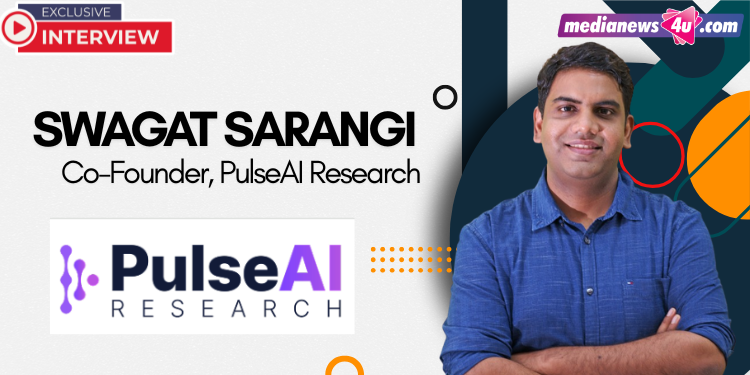
MediaNews4U.com caught up with Swagat Sarangi Co-Founder PulseAI Research.
Q. The real challenge for brands is deriving timely, actionable insights, as traditional research remains slow and reliant on stated responses. How does PulseAI Research help brands tackle this challenge?
PulseAI Research tackles this challenge by combining speed, depth, and clarity.
It moves beyond traditional, stated-response-heavy research by incorporating real consumer behavior signals, not just stated intent, giving brands a more accurate view of how consumers actually think and act. Its AI engine then uncovers the why behind these behaviors.
Insights are delivered in as little as 72 hours, and instead of raw data, brands receive clear, actionable recommendations on what to do next. Additionally, its advanced LLM layer allows teams to ask any relevant business question and instantly surface clean, synthesized insights without manual analysis.
The result is a shift from slow reporting to real-time, decision-ready intelligence, enabling faster and more confident decisions.
 Q. How much R&D has gone into the AI-driven consumer intelligence platform that helps enable faster, behaviour-led decision-making?
A significant amount of deep-tech and research engineering has gone into building PulseAI Research – because the platform is not just another survey dashboard layered with AI prompts. It has been built around a fundamentally harder problem: combining real consumer behaviour signals, AI-driven research workflows, and rapid decision intelligence into one unified system.
Over 12-15 months of model training, data ingestion, and learning from thousands of real research studies have gone into shaping the platform – with the ambition of our AI replicating the reasoning, pattern recognition, and decision-making ability of an experienced researcher at scale.
Q. How does the rebranding from Smytten PulseAI to PulseAI Research reflect its shift to an always-on, intelligence-led model?
The rebranding from Smytten PulseAI to PulseAI Research reflects a clear shift from a feature-led tool to a more comprehensive, intelligence-driven platform.
With PulseAI Research, the positioning expands to an always-on consumer intelligence engine, one that continuously tracks brand health, decodes consumer behavior, and informs decisions across the entire marketing and product lifecycle.
This evolution is also reflected in how insights are delivered. Instead of one-off studies, brands now have access to real-time signals, behavioral data, and AI-powered analysis that can be queried dynamically through an advanced LLM layer, making insights more accessible, continuous, and decision-ready.
In essence, the rebrand signals a move from periodic research to continuous, intelligence-led decision-making, helping brands stay ahead rather than react after the fact.
Q. In under 18 months, the platform has already partnered with 150+ enterprise clients, underscoring strong demand for agile, AI-led research. What have been the learnings from this?
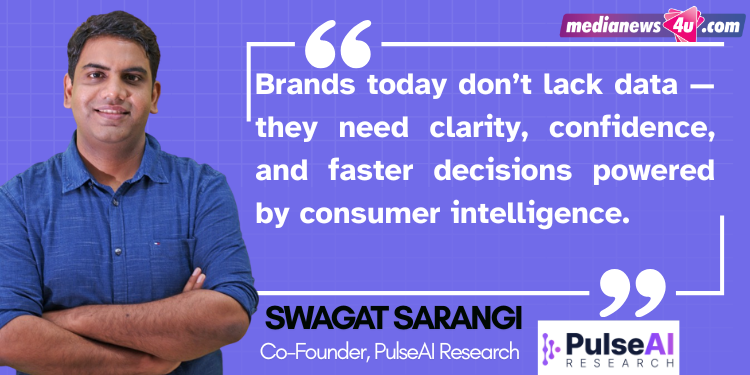
The biggest learning has been that brands are no longer struggling with a lack of data – in fact, there’s an oversupply of it. What they’re really struggling with is clarity and confidence in decision-making.
In under 18 months, having partnered with 150+ enterprise clients, one thing became very clear to us: brands are increasingly shifting towards behaviour-led signals over purely claimed responses, especially in categories where consumer preferences evolve rapidly and intent often differs from actual action.
Consumer intelligence is no longer a retrospective reporting function. It is rapidly becoming a real-time decision engine that influences actions across functions – from product and marketing to distribution, pricing, and growth strategy.
Q. How does Smytten’s ecosystem of 30M+ users and 2,800+ brand partnerships give PulseAI Research a strong base to work with to leverage real product interactions to deliver predictive, AI-led insights across sentiment analysis, concept testing, and brand tracking?
Smytten’s ecosystem provides PulseAI Research with a uniquely strong and differentiated data foundation.
With access to 30M+ users and 2,800+ brand partnerships, the platform captures real product interactions not just claimed preferences. This means insights are grounded in what consumers actually try, experience, and respond to, rather than what they say they might do.
This depth of behavioral data significantly strengthens the quality of AI-led analysis. It enables more accurate sentiment decoding, sharper concept and ad testing, and more reliable brand tracking, because the signals are rooted in real usage and engagement.
As a result, PulseAI Research can move beyond descriptive insights to predictive intelligence, helping brands anticipate consumer response, optimize decisions earlier, and reduce the risk of going to market with unvalidated ideas.
Q. What trends are being seen in terms of the rise of AI-driven, always-on research and how it is reshaping global decision-making?
AI-driven, always-on research is transforming consumer intelligence from a periodic activity into a continuous decision-making engine.
For example, brand tracking is no longer limited to quarterly reports reviewed after campaigns conclude. It is evolving into a live, year-round feedback loop that helps brands continuously refine communication, promotions, media spends, influencer strategies, and positioning in real time.
Similarly, product innovation is moving beyond twice-a-year brainstorming exercises toward an always-on ideation and validation model, where concepts, packaging, pricing, flavours, and features are continuously tested against evolving consumer behaviour.
This transformation is equally visible in advertising. Historically, brands selected one “hero” campaign based on pre-launch focus groups. Today, AI-driven Continuous Creative Optimization enables brands to test thousands of creative variations simultaneously, analysing which headlines, colours, formats, creators, and messages perform best across different audience cohorts in real time, while dynamically shifting spends toward top-performing combinations.
 Q. What is it important to move from traditional, reactive research models to proactive, data-led growth strategies?
It is becoming increasingly important because the pace of consumer change has outgrown traditional research models. Reactive research is typically slow, periodic, and backward-looking. By the time insights become available, market dynamics, consumer sentiment, or competitive actions may have already shifted. This creates a gap between insight and execution, often leading to delayed or suboptimal decisions.
In contrast, proactive, data-led growth strategies enable brands to continuously track consumer behaviour, sentiment, and market signals in real time. This allows teams to identify opportunities early, course-correct quickly, and validate decisions before making significant investments.
With access to behavioural data and AI-led analysis, brands can move beyond simply understanding what happened to anticipating what will happen next, whether it is predicting campaign performance, product acceptance, or shifts in brand perception.
Ultimately, this transition is about moving from hindsight to foresight, enabling brands to act faster, reduce risk, and drive more consistent, data-backed growth.
Q. Could you shed light on the growing importance of behaviour-led insights over claimed data in modern marketing?
Behaviour-led insights are becoming increasingly critical because there is often a clear gap between what consumers say and what they actually do.
Traditional research relies heavily on claimed data such as intent, preferences, or recall, all of which can be influenced by bias, memory gaps, or social desirability. While useful, this can sometimes result in an incomplete or even misleading understanding of consumer behaviour.
Behaviour-led insights, on the other hand, are grounded in real actions, what consumers try, engage with, purchase, or ignore. This makes them far more reliable in understanding true preferences and predicting future behavior.
For modern marketers, this shift is important for two reasons. First, it improves decision accuracy, whether it’s validating a product concept, refining messaging, or optimizing campaigns. Second, when combined with AI, behavioral data enables predictive insights, helping brands anticipate outcomes rather than react to them.
In a landscape where speed and precision matter, behaviour-led insights bring brands closer to reality, transforming research from a directional tool into a dependable decision-making engine.
Q. How is real-time consumer intelligence transforming product innovation and campaign effectiveness?
Real-time consumer intelligence is fundamentally changing how brands approach both product innovation and campaign effectiveness by shifting decisions from assumptions to live, validated signals.
For product innovation, it allows brands to test ideas, concepts, and prototypes with real consumers early and continuously. Instead of relying on delayed feedback or internal hypotheses, teams can understand how consumers are reacting in real time — what resonates, what doesn’t, and why. This reduces the risk of failed launches and ensures products are shaped by real demand rather than guesswork.
On the campaign side, real-time intelligence enables pre-launch validation and in-market optimization. Brands can assess message clarity, emotional resonance, and purchase intent before committing large media budgets, and then continuously refine based on live consumer response.
Importantly, when powered by behavioral data and AI-led analysis, it goes a step further by helping brands predict outcomes, not just measure them.
In essence, real-time consumer intelligence turns innovation and marketing into iterative, insight-led processes, driving higher success rates, better ROI, and faster execution.
Q. What role is AI and large-scale consumer ecosystems playing in delivering faster, more predictive insights?
AI and large-scale consumer ecosystems together are redefining how quickly and accurately insights can be generated.
AI plays a critical role by processing vast amounts of structured and unstructured data at scale — from open-ended responses to behavioral signals — and turning them into clear insights within hours, not weeks. More importantly, advanced models can identify patterns, decode sentiment, and uncover the “why” behind consumer actions, moving beyond descriptive analytics toward predictive intelligence.
At the same time, a large-scale consumer ecosystem like Smytten’s provides a continuous stream of real-world interaction data. With millions of users engaging with products, content, and experiences, brands gain access to behavior-led signals, not just stated intent.
When these two come together, the impact is significant:
- Speed: Automated data collection and analysis drastically reduce time-to-insight
- Depth: Rich behavioral data improves accuracy and context
- Predictability: AI models learn from large datasets to forecast outcomes more reliably
The result is a shift from static, one-time research to always-on learning systems that help brands anticipate trends, optimize decisions earlier, and act with far greater confidence.
Q. When you talk to enterprise brands how are their expectations evolving?
Enterprise brands today are no longer looking for just reports and dashboards – they are looking for decision partners.
Their expectations are shifting from “tell me what happened” to “tell me what I should do next, and tell me fast.” Speed, adaptability, and actionability have become far more critical than long static presentations.
Brands increasingly expect research to behave like a live operating system for decision-making – continuously tracking consumer shifts, validating ideas, optimising campaigns, identifying emerging trends, and reducing risk across functions in near real time.
At the same time, while enterprises are excited about using AI to build decision intelligence, their biggest concern remains accuracy and reliability. Organisations are increasingly looking for tightly controlled, deterministic AI systems trained around their specific business context and use cases – systems that can deliver highly reliable, explainable, and enterprise-grade outputs rather than probabilistic or generic AI responses.
 Q. What trends are being seen in terms of the shift towards agile, scalable research solutions?
One of the biggest shifts we’re seeing is the rise of autonomous research agents — AI systems that can increasingly handle research end-to-end, from drafting questionnaires and identifying cohorts to synthesising millions of data points into actionable decision frameworks.
At the enterprise level, the conversation is also moving beyond generic AI tools toward tightly governed, research-grade AI systems with built-in statistical models, privacy controls, and deterministic guardrails that organisations can trust for critical decisions.
Another emerging trend is the creation of “digital twins” of consumer cohorts, allowing brands to run high-velocity pre-testing simulations on creatives, concepts, pricing, and messaging before exposing them to real consumers.
At the same time, research itself is becoming embedded inside brand ecosystems – CRMs, loyalty platforms, apps, commerce journeys – turning every consumer interaction into a passive, continuous stream of behavioural intelligence.