Sanjay Ghodawat Group (SGG) is a diversified conglomerate with operations spanning various high-value business verticals such as Aviation, Consumer Products, Education, Energy, Realty and Retail. From an existing turnover of Rs.5,000 crore, the group aims to scale operations across all business verticals in a sustainable manner.
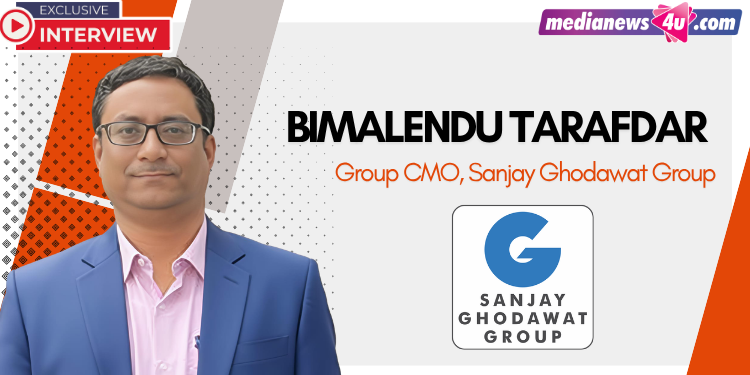
MediaNews4U.com caught up with Bimalendu Tarafdar, Group CMO Sanjay Ghodawat Group
Q. What is the vision for the future of marketing within the conglomerate over the next five years?
Marketing inside a conglomerate is fundamentally different from marketing within a single-category company. At the Sanjay Ghodawat Group (SGG), we’re building brands that span a regional airline (Star Air), a non-alcoholic beer (Coolberg), a snacking brand (TBH-To Be Honest), a regional staples brand (Star), neighbourhood retail (Star Localmart & DusMinute), education, and real estate. Each business speaks to a distinct consumer, operates under unique economics, and brings its own definition of what “marketing” means.
There’s no one-size-fits-all playbook. Our vision starts with this diversity: to build a marketing organisation that can operate seamlessly across all these sectors without fragmenting into disconnected silos. That means establishing sharper brand architecture at the Group level, embedding deep consumer understanding within each business, and creating a shared set of capabilities, data, content, digital, and brand discipline, that every business can tap into.
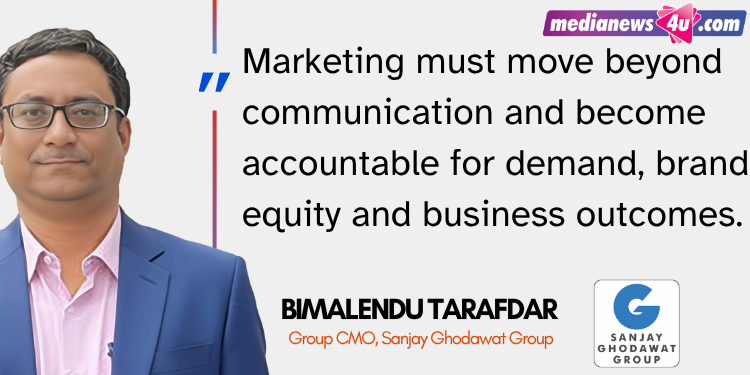
Equally important is accountability. Too often, marketing is kept at arm’s length from the business outcomes it’s meant to drive. As we move towards SGG’s Vision 2030, our mission is to close that gap. Demand generation, brand equity, reputation, and customer experience aren’t just separate pillars, they’re business drivers. Our goal is to make that connection tangible and measurable across every business we touch.
 Q. The mandate is to build a future-facing, business-aligned marketing organisation that drives demand, strengthens brand equity, and supports the Group’s Vision 2030 growth ambition. What does this entail?
For us, this comes down to three things; First, marketing must get closer to business realities. It needs to understand category dynamics, consumer pain points, revenue priorities, and the commercial levers that drive growth. Second, we have to invest in building long-term brand equity.
While short-term demand generation matters, enduring brands are built on consistency, trust, distinctiveness, and a great experience. We’re sharpening our positioning, deepening brand discipline, and striving for more meaningful consumer engagement across all our businesses. Third, we’re strengthening our marketing capabilities for the future.
That includes data-led decision-making, digital-first thinking, journey mapping, innovation support, content creation, PR, and stronger collaboration with Sales, R&D, Operations, and Technology. The mandate isn’t to make marketing louder, it’s to make it more accountable and growth-focused.
Q. As a marketer, is striking a balance between promotion and connection a key focus area?
Absolutely, but it’s important to unpack what “connection” really means. Promotion builds reach and drives trial, but brands that rely solely on promotion risk becoming forgettable. The brands that win loyalty and pricing power are those that consumers believe in and understand.
For us, connection is about clarity: ensuring consumers know what our brands stand for, not just on paper, but in their minds. That’s the focus for brands like Coolberg and TBH: moving beyond just a distinctive product to a truly distinctive identity.
Q. What tactics work in managing brand reputation in a hyper-connected and scrutiny-heavy environment across business verticals?
Reputation isn’t just a communications issue, it’s fundamentally about behaviour. In a conglomerate, the Group’s reputation is a shared asset. When Star Air delivers a great customer experience, it uplifts the SGG brand. When any business falls short, on quality, service, or conduct, the cost is felt Group-wide.
Marketing’s job is to hold the centre: ensuring clarity about what each brand stands for, maintaining consistency, and being genuinely prepared for crises. In an always-on world, issues move faster than responses. That’s why we invest in listening systems, escalation protocols, and spokesperson readiness, before they’re needed. But the real work happens upstream. Transparency earns goodwill when things go wrong, but only if credibility has been built over time. Stakeholders will forgive honest mistakes, but not evasion. The brands that weather scrutiny best are those that have been candid, even when it wasn’t easy.
Q. Could you talk about the key brand campaigns and marketing innovations coming up?
Across the Group, our focus is on campaigns and initiatives that address real consumer needs and business priorities, not just louder messaging. At Ghodawat Consumer Ltd. (GCL), we’re investing in our core categories while building contemporary positioning for brands like Coolberg and TBH. With Coolberg, India’s leading non-alcoholic beer, we’re sharpening what the brand truly stands for, moving beyond just celebrating the non-alcoholic choice to owning a unique cultural space.
For TBH, our 100% fruit and vegetable snacking brand, the challenge is to align the brand and product story even more tightly. In retail, we’re deepening local relevance, building sharper neighbourhood connections, and improving in-store engagement. In aviation, the focus is on trust, convenience, regional connectivity, and customer experience. A major area of innovation is in our processes: using insights more effectively, testing faster, refining customer journeys, and forging stronger links between marketing, sales, and operations.
Q. Will marketing spends and the media mix grow and change compared with 2025?
Yes, our media mix is evolving. The focus isn’t just on spending more, it’s on spending smarter. As our businesses scale and consumer journeys fragment, we’re balancing digital, performance marketing, content, influencer engagement, retail visibility, PR, and on-ground activation. The mix will vary by business, but overall, we’re moving towards more integrated, measurable, and audience-specific planning compared to 2025.
 Q. What are the challenges in fostering innovation and experimentation within a traditional business environment?
The biggest challenge isn’t a shortage of ideas, but creating an environment where ideas can be tested, learned from, and either dropped or scaled. Traditional businesses often favour certainty, but innovation starts with a hypothesis, a quick prototype, and a willingness to learn from failure. That requires patience and real commitment from leadership.
Another challenge is balancing short-term business pressures with long-term innovation. Teams are focused on monthly targets and costs, but innovation doesn’t always show immediate results. Deferring innovation for immediate pressures risks making us relevant only to yesterday’s consumer. Finally, true innovation requires cross-functional ownership. Marketing may kick things off, but meaningful change needs alignment from R&D, sales, operations, finance, supply chain, and leadership.
That’s where momentum can stall. Innovation must be a shared priority across the business.
Q. How is the Group leveraging marketing to communicate its ESG and sustainability goals?
For SGG, sustainability isn’t just a communication strategy, it’s embedded in how we operate across education, healthcare, community welfare, clean energy, water conservation, and responsible business. Our purpose of “Enhancing Lives Globally” is not just a tagline, but a reflection of our founding intent.
Marketing’s role is to communicate this work responsibly, focusing on specifics and proof, not just aspirations. There’s a real risk in ESG communication of making claims without backing them up. Stakeholders are quick to spot the difference.
Recognition like the Mahatma Award for ESG Excellence gives us proof points, but the most credible communication is grounded in real actions and outcomes.
The discipline we’re building is to let actions speak for themselves, using communication to make them visible, not to exaggerate them.
Q. How important is Gen Z as a target group? Do brands need to stop shouting and pushing messages even during the festive season?
Gen Z is vital, not just in terms of numbers, but in cultural influence and how they shape consumption patterns. But Gen Z isn’t a single, uniform audience. They’re digitally savvy, expressive, value-conscious, and quick to spot what’s genuine.
Context matters as much as demographics. Brands that treat Gen Z as a monolith are missing the point. As for shouting: we need to move away from that instinct, even during festive seasons. Frequency without relevance is just noise. Gen Z especially has strong filters for irrelevant content. What works is honest storytelling, creator-driven content, and being present in moments that matter to them, not just to the brand’s calendar.
Q. Linear TV has been facing a decline in ad revenue. Is it still an important marketing avenue for the Group’s FMCG and Retail divisions?
Linear TV shouldn’t be written off. Despite the rise of digital, TV is still one of the most efficient ways to reach a broad audience in India, particularly for brands seeking scale and household visibility.
That said, we evaluate every medium against our business objectives. Right now, our marketing priorities are more localised and market-specific, so while TV remains powerful, it’s not a core channel for us at this stage.
 Q. What role are AI and data analytics playing in shaping marketing decisions?
AI and data analytics are transforming how we work, but they’re enablers, not replacements for human judgment. On the data side, we’re building structured ways to better understand customers, identify demand patterns, track campaign results, improve media efficiency, and sharpen decision-making.
We’re moving from assumption-led to insight-led marketing across our businesses. AI is now part of our processes for consumer research, content development, trend analysis, and strategy.
We’ve run multi-platform AI research exercises to understand how consumers relate to our brands and new product ideas. Over time, AI will play a bigger role in personalisation, engagement, and predictive analytics.