Mumbai: JioStar is set to script a first for the Bigg Boss franchise by launching six language editions of the reality show this festive season. Beginning September 2026, audiences across India will be able to watch Bigg Boss in Hindi, Tamil, Telugu, Kannada, Malayalam and Bangla across the JioStar television network and JioHotstar.
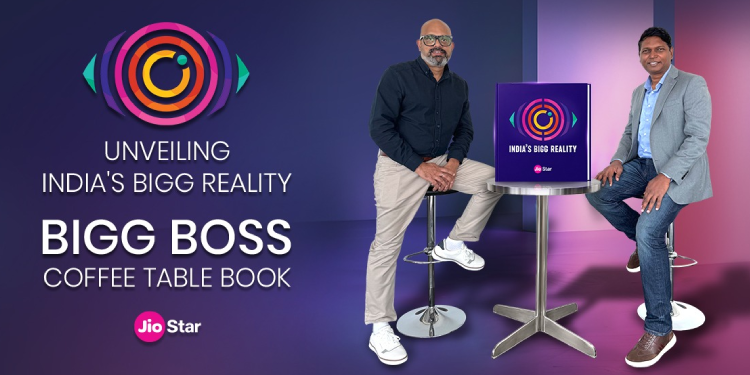
Alongside the launch, the company unveiled India’s Bigg Reality, a coffee table book that chronicles the evolution of the franchise over the past two decades and highlights its growing influence on audiences, advertisers and popular culture.
According to JioStar, Bigg Boss has evolved into one of India’s largest entertainment and marketing platforms. During 2025, the franchise reached more than 500 million viewers, generated 438 billion-plus viewing minutes, and recorded 47% year-on-year growth in engagement across its six language editions.
The broadcaster said the property has attracted more than 625 brands spanning 46 categories, including 49 first-time advertisers, reinforcing its position as a preferred destination for marketers looking to drive awareness, consideration and purchase intent.
This year’s line-up of hosts brings together some of the country’s biggest entertainment personalities. Salman Khan returns to host the Hindi edition, while Vijay Sethupathi, Nagarjuna, Kichcha Sudeepa and Mohanlal continue to helm the Tamil, Telugu, Kannada and Malayalam editions respectively. Joining the franchise for the first time is former Indian cricket captain Sourav Ganguly, who will host Bigg Boss Bangla.
The coffee table book showcases how brands have increasingly moved beyond conventional sponsorships to become part of the storytelling through immersive tasks, branded experiences and customised integrations. It cites examples ranging from Snack & Snack’s drone delivery activation and Vaseline-branded tasks to Spy Kuttan’s interactive robot and branded set integrations, illustrating how advertisers are leveraging the show’s format to deepen consumer engagement.
JioStar also highlighted the franchise’s high levels of audience participation. In 2025, viewers cast more than 9.32 billion votes and generated 43 million live chats on JioHotstar. The platform noted that nearly three out of every four viewers interact with the show beyond passive viewing, while social conversations around Bigg Boss generated over 1.7 billion engagements and 30 million user-generated memes during the year.
The report further points to the show’s regional strength, stating that Bigg Boss reaches over 200 million viewers across Hindi-speaking markets and more than 300 million viewers across Southern India. In the South, the franchise reaches eight out of every ten television viewers, with an audience footprint that is 3.5 times larger than all other reality shows in the region combined.
According to the broadcaster, advertisers participating in the 2025 season achieved average uplifts of 1.33x in brand awareness, 1.26x in consideration, and 1.25x in purchase intent, with campaigns from brands such as Mamaearth, VZY and Jar App cited as case studies.
Speaking during a media roundtable, Mahesh Shetty, Head – Entertainment Sales, TV, JioStar, said the strength of Bigg Boss lies in the fact that audiences continue to follow the property irrespective of the platform on which it is consumed.
“When media companies have powerful content brands that consumers love, audiences follow that content across platforms. That is what makes the property commercially viable and allows us to keep investing in it. We’ve expanded the franchise from one language to five, and this year we’re adding Bangla with Sourav Ganguly.”
Shetty said the company’s strategy is centred on building platform-agnostic entertainment properties rather than treating television and digital as competing businesses.
“Consumers today move seamlessly between television, digital and social platforms. Our focus isn’t on one screen over another. We invest in properties that travel across platforms because that’s how audiences consume content today.”
On the business viability of the franchise, he said continued investments and expansion were themselves indicators of its commercial success.
“If a property isn’t profitable over the long term, you don’t continue creating newer editions of it. The fact that we’re expanding the franchise speaks for itself.”
Explaining why Bigg Boss is positioned during the festive season, Shetty said the period presents brands with an opportunity to capture sustained consumer attention despite increasing media fragmentation.
“The festive season is when brands compete hardest for discretionary spending. Bigg Boss gives them attentive reach over three months, not just scale. Consumers understand the format, actively participate in it and return week after week, making it one of the strongest attention platforms in the country.”
Addressing questions around a possible future overlap with the IPL, he said the franchise has historically performed well even when cricket has dominated television viewing.
“We’ve co-existed with the IPL before. Match timings and Bigg Boss timings are different, and audiences continue to engage with both. What excites us this year is that all six language editions are launching together, creating an even bigger multiplier effect.”
On the return of Bigg Boss Bangla, Shetty said the show’s move to Star Jalsha following the JioStar merger significantly enhances its potential.
“A great property performs even better on the strongest platform. Star Jalsha gives Bigg Boss Bangla a much larger opportunity to reach audiences across the market.”
Responding to concerns about advertiser fatigue, he argued that simultaneous launches actually provide greater flexibility for marketers.
“Different language editions cater to different consumer markets. Brands don’t look at them as duplicate opportunities—they tailor different campaigns for different regions. Today, advertisers are buying outcomes rather than just reach, and Bigg Boss consistently delivers those outcomes.”
He added that JioStar continues to package sponsorships around the Bigg Boss property rather than individual distribution platforms.
“Consumers decide where they want to watch. Our role is to ensure brands remain part of that journey, whether it happens on television, digital or both. Every season brings back established advertisers while also attracting a healthy pipeline of new-age brands.”
Speaking about the growing importance of digital engagement, Bhaskar Ramesh, Head – Entertainment Sales, Digital, JioStar, said the franchise has become a powerful platform for attention in an increasingly fragmented media landscape.
“During the festive season, Bigg Boss becomes an attention magnet. With 24×7 live feeds, billions of votes and continuous audience participation, viewers become active participants rather than passive consumers. That creates a far richer opportunity for brands to build meaningful engagement at the intersection of content, culture and commerce.”
Ramesh added that while connected TV continues to grow rapidly, television remains the country’s largest mass-reach medium.
“Content today moves seamlessly across screens. Television continues to provide unmatched scale, while digital expands engagement and interactivity. Together, they strengthen the overall value proposition for audiences as well as advertisers.”