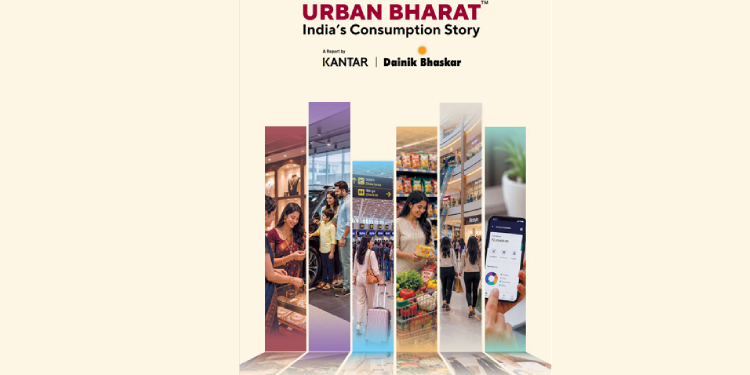
Mumbai: India’s next phase of consumption growth is being increasingly driven by Tier-2 and Tier-3 cities, with the affluent population in these markets rising 76% over the past six years, according to the Urban Bharat – India’s Consumption Story report released jointly by Kantar and DB Corp.
The report highlights that rising affluence, digital adoption and aspiration-led spending are reshaping consumption patterns across Urban Bharat, creating significant opportunities for businesses across sectors including automobiles, personal finance, e-commerce, education and FMCG.
The study also introduces the Urban Bharat City Opportunity Index, a first-of-its-kind ranking of the top 50 cities best positioned to drive India’s next wave of consumption growth. The index is designed to help businesses make investment, expansion and marketing decisions based on data-driven insights.
According to the report, nearly one in three urban Indians now resides in Tier-2 and Tier-3 cities, making Urban Bharat one of the country’s fastest-growing consumption markets. The report notes that affluent (NCCS A) households in these markets have increased from 26% to 40% over the past six years, signalling an accelerating trend towards premiumisation beyond metropolitan cities.

Commenting on the findings, Biswapriya Bhattacharya, Director, B2B & Technology, Kantar, said, “Urban Bharat is rapidly becoming one of India’s most important consumption growth markets, beyond the metros. As affluence rises and a younger, aspiration-led consumer base drives demand across categories, businesses have an opportunity to rethink where future growth will come from. The Urban Bharat report provides brands with robust, evidence-based insights to better understand evolving consumer behaviour, identify emerging opportunities and make more confident decisions across innovation, investment and market expansion.”

Girish Agarwal, Director, Dainik Bhaskar Group, said, “For years, marketers have looked at Bharat through the lens of metro India, often relying on assumptions due to the absence of credible market intelligence. That reality has changed. Today, cities like Jaipur, Lucknow, Surat and Indore are emerging as powerful consumption hubs. Consumers across Tier-2 and Tier-3 India are highly aspirational, digitally connected and increasingly willing to spend across categories. Through this joint initiative with Kantar, our objective is to equip marketers, media planners and businesses with robust insights that help them identify where India’s next phase of growth will come from.”
The report identifies four key trends shaping consumption in Urban Bharat:
- Affluence is rising rapidly, with the affluent population increasing by 76% in six years, positioning Tier-2 and Tier-3 cities as key growth engines.
- Young consumers are driving premiumisation, with 33% of the population below the age of 24 and affluent households expanding significantly.
- Digital adoption is accelerating, with digital payments, banking, investments and e-commerce becoming mainstream. One in three consumers now shops online, reflecting the rise of omnichannel consumption.
- Education remains a priority, with over 27% of households spending more than 10% of their income on education, underscoring a strong focus on long-term aspirations and upward mobility.
The report concludes that as consumption growth shifts beyond India’s metros, businesses will need to recalibrate their market strategies by focusing on regional consumer insights, targeted innovation, stronger distribution networks and localised media planning to unlock the opportunities emerging across Urban Bharat.