Mumbai: A new study by WARC has warned that a prolonged crisis in the Middle East could significantly disrupt global advertising growth, putting as much as $93.9 billion at risk over the next two years.
According to WARC’s Global Ad Spend Forecast Q1 2026 update, global ad spend is currently projected to grow 10.4% this year to reach $1.32 trillion. However, an extended Gulf crisis could shave off up to 4.2 percentage points—equivalent to $49.9 billion—from 2026 growth. The impact is expected to spill into 2027, where a further $44 billion in growth could be eroded, bringing the total potential loss close to $94 billion.
The report highlights that sectors such as food, travel and transport, and technology and electronics are particularly vulnerable to rising oil prices and potential shipping disruptions through the Strait of Hormuz. While ad market growth is expected to moderate to 8.2% next year, reaching $1.43 trillion, the outlook remains highly volatile amid ongoing geopolitical uncertainties.
Commenting on the findings, James McDonald said, “Even in a contained scenario, an oil shock of this nature acts like a tax on consumers – pushing up prices while eroding real spending power. In a more prolonged or severe disruption, we move into stagflation territory, where sectors like travel, automotive, food and consumer electronics take a direct hit from both rising costs and falling demand.
“The net effect is a meaningful squeeze on discretionary spend that puts up to $50bn of anticipated ad market growth at risk this year, as brands pare back their media investment in a bid to preserve thinning margins.”
WARC’s projections, based on data aggregated from 100 markets and powered by a proprietary neural network analysing over two million data points, outline three potential scenarios.
In the baseline scenario of a short-lived disruption, ad market growth would remain at 10.4% in 2026, supported by strong performances from major digital platforms. However, even in this case, sectors such as travel and transport are expected to see ad spend decline by 3.5%, reflecting pressure from rising fuel costs and reduced consumer spending.
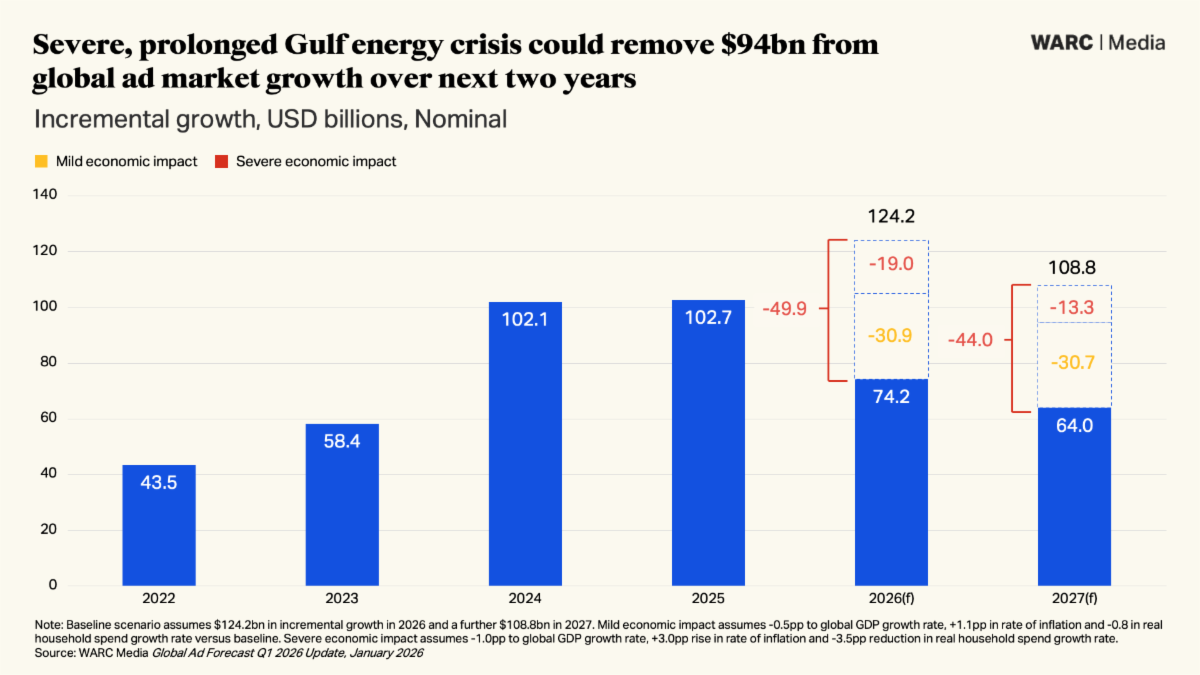
A more extended disruption scenario could cut 1.6 percentage points from ad growth this year, equivalent to a $19 billion hit, with continued impact into 2027. Under this scenario, consumer purchasing power weakens, particularly affecting consumer-packaged goods and technology sectors.
The most severe scenario, involving prolonged closure of key oil supply routes and prices rising to $150 per barrel, could trigger stagflation-like conditions. In such a case, global ad growth would slow to 6.2% this year, with heavily exposed sectors such as travel and transport expected to cut advertising budgets by as much as 5.8%.
Beyond macroeconomic pressures, the report also flags a slowdown in the technology sector as a key factor likely to temper growth in social media advertising. While platforms are still expected to register gains, momentum is forecast to ease as the surge in AI-driven investments begins to stabilise.
Overall, despite continued growth across most channels, WARC cautions that geopolitical instability and economic headwinds could significantly reshape advertising investment patterns in the near term, with brands likely to adopt a more cautious approach to media spending.