Mumbai: Television still delivers massive scale, high watch-time, and strong credibility, but broadcasters must evolve from passive reach to participative engagement. Brands today need an integrated mix of television, celebrities, regional influencers, and micro-content formats. Communication today is only one part of brand building, especially for e-commerce brands where the real brand is defined by the platform experience, search, delivery, user interface, and the overall customer journey
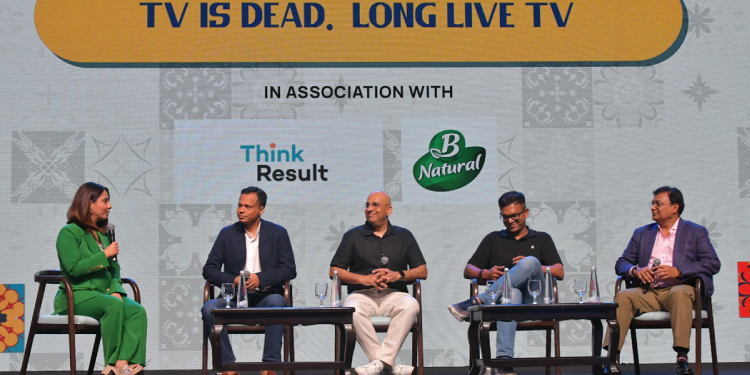
The second half of Day two of Goafest 2026 continued with a session titled ‘TV Is Dead. Long Live TV.’ in association with Think Results & B Natural. The session examined the changing role of television in an increasingly fragmented media ecosystem and explored how the medium continues to evolve amidst shifting audience consumption habits.
The panel featured Akshay Agrawal, Head Linear Ad Sales, Sony Pictures Networks India; Rajiv Dubey, Vice President Media & Marketing Activations, Dabur India Limited; Arpan Biswas, Chief Marketing Officer, Ajio; and Avinash Pandey, Secretary General, IBDF. The discussion was moderated by Tamanna Inamdar, Managing Editor, NDTV Profit. The conversation focused on the future of television advertising, audience fragmentation, cross-platform storytelling, and the enduring influence of television in building mass cultural moments.
Highlighting the evolving role of television in an increasingly digital-first media ecosystem, Akshay Agrawal, Head Linear Ad Sales, Sony Pictures Networks India, said, “Television still delivers massive scale, high watch-time, and strong credibility, but broadcasters must evolve from passive reach to participative engagement. Shows like Indian Idol and KBC work because audiences vote, engage socially, follow journeys, and use second screens, making TV increasingly interactive and connected to digital behaviour. The future of TV lies in interactive content, social amplification, co-created viewer experiences, and brand moments embedded within programming. Industry measurement must also shift from GRPs and reach to ROI, attribution, and business outcomes, because it is no longer TV versus digital, it is TV and digital together.”
Rajiv Dubey, Vice President Media & Marketing Activations, Dabur India Limited, said, “Southern markets and several Indian states still have over 80–90% TV penetration, while both Free-To-Air TV and Connected TV continue to grow rapidly. Brands today need an integrated mix of television, celebrities, regional influencers, and micro-content formats, as Gen Z increasingly uses mobile as the first screen. Influencer marketing helps reach audiences that TV alone cannot, but it also brings challenges like brand safety risks, reputation volatility, and cancel culture concerns. Ultimately, marketing is no longer ‘either-or’ but a fully integrated media mix.”
Speaking about how brand building is increasingly being shaped by platform and consumer experience, Arpan Biswas, Chief Marketing Officer, Ajio, said, “Communication today is only one part of brand building, especially for e-commerce brands where the real brand is defined by the platform experience, search, delivery, user interface, and the overall customer journey. As a result, brands are increasingly shifting spending toward consumer experience and performance-driven ecosystems. TV, in this context, is just a distribution channel like digital platforms, with the same content moving across TV, Meta, YouTube, and OTT depending on strategy. The real focus, therefore, is not platform comparison but content effectiveness.”
Highlighting the continued scale, credibility, and cultural relevance of television in India’s evolving media ecosystem, Avinash Pandey, Secretary General, IBDF, said, “Television in India still reaches nearly 900 million viewers across 190 million TV homes, with penetration growing around 6% annually and expected to add over 100 million homes by 2028. TV and OTT together are driving deeper content consumption, reinforcing that television is not dead, only the mode of signal delivery has changed. TV continues to be the strongest medium for mass reach, community viewing, trust, credibility, and unskippable storytelling, making it central to large-scale brand narratives. Emotional brand building cannot rely purely on algorithms, and credible platforms like TV still offer greater brand safety compared to unpredictable influencer ecosystems.”