Television is not dying. It is evolving. Right before our eyes, in millions of Indian homes, a quiet revolution is happening. The convergence of AI, addressable advertising, and Connected TV is not just changing how we watch, it is fundamentally rewriting the rules of brand-consumer relationships.
While traditional linear TV still commands massive attention, over 3 hours daily for the average Indian household – a parallel universe of precision, personalization, and programmatic efficiency is rapidly taking shape. The numbers tell the story: Connected TV households are growing at 32% annually, reaching 45+ million by 2024. Addressable TV advertising is projected to explode from ₹4,586 crore in 2023 to ₹9,872 crore by 2026. But here is the kicker, most brands and agencies are still thinking in yesterday’s playbook.
As someone who is spent three decades navigating TV sales, content, and now the digital transformation, I have witnessed this convergence firsthand. We are not just watching an evolution, we are living through the birth of a new media ecosystem.
The Living Room Revolution is Here
Walk into any Indian household today, and you will find a fascinating paradox. The same family consuming prime-time serials on Star Plus at 8 PM is simultaneously scrolling through Netflix recommendations, watching YouTube on their phones, and getting WhatsApp forwards of last night’s Bigg Boss clips.
This is not media fragmentation – it is media multiplication.
23% of Indians have already become digital only consumers, but here is what the numbers don’t reveal: 74% of CTV growth is coming from non-metro areas. Rural households are not just catching up, they are leapfrogging traditional cable infrastructure entirely. The farmer in Nashik is more likely to watch content on his smart TV app than his urban counterpart still fighting with his cable operator.
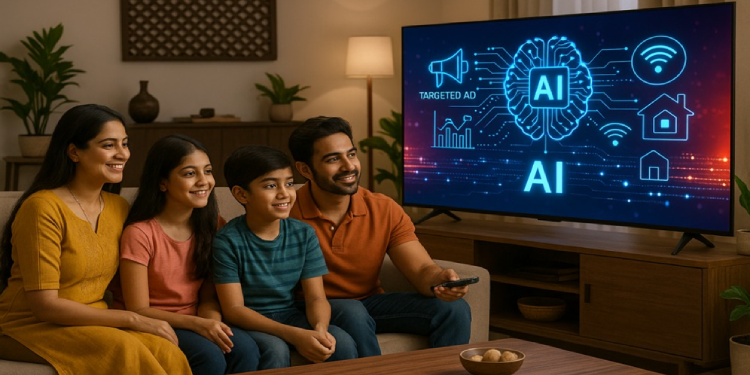
Connected TV has become the bridge between linear TV’s mass reach and digital’s precision targeting. Unlike traditional broadcasting where everyone watching Sony SAB at 9 PM sees the same Maggi ad, Connected TV can serve different creatives to different households – even on the same show, at the same time.
AI: The New Media Matchmaker
Here is where it gets interesting. AI in Connected TV is not just about better targeting, it is about creating entirely new forms of brand engagement that were impossible in linear television.
Imagine an automotive ad that changes its core message based on weather data. During monsoon season, the same Maruti Suzuki campaign automatically shifts from fuel efficiency messaging to safety features. The AI does not just know it is raining, it knows that rainy weather correlates with higher safety-conscious purchase decisions in that specific geography.
Traditional TV planning relied on crude demographics: Males 25-35, SEC A+B. AI-powered CTV creates behavioral cohorts that make demographic planning look prehistoric. It identifies “evening family viewers who prefer regional content but shop online for electronics” or “late-night binge-watchers who respond to impulse food delivery ads.”
The real magic happens when AI connects the dots across devices. The algorithm knows that viewers who watch cooking shows on their smart TV between 6-8 PM are 3x more likely to order groceries online within 48 hours.
The Addressable Goldmine
Let me share a number that should make every media planner sit up: 9.8% of India’s TV advertising revenue ₹4,586 crore, is already addressable. That is not a future projection, that is today’s reality.
Free Ad-Supported Streaming Television (FAST) channels are the unsung heroes. Platforms like MX Player, JioCinema, and Zee5 are offering premium content with addressable ad inventory at scale. A mid-sized brand can now buy specific audiences across multiple FAST channels for the same cost as a single prime-time slot on a national GEC.
The traditional TV buying process – RFPs, rate negotiations, make-goods, is giving way to programmatic efficiency. Media buyers can now purchase TV inventory in real-time auctions, optimizing for specific KPIs like brand recall or actual in-store footfall.
While linear TV buying still involves 15-20 day negotiation cycles, programmatic CTV campaigns can go live in under 48 hours.
Brand Engagement Transformation
The most profound change is not technological, it is behavioral. Brands are moving from interruption based advertising to invitation based engagement.
A beverage brand launching a new flavor no longer needs to carpet-bomb all television viewers. AI can identify households with teenage children, serve them ads during after-school viewing hours, and measure not just impressions but actual purchase behavior through retail data integration.
QR codes and voice commands are transforming passive TV viewing into active shopping experiences. Viewers can now purchase the saree they see on their favorite serial or book the vacation destination featured in a travel show, without leaving their couch.
Traditional Gross Rating Points measured exposure, not engagement. AI-powered CTV measures everything: attention time, completion rates, second-screen behavior, and downstream actions. A campaign’s success is not just reach and frequency, it is click-through rates, app downloads, and sales attribution.
The 2025-2027 Playbook
Based on current trajectory, here is how the landscape will reshape:
Traditional linear TV will stabilize at 55-60% of television ad budgets, but addressable CTV will capture 35-40%, a dramatic shift from today’s 15-20%. Media planners will need to think in audience ecosystems, not just channels.
A successful campaign might combine linear TV for mass awareness, addressable CTV for targeted frequency, and social media for amplification, all orchestrated by AI algorithms optimizing budget allocation in real-time.
The Challenges Ahead
This transformation is not without obstacles. Data privacy regulations are tightening. Consumer ad fatigue is real. Technical infrastructure in Tier-2 cities needs upgrading.
But the biggest challenge is mindset. Too many media professionals are trying to apply linear TV strategies to addressable platforms. It is like using a cricket bat to play tennis – the fundamentals are different.
While linear TV success was measured in reach and frequency, addressable TV demands attention metrics, engagement depth, and conversion attribution. Agencies need to retrain planning teams, and brands need to adjust KPI expectations.
Three Critical Actions
For Media Agencies: Stop treating CTV as just another digital channel. It is a hybrid medium combining television’s emotional impact with digital’s targeting precision. Invest in training, technology, and new measurement capabilities.
For Brands: Allocate dedicated budgets for addressable TV experimentation. Start small, measure everything, scale what works. The learning curve is steep, but the competitive advantage is enormous.
For Broadcasters: Embrace data partnerships and technology integration. Your content is the foundation, but AI-driven targeting capabilities will determine commercial success.
The Bottom Line
We are experiencing the birth of a new media ecosystem where artificial intelligence, addressable technology, and traditional broadcasting converge to create unprecedented opportunities for brand-consumer connection.
The winners will be those who recognize this is not about choosing between linear TV and digital platforms. It is about orchestrating an integrated media symphony where each element amplifies the others, guided by AI that understands audiences better than ever imagined.
The great Indian media convergence is happening now. The question is not whether you will participate, it is whether you will lead or follow.
(Views are personal)