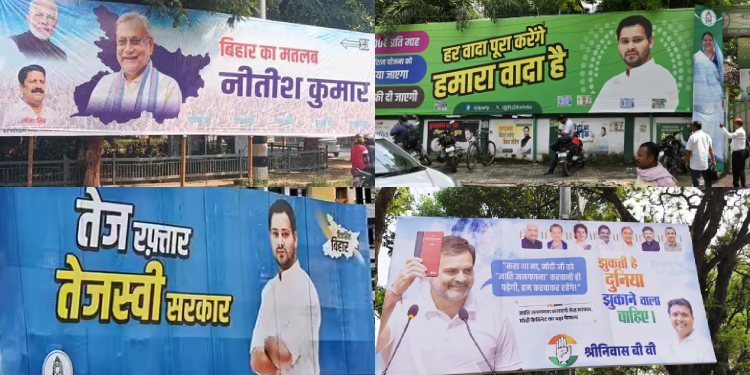
Mumbai: With the 2025 Bihar Assembly elections concluded and the new government in place, the latest TAM AdEx analysis offers a clear picture of how political parties shaped their media strategies in the crucial month leading up to polling. The report highlights a decisive tilt toward television, a diversified print presence, and sharp advertising spikes as the campaign entered its final leg.
TV Takes 86% Share as the Prime Election Medium
Television emerged as the centrepiece of election advertising, capturing 86% of total political ad insertions during the monitored period. Despite this dominance, TV’s share slipped from 93% in the 2020 elections, indicating a subtle rebalancing of media priorities.
Parties continued to rely on TV for mass visibility and high-impact narrative building, particularly for state-wide messaging. However, the stronger presence of Print compared to earlier cycles points toward an expanding need for community-level targeting and constituency-specific communication.
BJP Leads Ad Volume With 54% Share Across TV and Print
Across both TV and Print, the Bharatiya Janata Party (BJP) maintained a commanding presence, accounting for 54.2% of all political ad insertions. The Rashtriya Janata Dal (RJD) followed with 27.6%, intensifying the competitive narrative landscape between the two leading parties.
The National Democratic Alliance (NDA) contributed 6.1%, while the Congress stood at 2.5%. All remaining parties collectively contributed roughly 9% of insertions. The distribution signals a communications arena dominated by major political players, with BJP and RJD together controlling more than four-fifths of total ad visibility.
Medium-Wise Split Shows Divergent Strategies
The TAM AdEx report reveals stark contrasts in how parties approached the two media platforms:
Television: High-Intensity, Limited Participation
Television saw limited advertiser participation, with only six political advertisers opting for this medium. The BJP accounted for an overwhelming 68.4% of all TV ad insertions, followed by the RJD holding 31.5%. Other parties maintained a negligible share, reflecting both the cost and visibility dynamics associated with TV advertising.
Print: Broader Participation, Localised Push
Print presented a more democratic landscape with participation from 15 advertisers.
- The NDA led Print ads with 43.6%,
- Congress followed at 18.1%,
- The BJP claimed 10.3%,
- Jan Suraaj gained 6.7%,
- and JDU secured 4.6%.
Notably, regional outfits such as Jan Suraaj—almost absent on TV—leveraged Print to reach voters more affordably and more locally. This divergence indicates how Print served as a strategic platform for constituency-level engagement.
Ad Surges Intensified in Final Weeks Before Voting
The week-on-week trend analysis shows campaigns accelerating rapidly as polling approached.
During the first six weeks of the monitored period, political presence on TV was minimal. Activity began in earnest in Week 7, rising sharply by Week 8, and peaking in Week 9 with 38.97% of that week’s total ad insertions.
Print advertising, on the other hand, grew more steadily and reached its peak in Week 10, capturing 42.55% of weekly insertions—just ahead of voting day. This progression reflects a calibrated media strategy: high-impact TV bursts earlier in the final stretch, followed by a targeted Print push closer to polling dates.
With the results declared and governance underway, the TAM AdEx findings offer a retrospective view into the campaign machinery that shaped voter perceptions. They underline how television retained its role as the high-decibel, state-wide narrative driver, while Print reasserted itself as a critical tool for regional outreach.
As political communication continues to evolve, Bihar’s 2025 election cycle shows how parties blend mass reach with granular voter targeting—balancing visual dominance on TV with contextual depth in Print—to influence one of India’s most dynamic electoral landscapes.