Arthi Ramalingam has been serving as Founder & CEO at Eternz. It is a new-age jewellery marketplace reshaping how India shops for, experiences, and connects with jewellery.
Jewellery has always been central to Indian culture, and today, it’s being reimagined for a new generation of women.
When she set out to buy jewellery for herself, she noticed a clear gap: India lacked a single, credible, curated platform that brought together design, technology, and transparency. So she built Eternz, now India’s largest vertical jewellery marketplace, housing 200+ brands across gold, silver, brass, and lab-grown diamonds, alongside tech-forward tools like Gift Finder, Virtual Try-On, Ring Sizer, and swipe-based discovery.
In just over a year, the platform has scaled 10x, expanded into premium watches, and built new-age access for a generation that sees jewellery not as inheritance, but as identity and self-expression.
What makes Arthi’s journey particularly relevant for International Women’s Day is how she built from lived experience in a legacy-driven, male-dominated category. From launching a bootstrapped D2C brand post-IIM Ahmedabad to leading marketing at Udaan during its hyper-growth years, Arthi blends sharp business acumen with cultural intuition and a deeply consumer-first mindset.
On the occasion of International Women’s Day, Medianews4u.com caught up with Arthi Ramalingam Founder & CEO Eternz
Q. As a woman entrepreneur what have been the key learnings from Eternz?
Building Eternz over the years has reinforced one big belief for me, consumer insight is one of the key things. Jewelry is emotional, layered and deeply personal. If you don’t understand why someone is buying, you can’t build the right experience.
As one of the women founders in this space, I’ve also learned that empathy is an advantage. We’re not just building a platform, we’re building trust. And trust in jewelry takes consistency, curation, and transparency. Resilience has been critical too. When you’re challenging a traditional category, you need conviction.
Q. How is Eternz reimagining jewelry for a new generation of women?
For a long time, jewelry was tied to milestones chosen for women, weddings, family occasions, gifting rituals.
Today, women are buying for themselves and not just for occasions but for daily use. That shift changes everything.
At Eternz, we focus on discovery. We bring together different price points, styles, and categories, fashion, silver, demi-fine, fine, in one curated space. We use tech to simplify decision-making, but we never remove the emotional layer. Jewelry is about identity now, not obligation.
Q. What marketing activities and innovations will Eternz be doing on the occasion of International Women’s Day and beyond?
For us, International Women’s Day is about self-purchase and agency.
We’re focussing on celebrating women who are building, creating, and choosing for themselves. That could mean spotlighting women-led brands on the platform, storytelling campaigns, or curated edits that speak to self-expression.
This Valentine’s, we also introduced our new swipe feature on the website, a Tinder-like experience for jewellery discovery that makes browsing more interactive, personal, and fun.
From a product standpoint, we’re continuing to onboard brands that are into personalisation, making discovery smarter and more intuitive just like our recent collaboration with Timex. The goal isn’t to push product; it’s to make exploration effortless.
Q. In just over a year, the platform has scaled 10x. What has been the big challenge and how do you balance scale with profitability?
The biggest challenge is maintaining curation at scale.
When you grow fast, there’s pressure to onboard quickly. But we’re disciplined about who we bring on. The platform only works if customers trust our selection.
On profitability, we’ve always believed in building sustainable growth. Tech helps us optimise discovery, reduce inefficiencies, and improve conversion. But discipline on costs and unit economics is non-negotiable. Growth without structure is fragile.
Q. Why are women founders uniquely positioned to redesign traditional industries?
Because we question default assumptions and we lead with empathy.
In categories like jewelry, many norms were built decades ago. Women founders often approach these industries from lived experience. We understand the friction points because we’ve felt them.
That perspective helps redesign experiences that feel intuitive and relevant today.
Q. How is tech democratising access to fine jewelry?
Technology removes both informational and psychological barriers. As a brand that uses technology at scale and has 200+ unique brands on the website, tech is integral to how we give customers meaningful choice.
It creates transparency, expands options, and allows customers to explore privately and at their own pace. At the same time, it provides emerging designers a platform they may not have had access to offline.
When discovery becomes easier and choice becomes visible, access naturally broadens and that’s where real democratization happens.
Q. What trends are being seen in terms of the shift from jewelry as obligation to jewelry as empowerment?
We’re seeing more everyday buying. Consumers are investing in pieces that fit their lifestyle -work, travel, and social settings, not just ceremonial occasions. Jewelry is increasingly being chosen to mark personal milestones rather than meet societal expectations. There’s also greater comfort with experimentation. People are mixing categories, pairing silver with fine, lab-grown with gold and embracing styles that feel less rigid and more expressive.
Importantly, jewelry is no longer just for women; men’s and kids’ segments are growing steadily. Trends like demi-fine jewelry, lab-grown diamonds, everyday wear, and personalization are shaping how consumers build collections that feel individual and versatile.
Q. What do modern Indian women expect from luxury today?
They expect transparency, relevance, and meaningful choice. Luxury is no longer defined only by price or legacy, it’s about how well a brand understands its customers. Service, storytelling, and the digital experience all play an important role.
Modern consumers also expect brands to listen, to take feedback seriously, offer options, and evolve based on what customers actually need. They want to feel informed and empowered, not overwhelmed.
Q. What does it take to build and scale as a woman entrepreneur in India?
It takes many things: clarity of vision, patience, a strong product or service, and a deep sense of empathy.
There’s often a tendency to romanticize entrepreneurship, but execution matters far more than inspiration. Building and scaling requires systems, a strong team, and consistent focus. It also demands resilience. Doubt is inevitable, sometimes external, sometimes internal and staying anchored to your purpose becomes essential.
Q. What do women entrepreneurs bring to the table when it comes to sharp business acumen and adopting a consumer-first mindset?
Women entrepreneurs often combine sharp business acumen with deep consumer empathy and that balance is powerful.
Because many of us build from lived experience, we naturally question outdated assumptions and look closely at real consumer behavior. That leads to sharper decision-making grounded not just in data, but in context. We pay attention to friction points, emotional triggers, and unspoken needs which strengthens both product strategy and positioning.
At the same time, scaling a business demands clarity, systems, financial discipline, and strong execution. A consumer-first mindset doesn’t mean compromising on numbers; it means aligning them with genuine demand. When empathy and operational rigor come together, you build brands that are both commercially strong and deeply relevant.
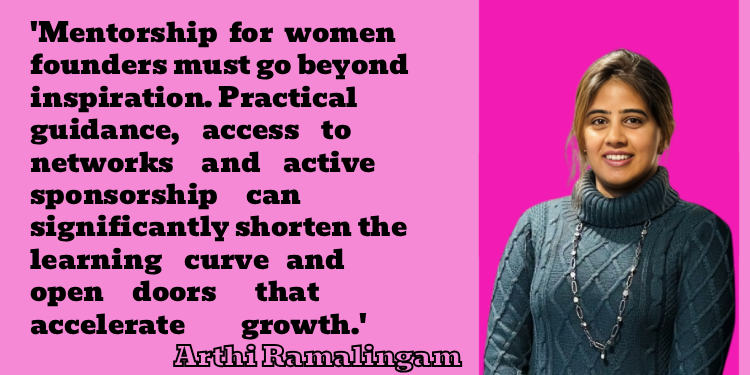
Q. Are more and better mentorship programmes for women entrepreneurs needed?
Yes, but more importantly, we need mentorship that is practical, accessible, and outcome-driven.
Women entrepreneurs don’t just need inspiration; they need guidance on fundraising, hiring, financial structuring, negotiation, and scaling operations. The real value of mentorship lies in shortening the learning curve and helping founders avoid costly mistakes.
It’s also important to see more women in leadership mentoring the next generation. Representation builds confidence, and shared lived experiences make advice more contextual and actionable.
That said, mentorship should evolve into sponsorship, opening doors, making introductions, and actively advocating for women founders in rooms where decisions are made. That’s when impact truly multiplies.