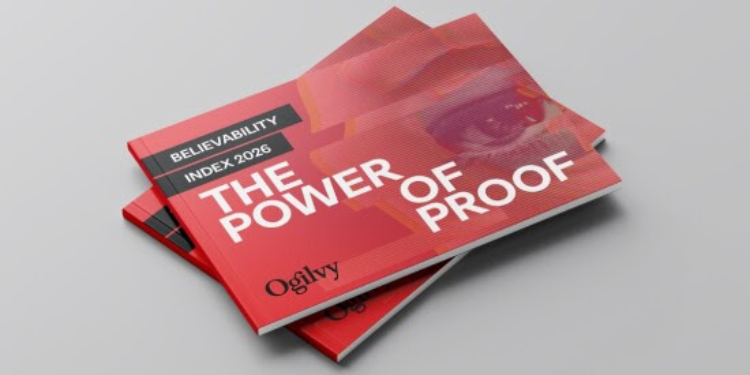
Singapore: Ogilvy has unveiled its inaugural 2026 APAC Believability Index: The Power of Proof, a regional study examining how consumers across Asia-Pacific determine what—and who—they believe in amid an increasingly complex information environment.
Conducted in partnership with YouGov, the study surveyed 7,176 respondents across Australia, Indonesia, Singapore, Malaysia, the Philippines, Hong Kong SAR and Mainland China. The research explores the evolving drivers of consumer trust and highlights the growing business implications of declining brand credibility.
According to the report, 93% of consumers across the Asia-Pacific region quietly disengage from brands and organisations after losing belief in them, with nearly half (48%) ceasing purchases altogether. The findings suggest that reputational damage increasingly translates into commercial losses without necessarily triggering public criticism or social media backlash.
Coinciding with the report’s release, Ogilvy has introduced its Believability Agent, an AI-powered diagnostic tool designed to help business leaders identify reputational gaps and predict potential customer churn before it affects business performance.

Commenting on the findings, Richard Brett, President of Ogilvy PR APAC, said, “As AI slop and synthetic content reshape the communications landscape, believability has evolved from a PR challenge into a commercial imperative. Traditional reputation metrics no longer tell the full story because the greatest risks are now invisible. The true cost of lost belief is measured in lost revenue, rather than negative headlines. The organizations that succeed in 2026 will be those that recognize operational action matters more than a traditional holding statement.”
The study found that silent disengagement has become the dominant reputational risk, with 93% of consumers choosing to withdraw support privately compared to 55% who publicly express dissatisfaction. Only 10% said they would share a negative experience on social media.
Operational performance also emerged as a stronger determinant of credibility than corporate purpose. Around 42% of respondents said they stopped engaging with an organisation because its products or services failed to meet expectations, while 29% cited poor business ethics as the primary reason for disengagement.
The research also revealed significant regional differences in how consumers evaluate credibility. Markets such as Singapore and Malaysia place greater trust in institutional authority and official sources, whereas consumers in Australia and the Philippines rely more heavily on peer recommendations and lived experiences, underscoring the need for market-specific communication strategies.
When it comes to rebuilding trust, the findings suggest that actions outweigh apologies. Although 85% of consumers believe organisations can restore lost credibility, 57% said meaningful operational improvements are more important than issuing a corporate apology.
To help organisations address these challenges, Ogilvy has launched the Believability Diagnostic Tool, powered by an enterprise-grade AI agent built within WPP Open. The platform combines Ogilvy’s seven-year proprietary Believability dataset with a behavioural science cognitive engine to analyse the gap between brand promises and actual customer experience.
By comparing corporate messaging with verified customer and employee sentiment, the AI tool measures a brand’s “Believability Elasticity,” enabling organisations to identify commercial risks and predict silent customer churn before it impacts revenue.
The 2026 APAC Believability Index: The Power of Proof positions credibility as an increasingly measurable business asset, offering organisations practical insights into building, protecting and restoring consumer belief in an evolving communications landscape.