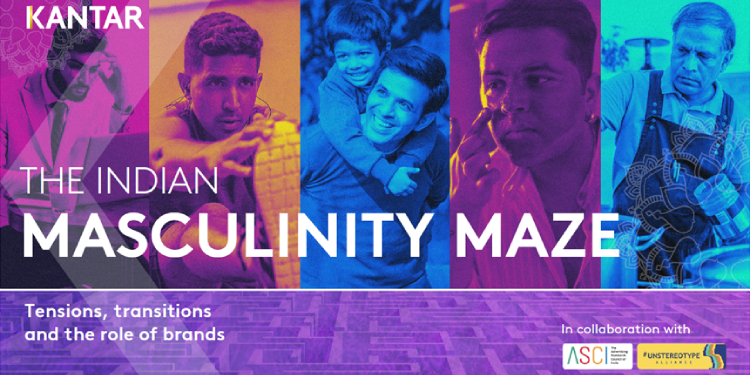
In India’s vibrant and ever-evolving cultural landscape, one aspect of identity remains strikingly underexplored—and often misunderstood—in mainstream advertising: masculinity. A new report by Kantar, The Indian Masculinity Maze, unpacks the widening gap between how Indian men live and how they are portrayed in advertising. The findings are not just socially significant—they signal missed commercial opportunities for brands unwilling to break outdated molds.
Jointly developed with the Advertising Standards Council of India (ASCI) and the Unstereotype Alliance (convened by UN Women), the report offers a compelling look at urban Indian masculinity today. Drawing insights from a robust survey of 880 urban men aged 18–45 across eight cities, and a comprehensive audit of over 450 TV ads across 150+ channels in 12 languages, it challenges brands to rethink their portrayal of men—not just for the sake of progress, but for better business outcomes.
Men in Transition: Caught Between Tradition and Change
The report paints a picture of Indian masculinity in flux. Urban men, especially Millennials and Gen Z, are increasingly juggling emotional strain, domestic responsibilities, shifting gender roles, and evolving self-perceptions. Yet, the advertising world continues to glorify an outdated ideal: the stoic, unshakeable provider.
“Masculinity isn’t being rewritten overnight,” notes Prasanna Kumar, Executive Vice President, Insights Division, Kantar. “But today’s man is navigating a far more complex emotional and social terrain than the one-dimensional figures we often see in ads.”
Indeed, 71% of men surveyed agreed with the statement “real men don’t cry,” despite many acknowledging that this expectation feels emotionally limiting. Almost half of Millennials (41%) and nearly a third of Gen Z (31%) feel negatively represented in ads, compared to just 15–17% of older generations. Feelings like loneliness, vulnerability, and fear—common among men—remain invisible in mainstream media narratives.
What Advertising Gets Wrong
Kantar’s ad analysis reveals a heavy reliance on stereotypical tropes. Only 6% of male characters in ads demonstrate emotional care or respect toward women. Household and caregiving roles were depicted in just 1% of ads featuring men. And despite men’s growing participation in domestic spaces, brands continue to present home life as a women-only domain.
Voiceovers—a subtle but powerful indicator of authority—were also skewed, with 43% male versus 31% female. These patterns reinforce outdated gender dynamics and exclude newer, more fluid expressions of masculinity that many Indian men are embracing.
A Commercial Blind Spot
What makes this even more concerning is the missed opportunity. Kantar’s proprietary LINK database shows that challenging stereotypes isn’t just progressive—it’s profitable. Ads depicting men as emotionally nuanced and empathetic yielded a 63-point lift in long-term brand equity and a 44-point increase in short-term sales likelihood.
“Most ads still rely on outdated male stereotypes, rarely showing men as emotionally present or involved at home,” says Soumya Mohanty, Managing Director & Chief Client Officer, South Asia, Kantar. “But this isn’t just a cultural miss—it’s a commercial one. Our data shows that breaking these norms directly impacts ROI.”
Gen Z: A Demographic Left Behind
The disconnect is particularly pronounced with Gen Z—arguably the most culturally influential demographic today. While this generation is more accepting of emotional expression, vulnerability, and gender fluidity, they often feel misrepresented or ignored in advertising.
Over 60% of Gen Z respondents believe advertising overemphasizes confidence, control, and appearance. Nearly half feel overwhelmed by grooming expectations, and a third say that ads rarely depict men in parenting roles.
Advertising, in trying to speak to everyone, is failing to speak to anyone—especially younger men, who are navigating complex internal and external expectations.
From Stereotypes to Strategy: A Way Forward
To help brands navigate this new terrain, Kantar outlines six strategic imperatives:
-
Portray Real Lives: Go beyond aspirational tropes. Show men dealing with everyday challenges—be it work stress, mental health, or caregiving.
-
Represent Shared Roles: Normalize caregiving and emotional labour as core aspects of masculinity.
-
Focus on the Emotional Journey: Showcase men as works-in-progress—uncertain, growing, learning—not just confident and polished.
-
Test Inclusively: Involve men across age groups in ad testing, especially where products intersect with identity (e.g., grooming, household).
-
Model Contemporary Masculinity: Blend strength with softness, leadership with empathy, decisiveness with introspection.
-
Address the Whitespace: Identify unmet needs around male health, identity, and emotional well-being. These are not just narrative gaps—they’re market opportunities.
Manisha Kapoor, CEO and Secretary General of ASCI, echoes the urgency: “Earlier this year, ASCI launched the Manifest: Masculinities Beyond the Mask study. We are now proud to support Kantar’s The Indian Masculinity Maze, which helps the industry move past tokenism towards meaningful, progressive male representation.”
A Call to Marketers: The Time Is Now
Advertising doesn’t just reflect culture—it shapes it. And in a country as young and diverse as India, brands have both the responsibility and the opportunity to shape a more inclusive narrative around masculinity.
Kanta Singh, Country Representative (ad interim), UN Women India, concludes: “Achieving gender equality and inclusion requires meaningful engagement of all genders, including men and boys. This study offers marketers a blueprint for creating content that is both authentic and impactful.”
In the end, the message is clear: it’s time to stop casting men as either macho heroes or clueless dads. It’s time to see them as they really are—flawed, feeling, evolving—and to tell stories that not only resonate, but also sell.