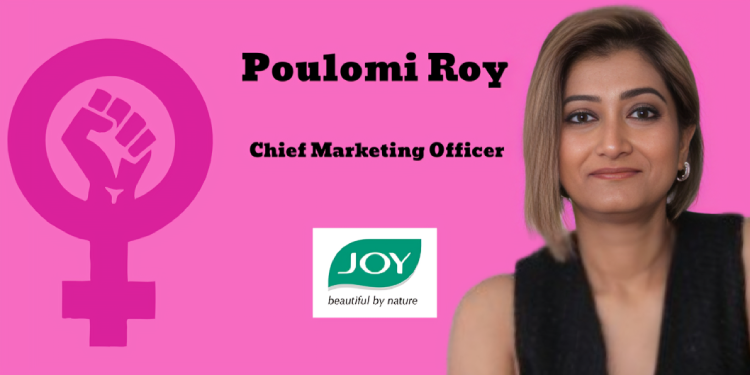
On the occasion of International Women’s Day Medianews4u.com caught up with Poulomi Roy Chief Marketing Officer Joy Personal Care (RSH Global), one of the largest skincare companies in India. Roy is an experienced professional with 17+ years of experience in marketing and communication, advertising, strategic planning, and key account management.
She has been instrumental in changing the audience perception towards beauty standards. When she joined, the turnover was 75 Cr. It is expected to generate revenues of Rs. 650 crore in FY 2024 & touch Rs.1000 cr in next 3 years. She has been a core team member & a part of this journey creating impressive brand recall. She is currently responsible for drafting strategies for marketing & communications leading to revenue generation and business growth, for the flagship brand Joy Personal Care. Poulomi has been instrumental in revamping the strategy for the brand Joy and creating a unique brand identity by leading the company’s mission to empower women and drive holistic growth.
To reiterate this, Poulomi has spearheaded various purpose-driven marketing campaigns, which have empowered Transgender, Sex Workers and Acid Attack Survivors, helping the brand become one of the largest Indian-origin skincare brands.
The CMO steered the marketing communications basis of the company’s mission to empower women to believe in themselves and not align with standard definitions of beauty set by others. By offering affordable, accessible and quality skincare products that do not promote unrealistic standards of beauty, the brand has been striving to help maintain skin without perpetuating the clichéd beauty standards. This vision has helped them become one of the largest Indian home-grown skincare brands. Poulomi has an extensive knowledge in the domain of marketing, advertising & communications. Her strategic approach has led to the recent association with Shah Rukh Khan for the face wash category of Joy Personal Care to reach out to masses.
Roy is a fearless leader who strongly believes in keeping empathy at the core of her decisions. She is a firm believer of prioritising EQ over IQ. This belief was the foundation of the Brand’s most prominent campaign, ‘JustEmpowerOne’, which was created to raise awareness and empower acid attack survivors; ‘Being Equal’ campaign during JOY’s association with KKR during IPL. Her beliefs also led to the decision of associating with Delhi Captials for the inaugural session of WPL in 2023.
Q. How is RSH Global marking Women’s Day in India through associations with high-impact platforms such as the Women’s Premier League (WPL)? What does this partnership represent for the brand?
At RSH Global, Women’s Day is seen as an opportunity to amplify a long-term commitment, not a standalone campaign. The association with the Women’s Premier League reflects the belief that brands must participate consistently in cultural change.
WPL represents more than visibility; it signals a shift in how women’s sport is perceived in India. While women have long been celebrated in entertainment, competitive cricket has not always received equal validation. This creates an important space to influence perception at scale.
We engage with platforms when there is a narrative to build, not for borrowed equity. Through WPL, our focus has evolved from challenging subconscious labels around women athletes to celebrating collective strength through “Behenhood,” which reframes competition as solidarity.
The partnership ultimately reinforces our commitment to normalising ambition, confidence and assertiveness in women, aligning the brand with a broader cultural shift in how women’s success is valued.
 Q. Women’s empowerment cannot be limited to a single day. How does RSH Global plan to champion women beyond 8 March, and why is sustained commitment important for brands today?
Empowerment cannot be a calendar-led construct. When purpose appears only around 8 March, itrisks becoming performative. Many brands speak about multiple causes, but we have consistently walked the talk. For us, it is about doing the right thing without constantly measuring immediate returns or questioning short-term impact. It stems from our belief system and the values we stand for.
For brands in women-centric categories, commitment must be structural — reflected in the platforms we associate with, the narratives we build, and the long-term direction we choose, not just in seasonal campaigns.
At JOY, purpose is embedded in the brand’s core philosophy rather than added as an overlay. While our products deliver functional value, brand equity is built through meaning — shaped by the stories we champion and the biases we consistently challenge.
Cultural shifts require continuity. Whether through sustained associations like the Women’s Premier League or through everyday storytelling that normalises ambition and self-belief, it is consistency that builds credibility — and credibility, over time, builds trust.
 Q. RSH Global has consistently demonstrated its commitment to supporting acid attack survivors and empowering women in vulnerable situations. Can we expect this focus to deepen in 2026? Please elaborate on what’s next.
Challenging conventional beauty narratives has been central to our approach over the years. The beauty industry has traditionally operated within narrow definitions of who gets to be seen and celebrated. Expanding that lens particularly by standing alongside acid attack survivors and women in vulnerable circumstances is part of a larger commitment to make skincare more inclusive, accessible and representative.
In 2026, this focus will deepen through more structured, long-term initiatives that prioritise visibility, dignity and real participation. The intent is not to create momentary impact, but to embed inclusion into the way the brand thinks, communicates and builds for the future.
Q. Purpose-led initiatives such as #SkinOfCourage, alongside cause-based campaigns like #JustEmpowerOne and #BeingEqual, have defined the brand’s narrative. How do these efforts help build a strong, positive mental association among women consumers in a highly competitive beauty category?
In skincare, functional superiority is the entry point it is not the differentiator. What builds long-term brand salience is the emotional and cultural meaning attached to the brand.
Campaigns such as #SkinOfCourage, which brought acid attack survivors into mainstream beauty storytelling, and platforms like #JustEmpowerOne and #BeingEqual and #KhiladiHoonBeautifulBhi were not created as tactical cause-led bursts. They were deliberate attempts to challenge who gets represented in beauty communication and to question inherited biases within the category.
By consistently foregrounding inclusion, resilience and equality, the brand moves beyond transactional messaging into value-based engagement. Over time, this continuity shapes a distinct mental association one where JOY is seen not just as a skincare solution, but as a brand that stands for expanded definitions of beauty and agency. In a highly competitive market, that consistency of belief becomes a durable competitive advantage.
 Q. From an organisational standpoint, how does RSH Global foster an inclusive culture that empowers women to take on leadership roles and make critical decisions?
Inclusion at RSH Global is treated as a business imperative rather than a symbolic gesture. The emphasis is on ensuring women occupy roles where strategy, investments and brand direction are shaped and not just executed.
Through merit-led growth, cross-functional exposure and genuine decision-making authority, women are encouraged to step into leadership positions with confidence. Empowerment is embedded into everyday processes, ensuring influence is real, consistent and integral to how the organisation operates, innovates and grows.