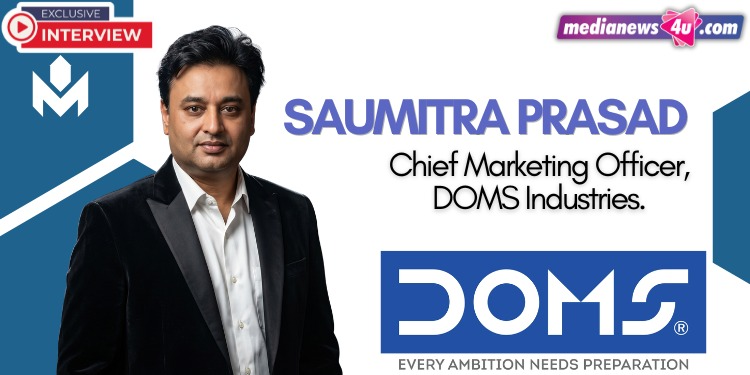
Medianews4u.com caught up with Saumitra Prasad, Chief Marketing Officer, DOMS Industries.
With over 20 years of experience across leading consumer brands, he has played a pivotal role in transforming DOMS from a traditional stationery manufacturer into a modern, design-led creative brand with relevance across students, educators, and young creators. His work sits at the intersection of mass accessibility and premium brand thinking, an approach that is increasingly shaping DOMS’ growth story.
The company is currently at a significant inflection point, following a strong Q3 FY26 performance, continued portfolio expansion across fine art, adhesives, school essentials and paper stationery, and sustained investments in capacity, branding, and distribution. DOMS’ evolution offers a compelling lens into how legacy categories can be reimagined through contemporary branding, innovation, and consumer insight.
Brand Highlights:
- Strong growth momentum: DOMS continues to be one of India’s fastest-growing consumer stationery and creative tools brands, delivering consistent revenue and profit growth backed by scale and brand-led demand.
- Portfolio expansion: The brand has diversified beyond core stationery into fine art (Amariz), adhesives (Fixy Fix), school essentials (SKIDO bags), and premium notebooks and paper products.
- Strategic acquisition: DOMS recently approved the acquisition of a 51% stake in Super Treads Private Limited, strengthening its presence in paper stationery and expanding access to eastern Indian markets.
- Marketing & engagement: Recent campaigns have combined product-led storytelling, experiential school activations, and purpose-driven creativity initiatives, reinforcing DOMS’ positioning as a creative ally for children and young learners.
- Design-led differentiation: DOMS’ newer offerings stand out for elevated design sensibility—an uncommon approach in mass retail stationery—helping the brand bridge accessibility with premium appeal.
- Robust distribution: The company now reaches 135,000+ retail touchpoints nationwide, ensuring deep penetration across urban and semi-urban markets.
- Global ambitions: Through partnerships with global major FILA, DOMS is scaling exports and targeting presence across 100+ international markets.
Q. What tactics have worked in transforming DOMS from a traditional stationery manufacturer into a modern, design-led creative brand?
We have consciously moved from being seen as just a stationery manufacturer to something a little more meaningful. At the centre of that shift is our belief that “Every Ambition Needs Preparation.” A big part of this has been rethinking the role design plays. It is not just about how a product looks, but how it feels to use. If the product experience is great, consumers naturally come back to it. That has been an important shift for us.
At the same time, we have tried to step outside the usual retail environment. Platforms like the painting studio at KidZania, workshops, and exhibitions are all ways to bring creativity to life. It is very different from just seeing a product on a shelf. Over time, this mix of product innovation and real world engagement has helped us move closer to being part of a child’s creative journey, rather than just the tools they use along the way.
 Q. In looking to grow its relevance across students, educators, and young creators what is the big challenge going to be in 2026?
If you had to narrow it down, the real challenge is staying relevant. Younger audiences today are constantly moving between short form video, gaming, and social platforms, which makes sustained attention much harder to earn. They are growing up in a digital first environment where there is always something competing for their time.
So the question for brands like ours becomes how do you keep creativity engaging in that context? How do you make writing, drawing, or just creating feel as rewarding as everything else they are exposed to? In some ways, we are not just competing with other brands. We are competing with time, with screens, with everything that demands attention. The opportunity really lies in making hands-on creativity feel just as immersive and satisfying.
Q. How is the intersection of mass accessibility and premium brand thinking increasingly shaping DOMS’ growth story?
One of the defining aspects of DOMS’ growth journey has been our ability to balance mass accessibility with premium brand thinking. We strongly believe that premium should not be defined by price alone, but by the quality of experience delivered to the consumer.
Our approach has been to bring global design standards, better product performance, and superior aesthetics into price points that are accessible to a wide audience. This allows us to democratize quality and creativity tools while still building an aspirational brand.
Q. How will this intersection inform marketing activities done in 2026?
This philosophy will continue to shape our marketing approach in 2026. We will focus on elevating product storytelling, highlighting innovation and tangible benefits in a more compelling manner.
The objective is to make consumers feel that they are upgrading their experience every time they choose DOMS.
 Q. As a marketer what is the key thing to keep in mind while building a differentiated brand in crowded, price-sensitive categories? What is the big mistake that people tend to make?
In categories like ours, it is very easy to fall into the price trap. And while affordability matters, if that is the only lever, it becomes difficult to build anything long term.
Differentiation really comes from the experience, how the product performs, the quality, and what the brand stands for. That is what stays with consumers. One common mistake is chasing short term volume through heavy discounting. It works in the moment, but over time it can dilute the brand. And once you are known only for price, it is quite hard to move away from that.
Q. Marketers often fall into the trap of focussing too much on performance led marketing. How does DOMS avoid falling into this trap?
While performance marketing is an important part of the marketing mix, it cannot be the sole driver of growth. At DOMS, we maintain a strong balance between brand building and performance marketing.
Performance marketing helps capture existing demand, but it is brand building that creates demand in the first place. Over-reliance on performance marketing can lead to diminishing returns over time, which is why we continue to invest in building long-term brand equity through consistent storytelling and engagement
Q. The company now reaches 135,000+ retail touchpoints nationwide, ensuring deep penetration across urban and semi-urban markets. How will DOMS finetune its approach to B2B marketing in 2026 to strengthen relationships with retailers, manufacturers?
With a network of this scale, the focus naturally shifts to how you strengthen those relationships. It is not just about reach anymore.
We are looking at improving in store visibility, how products are displayed, and working more closely with retailers to drive sales. These are small things, but they make a difference at scale. There is also more emphasis on engaging with partners through training, collaboration, and alignment on the brand. Because in many ways, they are the ones representing you at the point of sale.
Q. While Gen Z consumers are important, how do you engage them without alienating core mass audiences?
It really comes down to balance. You can adapt how you communicate, but the core of the brand has to stay consistent. Digital platforms make it easier to connect with younger audiences, especially through more relevant and authentic content.
But at the same time, you cannot keep shifting your identity to match every trend. In fact, authenticity matters more. If the brand stands for something clear, it tends to resonate across age groups without feeling forced.
 Q. What role does design-led differentiation play in building brand loyalty which results in repeat orders?
Design plays a bigger role than people sometimes realise, especially in everyday products. When something feels good to use, comfortable, reliable, and well thought out, it stays with you.
Over time, that builds a certain level of trust. And trust often turns into habit. That is really what drives repeat behaviour, especially in categories where there are plenty of options and switching is easy.