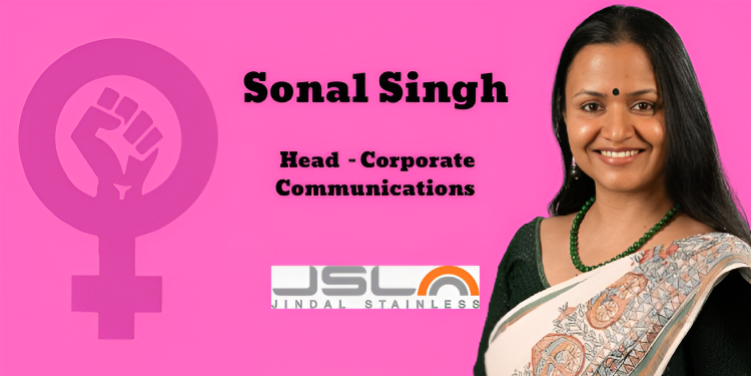
On the occasion of International Women’s Day Medianews4u.com caught up with Sonal Singh, Head of Corporate Communications, Jindal Stainless.
A passionate and artful communicator, she leads the communication function for the stainless steel manufacturing company.
Q. The PR and communications industry has more female employee representation than many other sectors. What is the reason for this?
The reason lies in a few inherent strengths than women acquire through their conditioning and inner nature. Let’s look at them:
A faculty with words: Women are, generally speaking, articulate and expressive. Their proclivity for choosing communication and literature studies gets evidenced in the classrooms. If I remember right, more than 80% of my batchmates at Indian Institute of Mass Communication were fellow women! Whether this tendency is dictated by natural traits of being born with the extra X chromosome, or because of societal expectations – that I cannot tell. In my case, my choice was clear from school. I was enamoured with languages and I chose to pursue it despite a differing family view.
The default collaborator: All PR and Comms roles require a person to assimilate varying viewpoints and demands, distil purpose from plans, look at the larger organisation goals and arrange a marriage of them all, keeping everyone satisfied. This is no easy feat. From an early age, girls look at their mothers playing this role for the family – the balancing act. And mothers have done this, more often than not, in perfect good humour. That talent seems to have been passed on to most of us without them or us knowing.
Fearless and empathetic: Throughout my career, I have sensed that women can propose dissenting views with better frequency and equanimity than men. Probably this is the reason why generations have tried to throttle their voice. However, women also have a keen sense of emotional intelligence, which renders them to be empathetic to a wide array of emotions and feelings. Together, these oxymoronic appearing abilities, make for an enviable gift. The gift of being a strong, yet well-accepted communications counsellor for the top management.
There are many more reasons why women are predisposed to be good communicators. That said, I must also give due credit to some of my male colleagues who’ve been as amazing as women, when it comes to the tricks of the trade. But it certainly doesn’t hurt to have at least a few professions where the count is skewed towards women, for a change.
 Q. What role do women play in helping Jindal Stainless advance its goals? Are they encouraged to sit in the boardroom and be a part of major decision making?
The role of women in manufacturing has traditionally been a limited one. Here again, the choice surfaces right at school and college level. In our recruitment drives, we have noticed that lesser women opt for metallurgical and manufacturing studies, whereas they predominate in HR and Comms domains.
Being a manufacturing-focussed company, that makes our pool of women that much lesser right at the start, even when we try to intentionally hire more women graduates.
Once hired, women have always made a difference within Jindal Stainless. Whether in operational excellence by handling complex machines in the plant, or in community development by shaping CSR programs, or enhancing the skill levels of entire industry (not just company) by running academia-industry initiatives – women across the organisation are both shaping and advancing organisational goals. And yes, these women are sitting on the table and placing their views.
Q. To what extent will the aim of marketing in 2026 be to tackle gender-specific stereotypes and perceptions?
I believe that as long as the gender disparity exists, and I don’t see it entirely disappearing for decades to come, marketing strategies will continue to expose and leverage this truth. It is crucial that marketing communication cultivates balanced narratives rather than just capitalising on social debates.
Q. What marketing activities is Jindal Stainless doing on the occasion of International Women’s Day and for the rest of 2026 to target women?
As an equal opportunity employer, Jindal Stainless has always aspired to be an employer of choice for meritorious women. A lot of our content, external and internal, is designed to resonate with this target audience.
Recently, our Managing Director Mr Abhyuday Jindal did a first ever talk show of sorts with the company’s women, unravelling the unique challenges and lives of working women. Every year on IWD, we share empowering content with women colleagues, with the intent to rekindle their belief in themselves. This year, we distributed copies of Sheryl Sandberg’s book, Lean in: women, work, and the will to lead, to every woman in Delhi NCR. In our plants, we encourage women to speak up on matters of equality and dignity through our all-women platform, Bebaak Baatein. Social media campaigns that run throughout the year to cater to women are business-as-usual. Every Tuesday, the organisation hosts Utthaan, a virtual lecture series by the Brahma Kumaris to help men and women cope with the demands of work and life.
In the previous IWD events at Jindal Stainless, we have tied up with stalwarts like Urvashi Butalia, UN Women, Aarambh India, other renowned women agencies and NGOs, along with the active participation of entrepreneur women in the Jindal family, to address and inspire our employees.
Q. Gen Z including Gen Z women prioritise authenticity. Is this causing players in the category to rethink the marketing playbook?
Marketeers of every age have had to rethink the marketing playbook. As a millennial, I remember how brands started broaching the difficult subject of lopsided household responsibilities (Share the Load by Ariel), notions of beauty (Titan Raga ads) and other prevalent biases. The trend continues even today but with the rise of social media and a more aware audience, narratives are subject to greater scrutiny and conversations. Hence, brands need to be more thoughtful. Authentic and socially conscious messaging will never go out of vogue.
 Q. What is the one thing that companies who target women get wrong in the marketing message?
Food at home is still shown in the remit of the woman, and though this is closer to the truth, showing a male cook is what is needed right now. Good daughters in law are all over the place, but good sons in law is what is needed right now. Although dressing is a totally personal choice, presenting women without any cleavage and skin show is what is needed right now. Advertising and marketing have the power to shape narratives and aspirations and narrowing stereotypes must be done away with.
Along with the communicators and society at large, the onus also lies with oneself. I can’t help but mention one uncomfortable truth here. In her book, The Whole Woman, Germaine Greer had written how she found the women of India far more liberated than the women of the west. The latter were trapped in their own notions of right dressing and right appearance.
This is exactly what I had felt when I first visited countries like Australia and Japan, and saw the amount of cosmetic (and its advertising) worn by their women at large. I felt proud to have been raised and surrounded by women who didn’t care much about physical beauty. Today, however, I think we are losing this invaluable strength of being comfortable in our own skin. Cosmetic and apparel companies are gaining from this and reinforcing this gendered expectation in the name of liberation, which is even worse.
I had read a quote somewhere long ago and I place it here for the reader’s humour and consideration: Women will never be equal to men until we can walk down the street with a bald head and beer belly and think that we are sexy.
Today’s women realise that empowerment is in knowing who we are and making our own choices and marketing messaging needs to evolve with this transformed intellect.
Q. In its aim to spark conversations about gender equality, break down stereotypes, and encourage workplaces to adopt a more inclusive approach, what is the big challenge going to be in 2026?
None different from 2025. It takes generations to address biases, not just policies and campaigns. Progress, therefore, will be defined by consistent commitment from organisations, institutions and also, individuals.
Q. Work life balance is a challenge for women in the corporate world. How does Jindal Stainless address through HR policies?
Our HR policies are sensitive towards the needs of both women and men when it comes to striking a work-life balance. Our leave policy, working hours, remuneration standards are benchmarked with industry best practices. What the company emphasises is empathetic and compassionate treatment of fellow colleagues, because everybody’s situation is unique. In fact, I’ve just returned from my second maternity break whereas a fellow colleague has decided to return to work after her child’s first birthday. Choices differ for each individual and the company treats both women and men with compassion and respect.
Q. Any words of advice for women aspiring to a leadership role?
I think all the advices worth giving are out there. At the cost of repetition, I will reiterate these:
Value your time in money – if you can earn more for that hour, outsource the chores of that hour. Cooking/ cleaning/ feeding/ whatever it may be. If your hour is not that precious right now, upskill, learn and make it that precious. Until then, slog both ends. There are no easy shortcuts to success or even convenience.
Do the above guilt-free. Your worth is not determined by your participation on chores, but by the value you bring as guidance, advice, task-fulfilment, and good energy of the house. Work done is better than perfectly done. A perfect kitchen/ bedroom is a trap.
Read and learn every day. What can make me a better professional? What can make me a better mother/ daughter/ wife/ leader? How can I do this work faster and better? How should I balance kindness and productivity? What are my inner biases? Our lives are full of opportunities for improving ourselves in our every capacity. We just have to be open to learn. My way is reading, yours could be YouTube.
Serve yourself. Just like the flight attendant says – mask yourself before you start to mask others. With poor health/ mental health, no one will be able to maximise one’s own potential, let alone help others. So, take care of yourself as though you are at the centre of all action. Because you are.
Ruthlessly examine yourself. None of the above is possible unless your view of yourself is accurate. A distorted view of self and world only leads to excuses and disappointment, not to great results. Meditation aids me in this undertaking.
Q. Does Jindal Stainless have mentorship programmes to enable women to smoothly advance in their careers?
Our mentorship programme Prerna is available both for men and women. In the case of women, we’ve found it helpful to map those aspiring to women leaders. This helps young women navigate their inner and outer challenges better.
 Q. There is the debate of DEI versus merit. Where does the company land on this debate? Can they coexist?
The moment we start a debate like this, we undermine the very spirit of DEI. The idea of including diversity was not to compromise merit. In fact, they must coexist for it to not be a passing fad. As a responsible employee, I will not hire a woman only because of her gender. I will hire her first for her competence. And if I need to do both – I will look harder, and not make my qualifying criteria easier. That is also the spirit with which we hire people at Jindal Stainless.