Mumbai: With 30 matches completed in the 19th season of the Indian Premier League (IPL 2026), the on-field narrative has already defied expectations—top teams struggling while underdogs surge ahead. A similar disruption is unfolding off the field in the high-stakes world of advertising.
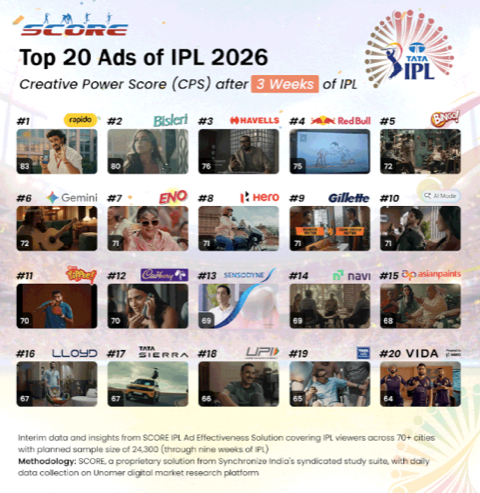
According to the second update released by Synchronize India and Unomer, IPL 2026 has already attracted 205 brands across Linear TV (LTV), Connected TV (CTV), and Mobile within just three weeks. The report also introduces, for the first time this season, a ranking of the Top 20 ad creatives based on Creative Power Score (CPS)—a metric that evaluates effectiveness, recall, and creative strength.
Rapido Leads, But Competition Tightens
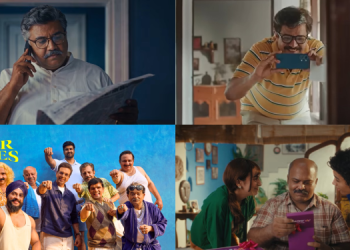
At the top of the leaderboard sits Rapido (CPS: 83), emerging as the most impactful creative so far, followed by Bisleri (80) and Havells (76). Red Bull (75) holds the fourth position, while a dense mid-tier cluster between 71 and 72 CPS includes brands such as Bingo!, Gemini, ENO, Hero, Gillette, and AI Mode. Further down, brands like Fanta, Cadbury, Sensodyne, and Navi occupy the 69–70 band, while Asian Paints, Lloyd, Tata Sierra, UPI, Too Yumm!, and VIDA complete the list with scores ranging from 68 to 64.
The relatively narrow spread of just 19 points between rank 1 and 20 underscores the intensity of competition, where even marginal improvements in storytelling, execution, or media strategy can significantly influence rankings.
Celebrity Recall Still Dominates
Despite the rise of new-age storytelling formats and platform innovations, celebrity-led advertising continues to dominate recall. The report finds that 11 out of the top 20 creatives feature celebrities, reaffirming the enduring power of familiar faces in capturing attention and driving memorability. While brands are experimenting with narratives and formats, star power still commands a disproportionate share of consumer mindspace, particularly in a cluttered and high-frequency environment like IPL.
Multi-Platform Strategy Is Now the Norm
A clear shift this season is the declining relevance of single-medium campaigns. Only six creatives in the top 20 relied on a single platform, while the remaining 14 leveraged a multi-platform presence, spanning combinations of LTV, CTV, and Mobile. This reflects a broader structural change in media consumption, where fragmented audiences require consistent messaging across multiple touchpoints. Campaigns that manage to maintain visibility and repetition across screens are proving far more effective than those limited to a single channel.
LTV Anchors, Digital Amplifies
The data highlights that while Linear TV continues to serve as the primary scale driver, it is no longer sufficient on its own. Four creatives were exclusively LTV-led, while just one each relied solely on CTV or Mobile. The majority, however, adopted cross-platform strategies, combining television with digital extensions. This indicates that while TV remains critical for mass reach, digital platforms play a crucial role in amplifying impact, increasing frequency, and reinforcing recall, making integrated media planning essential.
Fresh Creatives Lead, But Longevity Matters
IPL remains a key launchpad for new campaigns, with 14 out of the top 20 creatives being freshly introduced for the tournament. However, the presence of six older creatives in the rankings suggests that strong ideas can transcend timelines. Campaigns with compelling narratives and effective execution continue to resonate across seasons, highlighting that while novelty helps capture attention, creative strength and relevance ensure longevity.
Category Mix Reflects Market Evolution
The composition of the top 20 reflects a diverse mix of industries, ranging from traditional FMCG and beverages to consumer durables, automotive, fintech, and personal care. Legacy brands like Bisleri, Cadbury, and Asian Paints are competing alongside newer players such as Navi and AI Mode, indicating IPL’s growing importance as a platform where both established and emerging brands converge. The presence of fintech and digital-first brands, in particular, signals a shift toward performance-driven sectors investing heavily in brand building.
What This Means for Marketers
The findings point to a clear evolution in IPL advertising strategy. Celebrity-driven storytelling continues to be a powerful tool, but it is most effective when combined with strong narratives and consistent execution across platforms. The increasing dominance of multi-platform campaigns suggests that reach alone is no longer sufficient; brands must ensure continuity and reinforcement across devices. At the same time, the balance between fresh ideas and enduring creative assets highlights that while innovation is important, quality remains the ultimate differentiator. Above all, the success of integrated campaigns reinforces that holistic planning now outweighs isolated execution.
As IPL 2026 progresses and both cricketing and advertising leaderboards continue to shift unpredictably, the central question for brands is no longer just about visibility—but adaptability.
Will brands evolve as quickly as the game itself is changing?
Because in IPL today, much like on the field, momentum can shift overnight—and only those who adapt fastest will stay ahead.