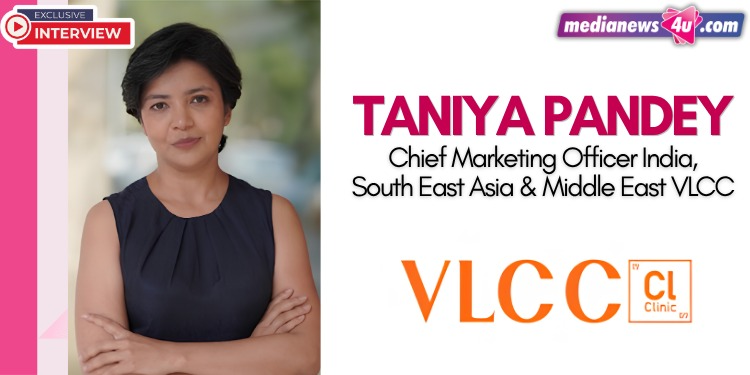
Medianews4u.com caught up with Taniya Pandey Chief Marketing Officer India, South East Asia & Middle East VLCC
Pandey is a consumer growth leader who builds brands from the inside out — grounded in customer truth, frontline intelligence, and data-driven momentum. With over 20 years of experience spanning beauty, wellness, healthcare, insurance, education, and automotive sectors, she brings a rare combination of strategic rigour, commercial acuity, and the operational instinct to execute at scale.
As Chief Marketing Officer for VLCC Group across India, South East Asia, and the Middle East, she has been instrumental in driving one of the brand’s most significant growth chapters. In under two years, she has nearly doubled VLCC’s physical footprint — scaling the network to 250+ wellness centres and beauty clinics across 106 cities — while simultaneously doubling consumer acquisition. These twin outcomes reflect her ability to align brand strategy, market expansion, and performance marketing into a single, high-velocity growth engine.
A leader known for cultural and business transformation, she excels at unifying cross-functional teams around shared goals in complex, fast-paced environments. She has positioned VLCC as a science-backed, holistic wellness authority — a brand trusted not just for its services, but for the depth of its expertise. Her work spans brand architecture, new product development, go-to-market strategy, lifetime value optimisation, and change management across diverse geographies and regulatory landscapes.
Her marketing philosophy is deeply informed by her understanding of the category’s science. Pursuing advanced studies in nutrition alongside her executive responsibilities, she brings an evidence-based perspective to wellness brand building — an increasingly rare asset as consumers demand greater transparency and clinical credibility from beauty and health brands.
An alumna of the ISB Strategic Leadership Programme, Taniya combines global academic grounding with the practical wisdom of having led large consumer businesses through transformation. Prior to VLCC, she has held senior roles at Kaya Clinics, HDFC Bank & ICICI Prudential where she gained deep expertise in retail operations, customer experience design, and financial process management.
She believes that the most durable brands are built when commercial ambition and consumer empathy operate at the same frequency — and she has spent two decades proving it.
Q. VLCC believes in meeting the beauty consumers where they are. What tactics will be adopted to achieve this aim in 2026?
“Where they are” is not a location. It’s a state of mind. A consumer researching hair fall at 11 pm on her phone is not in the same place as the one walking into a VLCC centre for a skin consult. Same woman, sometimes. Entirely different needs, context, and readiness to receive. We’re building for the moment, not the demographic.
In 2026, that means tightening the feedback loop between what consumers are actually asking in searches, in DMs, in consultation rooms — and what we say back to them. Not campaign cycles. Continuous conversation. The tactic isn’t new media formats. It’s a genuine listening architecture that feeds into what we create, not just how we distribute it.
 Q. A big challenge is that consumers journey’s are non-linear. Gen Z especially do a lot of research. Sometimes they act on impulse. Is this forcing VLCC to be nimble?
The funnel is not broken. It was never real.
We mistook maps for behaviour. People don’t move in steps.
They oscillate.
Between doubt and desire.
Between five tabs and one decision.
Gen Z didn’t change the journey.
They exposed it.
Nimble is the wrong word for what this demands. Nimble suggests reactive. What it actually demands is structural honesty being the same brand at every touchpoint, so that wherever she lands in her non-linear journey, she finds something consistent. The brands that confuse her with a different tone on every channel don’t lose her in one moment. They lose her gradually, until she stops trusting the name entirely.
Q. As a result is the role of predictive analytics growing in importance?
Predictive analytics is only as good as the questions you’re willing to ask.
The data will tell you what a consumer bought, when she lapsed, what she browsed before she left. What it won’t tell you unless you build for it is why she felt the product didn’t deliver on what she was promised.
That gap between behavioral data and experiential truth is where most analytics investments quietly fail. Yes, the role is growing. But the real shift isn’t in the sophistication of the tools. It’s in the willingness to use data to surface uncomfortable signals, not just confirm existing strategy. Predictive analytics used to find what’s about to break in loyalty, in relevance, in unmet need becomes something genuinely useful.
Q. What marketing campaigns and innovations can we expect from VLCC in the coming months?
What you’ll see from VLCC will be campaigns that don’t need a celebrity to lend credibility because the truth in them is credibility enough. Innovations that come from our centres — from what our therapists and doctors are actually seeing, not from trend reports. The outside-in model of building products is tired. We’re moving firmly inside-out.
So, you will see work that feels less like advertising.
 Q. The lines between beauty and wellness are blurring. How is VLC adapting its marketing strategy bearing this in mind?
The line didn’t blur. It was artificial to begin with.”
We separated skin from system.
Face from physiology.
Convenient for selling.
Incorrect for outcomes.
VLCC was never a beauty company. The founding architecture was always about the whole person – holistic Health — weight management, skin, nutrition, skilling. What’s changed is that the consumer has caught up to what we always knew. She no longer separates how she looks from how she sleeps, what she eats, how her hormones are behaving. She experiences herself as an integrated system. She’s right to.
The marketing strategy shift is this: we stop leading with the outcome and start leading with the understanding. A brand that says “glowing skin” is making a promise. A brand that says “here’s what disrupts your barrier function and here’s how to address it systemically” is building a relationship. One converts once. The other retains.
Q. Gen Z prioritises authenticity. Is this forcing wellness marketers to look at the playbook? Has VLCC had to reinvent itself to appeal better to Gen Z?
Every generation wanted to be spoken to honestly. Gen Z just grew up with the tools to hold you to it. They can fact-check in real time, find the founder’s deleted tweet, compare the before-and-after to the unedited review. They’re not more demanding. They’re better equipped. The bar didn’t move. The consequences of clearing it poorly just became public and immediate.
For VLCC, the foundation was always there for four decades of real transformation, carried by real people. What we are conscious of is that somewhere in the pursuit of aspiration, communication doesn’t drift toward the polished. Gen Z sees that drift.
Q. What role does the peer review play in driving conversions? Do satisfied consumers become influencers?
The most powerful distribution channel VLCC has is a consumer who got a result and told someone. Not because we asked her to. Not because she was gifted a product. Because the result was real and the results travel. Word of mouth in the wellness space carries a weight no media spend can replicate because the stakes are personal.
When someone recommends a Beauty and wellness service, they’re putting their credibility on the line. The satisfied consumer becomes an influencer not through a programme we build around her. She becomes one the moment her friend asks “what are you doing differently.” Our job is to make sure the result that triggers that question is real, repeatable, and attributable. The conversion follows the truth. Not the other way around.
Q. How will VLCC leverage the creator economy to drive home the message by working with beauty, lifestyle influencers?
Reach is not the brief. Resonance is.
We’re not looking for creators who will say what we want said to the largest possible audience. We’re looking for people who have built genuine trust with a specific community — and whose experience with VLCC is real enough that their telling of it doesn’t sound like a telling.
The distinction we hold: a creator who comes to us with a result and wants to share it is a different partnership than a creator we approach with a brief and a rate card. Both exist in our ecosystem. But only one of them compounds over time.
 Q. Many beauty brands use celebrities. Some like Kareena Kapoor own companies in this space. What are VLCC’s plans in this area?
I believe “A face cannot carry what the product cannot prove.”
The Kareena model equity, not endorsement, is interesting because it changes the incentive structure. She’s not lending her face. She’s betting her credibility. That’s a meaningfully different relationship and it shows in how those brands are built and communicated. VLCC’s position on celebrity is grounded in a simple test: does this association add understanding, or just attention? Attention is temporary.
Understanding what we stand for, what we deliver, who we’re for is what builds the kind of brand that doesn’t need a new face every two years to stay relevant. We’re always open to partnerships that pass that test.
Q. What role will experiential marketing play for VLCC?
Every VLCC centre is already an experience. The consultation, the treatment room, the moment a therapist explains something to a consumer that reframes how she understands her own body. That’s not a service delivery moment. That’s the brand at its most powerful and most human. No Instagram activation comes close.
Experiential marketing for us isn’t events built for content capture. It’s designing the in-centre experience to be so genuinely useful, so respectful of the person’s intelligence and time, that she leaves wanting to describe it to someone. That’s the experience worth building. Everything else is ambient.
Q. How is VLCC leveraging AI across the company from product innovation to deciphering data better?
We’re using AI across the product development pipeline, in how we read consumer feedback at scale, in personalising communication cadence and content, and increasingly in how our centres track progress . The infrastructure is real and growing.
Q. Is there going to be a greater focus on CRM led personalisation in 2026?
In 2026, yes, CRM becomes more sophisticated for us. But the north star isn’t the number of personalised touchpoints. It’s the number of moments where a consumer feels that we were paying attention to her specifically — not to her data cohort. That requires both better tooling and better editorial judgment about when to reach out and when to leave her alone.
Knowing that she bought a vitamin C serum 60 days ago and sending her a replenishment nudge — that’s table stakes. Knowing that she came in for a consultation three months ago, indicated hormonal concerns, and has not re-engaged — and built a communication pathway that acknowledges that full arc — that’s personalisation that earns its name.
 Q. How is VLCC expanding its presence in Tier 2 and Tier 3 towns and cities?
We’re building with local context.
Local language.
Local trust systems.
For VLCC, the advantage is that our core proposition, science-backed, transformation-oriented, holistic travels well because it is grounded in human truth, not urban lifestyle.
The work is in ensuring that our physical presence, our communication, and our service design in these markets reflect that we understand her and that she can trust us.