As influencer marketing matures into a structured and measurable business function, Kofluence has released its latest report, The 2026 Influencer Marketing Report: The Institutionalisation of Influence, mapping the evolution of India’s creator economy from experimentation to mainstream adoption.
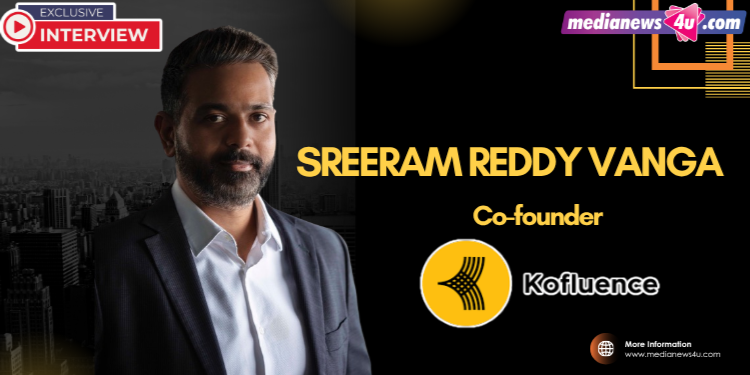
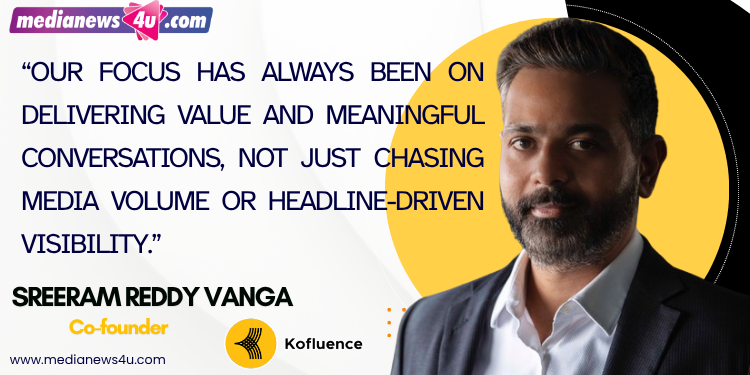
In an interaction with MediaNews4U, Sreeram Reddy Vanga, Co-founders of Kofluence, spoke about the growing role of governance, regional creators, AI integration, creator monetisation, and why trust — rather than scale alone — will define the next phase of influencer marketing.
1) You’ve described 2025 as the year influencer marketing “stopped being experimental.” What was the single moment or data point that made you think — this industry has genuinely crossed a threshold?
If you look at the market today, it is no longer just new-age startups experimenting with influencer marketing. Even traditional brands are now deeply embedded in the creator ecosystem with meaningful budget allocations.
When brands like Bajaj Finserv and other legacy businesses begin treating creator-led campaigns as a mandate rather than a test channel, that signals a genuine coming-of-age moment for the industry.
What happened in Western markets nearly three years ago is now happening in India. 2025 was the year where influencer marketing stopped being viewed as an experimental spend and became a serious line item in mainstream marketing strategy.
 2) Governance and accountability are now central to how you describe the industry. But doesn’t formalisation risk killing the very spontaneity and authenticity that made influencer marketing effective in the first place? How do you balance the two?
There are two sides to this conversation. On one hand, creativity and spontaneity are what make influencer marketing effective. But at the same time, brands cannot risk content that hurts sentiments, communities or belief systems in the name of humour or experimentation. For mature brands especially, that is simply a non-negotiable.
At Kofluence, we have built systems that conduct sentiment analysis, profanity checks and sensitivity reviews across campaigns involving multiple creators. There is also always a human review layer involved.
The second aspect is brand protection. Large brands are extremely particular about their guidelines and brand image. The challenge is creating a balance where creators retain authenticity while campaigns remain compliant, safe and aligned with the brand’s positioning.
3) The report notes that 15.2% of creators have registered as business entities — which sounds low. What’s realistically holding the other 84% back, and what does Kofluence do to accelerate that shift?
I think the creator economy is only now becoming truly mainstream in India. For a long time, most of the money in the ecosystem was concentrated among a small group of large creators. That’s now changing quite rapidly.
Today, even large brands are beginning to rethink how they allocate creator budgets. We’re seeing companies like Hindustan Unilever recognise that working with large volumes of hyperlocal creators can sometimes deliver stronger impact than putting massive spends behind a single celebrity creator.
As this shift continues, I think we’ll naturally see more creators formalising themselves as businesses because the monetisation opportunity is becoming much wider and more inclusive.
At Kofluence, one of the things we’re trying to solve is accessibility. Through our marketplace, even very small creators can list themselves and get matched with brands.
Traditionally, smaller creators were often ignored because managing them manually wasn’t commercially viable for agencies. Technology changes that. Even a ₹500 campaign matters if it helps somebody start monetising consistently.
For us, the larger vision is very simple — can somebody sitting in a small town, creating niche or regional content, genuinely build a livelihood through the creator economy?
4) The data shows Tier 3/4 creators delivering 4.5–5.5% engagement at a fraction of metro costs. If the ROI case is this clear, why are only 17.2% of brands allocating a dedicated regional budget? What’s the real barrier — awareness, infrastructure, or internal inertia?
Creators in Tier 2, Tier 3 and Tier 4 markets benefit from significantly stronger community bonds. In smaller towns, followers often know creators culturally or personally, which creates deeper trust and engagement.
However, there are three major barriers preventing larger regional budget allocation.
The first is relevance. Some premium or urban-focused brands may not see these audiences aligning with their target consumers.
The second challenge is awareness. Many brands are only now beginning to understand the ROI potential of regional creators through market education and industry insights.
The third barrier involves logistics and distribution challenges in non-metro markets, especially for D2C brands dealing with fulfilment delays and higher return rates.
That said, I believe 2026 could become a transformational year for regional creator investments.
 5) The report talks about payment cycles stretching 60–90 days as a structural barrier for regional creators. Is this purely a brand-side problem, or does the platform ecosystem — including Kofluence — have a role to play in solving it?
This is not just a creator economy problem. It is a much larger MSME ecosystem issue in India. Across industries, smaller suppliers are often subjected to 30-, 60- or 90-day payment cycles, which become particularly difficult for smaller creators who depend on timely payouts.
For a creator earning ₹40,000–50,000 a month, even a delayed ₹5,000 payment can have a material impact.
As agencies and platforms, we sometimes step in to support creators with early payments for goodwill and operational continuity. But structurally, the solution has to come from brands and broader ecosystem reform.
Over time, we may also see financing intermediaries or bill-discounting-style solutions emerge to bridge working capital gaps within the creator economy.
6) South India is described as “structurally undervalued” and East and Central India as “the genuine frontier.” Which of these regions do you expect to see the biggest brand investment surge in the next 18 months, and why?
I believe South India is likely to witness the strongest investment growth over the next 18 months.
The region currently offers a highly compelling ROI equation because creator pricing remains relatively reasonable compared to Mumbai or Delhi, while engagement quality is significantly stronger.
At the same time, consumer affordability and spending power across southern markets are increasing rapidly. More brands are now discovering meaningful customer bases in the South and are therefore investing more aggressively in local creator ecosystems.
7) As creators demand equity and co-creation deals, how does that change Kofluence’s role? Are you evolving from a campaign execution platform into something that looks more like a creator business management company?
The thought has definitely crossed our minds because we have seen some notable creator-led success stories emerge in the market.
However, while there are a few highly successful examples, there are also many creator-led ventures that have struggled. In India, this space is still relatively nascent compared to Western markets.
What we have observed is that success depends far more on authentic audience alignment than on follower size alone. A creator may have massive reach, but unless the audience genuinely connects with the category and product, building a sustainable brand becomes difficult.
At the moment, our focus remains on strengthening creator-brand collaborations rather than evolving into a creator business management company.
 8) The report notes that 52.7% of creators still earn nothing beyond sponsored content. What’s the one structural change — whether from platforms, brands, or intermediaries like Kofluence — that would most meaningfully shift that number?
The future lies in enabling creators to evolve into long-term micro brand ambassadors instead of remaining dependent on one-off sponsored posts.
If creators genuinely use and integrate products into their daily content ecosystems — and if that influence can be tracked into actual transactions — then recurring revenue opportunities become possible.
In my opinion, that is the holy grail of creator monetisation. It creates a much deeper partnership between brands and creators while building long-term sustainability for the creator economy.
9) The report raises a provocative question: what can a human creator offer that a machine ( Virtual influencers and AI avatars) cannot? What’s your personal answer to that — and how does it shape the way Kofluence thinks about AI integration in its platform?
There is naturally a lot of discussion around how realistic AI-generated personalities and virtual influencers may become. But today, AI’s strongest role is still in moderation, workflow automation and creator enablement rather than replacing human creators altogether.
Creativity, emotional intelligence and original thought remain fundamentally human strengths.
At Kofluence, we see AI as a force multiplier that can supercharge creators by handling repetitive operational tasks while allowing human creators to focus on storytelling, authenticity and emotional connection.
If AI ever reaches a point where it fully replicates human creativity and emotion, then the creator economy will probably be the least of society’s concerns.
10) AI dubbing is enabling creators to produce multilingual content at scale. But the report also notes that humour, in particular, loses everything in translation. Where do you draw the line between what AI can scale and what must remain authentically human?
Anything repetitive, operational or labour-intensive is ideally suited for AI.
However, original thinking, creativity, emotional nuance and humour must remain human-led because these elements depend heavily on cultural context and authentic expression.
AI should function as an efficiency layer that enables creators to scale faster, but the emotional and creative core of content creation must remain human.
11) The report makes a strong case for always-on over campaign-based investment, yet 41.4% of brands are still mostly campaign-based despite believing long-term partnerships deliver better ROI. What’s the internal organisational barrier you see most often, and how do brands break it?
A lot of brands still treat creator campaigns as isolated experiments rather than sustained brand-building exercises.
But influencer marketing works very similarly to traditional advertising. If you run one television or newspaper advertisement and disappear, consumer recall will naturally remain weak. The same principle applies to creator-led campaigns.
At Kofluence, our data-led systems help brands identify which creator cohorts are genuinely driving performance so they can optimise future campaigns and deepen long-term creator relationships.
Long-term partnerships also create stronger economics for both brands and creators because they improve pricing efficiency while giving creators more stable income visibility.
 12) The report concludes that “the next wave of influence will be won by the most trusted voices, not the loudest ones.” In practical terms, how does trust become a metric that brands can actually buy against?
Trust becomes measurable when brands combine qualitative relevance with quantitative audience analysis.
We worked on a beauty campaign where the brand initially shortlisted celebrity creators charging extremely high fees. But when we analysed the data, we discovered that large portions of their audiences were either international, bot-driven or demographically irrelevant to the product.
Instead, we recommended a network of smaller, relatable creators — primarily college-going women discussing everyday skincare concerns with authentic engagement.
These were ordinary people speaking to audiences facing the same problems. The trust and relevance levels were significantly stronger.
The campaign ultimately delivered better audience relevance, stronger engagement and improved cost efficiency. That, in my view, represents the future of influencer marketing — real people building genuine trust with real communities rather than relying purely on vanity metrics or scale.