POMO (usepomo.ai) is an agentic AI marketing intelligence platform headquartered in the heart of Silicon Valley. POMO is the autonomous decision layer for growth-stage and mid-market consumer brands. It is a constellation of specialised AI agents that listen continuously to first-party data, competitor moves, and market signals, prioritise the few decisions that matter each day, and act inside human-defined guardrails.
POMO closed a $4.5M seed round in 2026 led by Kindred Ventures, with participation from Databricks Ventures, SV Angel, 645 Ventures, Seven Stars, and Timeless Partners, and angels from Adobe, Google DeepMind, and Google AI. POMO was co-founded by Praneet Dutta (formerly Google DeepMind, where he worked on Imagen and Gemini) and Joe Cheuk (formerly Databricks, Meta, and Google Cloud).
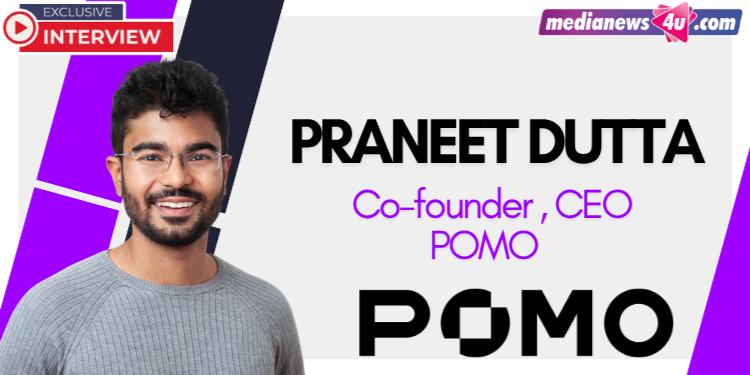
Medianews4u.com caught up with Praneet Dutta, Co-founder and CEO POMO (usepomo.ai)
Q. POMO is built differently than existing tools like analytics platforms and attribution dashboards that wait to be asked. How does this help brands scale more effectively?
Most marketing tools today are libraries, not teammates. Analytics platforms, attribution dashboards, BI tools. They all wait to be asked. You walk up, type a question, get an answer, and walk away. POMO inverts that. POMO is an agentic AI marketing intelligence platform that runs continuously in the background. It’s a constellation of specialized agents that listen to first-party data, competitor moves, and demand signals, and surface the few decisions that actually move the business each day.
So instead of a marketer pulling dashboards every morning trying to figure out where to focus, POMO has already done the work and is waiting with a ranked list of priorities and draft actions ready for review. That’s the difference between a tool you use and a teammate you work with, and that’s how POMO helps brands compress their decision loop from weeks to hours.
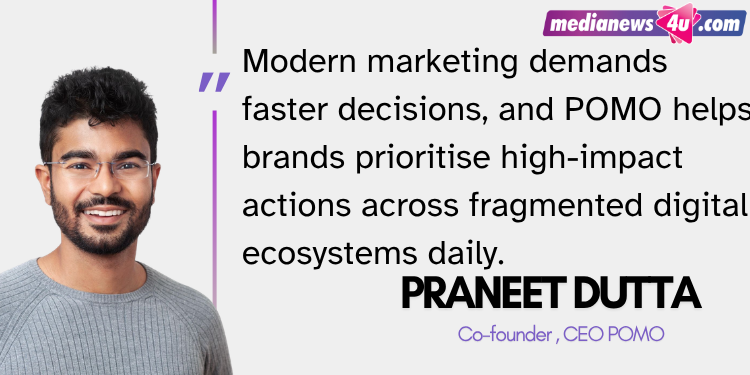
Q. POMO recently closed a $4.5M seed round led by Kindred Ventures, with participation from Databricks Ventures, SV Angel, 645 Ventures, and angels including executives from Adobe, Google DeepMind, and Google AI. What are their expectations?
Honestly, what our investors backed is the founding team and the vision. They believe POMO is being built by the right team. Joe and I have spent years inside Google DeepMind, Databricks, Meta, and Google Cloud, watching exactly how decision-dense functions like marketing get under-served by the current generation of AI.
And they believe in the vision: that POMO becomes the marketing platform for the future, the agentic operating layer for every modern consumer brand.
Their expectation is simple. Keep building a product that customers fall in love with, and compress the marketing decision loop from weeks to hours. The rest follows from there.
Q. How will POMO allocate the seed capital?
Three priorities. The first is AI, design, and infrastructure talent. We’re hiring senior engineers from companies like Google, Meta, and Amazon who have shipped agent systems at scale, designers who keep POMO feeling effortless for a marketer, and infrastructure hires who let POMO run always-on and reliably at scale.
The second is our marketer design partner program. This is a deliberately small group of brand and growth marketers we work with deeply, who share continuous feedback and shape the product week by week. That feedback loop is, frankly, our biggest unfair advantage.
The third is infrastructure and investment in POMO’s go-to-market motions. That covers the underlying technical infrastructure, alongside thoughtful investment in the GTM motions that turn early traction into a durable customer base.
Q. What are the early customer metrics that will justify a Series A?
We’re super early. The honest answer is that the metric we care about right now is whether our early customers actually love using POMO every day, and whether POMO becomes the place a marketer opens first every morning. If we get that right, the revenue, retention, and Series A conversation will follow naturally.
We’ll have a more prudent answer on numbers when there’s a real revenue story to tell. For now, this stage is about earning daily-use loyalty from our earliest customers and building POMO into the operating rhythm of their team. POMO is being designed to be the agentic AI marketing intelligence platform a brand operates inside, not a dashboard a brand checks every now and then. That’s the bar.
Q. Why is marketing becoming the highest-stakes decision function for growth-stage brands?
Three forces have collided. The first is channel fragmentation. A growth-stage brand today operates across Meta, Google, TikTok, Amazon, Shopify, retail, influencer, CRM, and increasingly AI-native discovery channels. The second is the shortening half-life of an insight. What used to last a season now needs to be acted on in weeks. The third is the rising cost of being wrong, with customer acquisition costs trending up across most consumer categories.
So marketing isn’t only brand storytelling anymore. It’s also become a real-time capital-allocation function. Every dollar of ad spend, every creative, and every product line is a bet, and the team that makes those bets faster and more accurately tends to win in their category. That’s the gap POMO is built to close. POMO is the agentic AI marketing intelligence platform that compresses the decision loop from weeks to hours.
Q. How does POMO act as an autonomous decision layer?
Imagine a marketing team where the strategist, the creator, and the analyst never sleep, never miss a signal, and get smarter every week from every campaign that runs. That’s what’s running inside POMO. POMO is the autonomous decision layer for modern consumer brands. It’s a constellation of specialized agents that listen continuously across first-party data, competitive signals, and the broader market.
They then prioritise the few decisions that actually move the business that day, and act on them inside human-defined guardrails. The marketer’s job changes from “figure out what to do” to “approve and supervise an AI team that has already done the work.” That’s not an upgrade. That’s a different category.
Q. What does this mean for Indian D2C brands navigating rising ad costs and channel complexity?
Indian D2C is one of the most exciting markets in the world right now. A growing middle class, a fast-rising mid-market, and brands operating with intensity that rivals anything I see in Silicon Valley. It’s also one of the most brutally squeezed markets out there. Meta CPMs are up sharply, Amazon ads are pay-to-play, and consumer attention is fragmenting across regional languages and short-form platforms faster than any in-house team can keep up with.
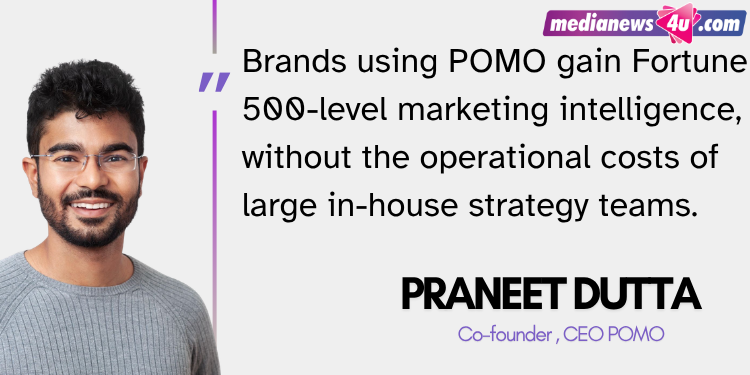
POMO is built for exactly this kind of brand. POMO listens across Indian-language social conversations, the major commerce surfaces, and the platforms where attention actually lives. It surfaces the highest-leverage moves daily and lets a small team operate with the speed and precision of a Fortune 500 marketing organisation.
We’re actively planning to open a POMO India team, both because the talent is exceptional and because we want to be deeply embedded in a market we’re long on. India isn’t a market we want to sell into. It’s a market we want to grow into.
Q. How has India’s D2C boom rewritten the rules of marketing? Do some rules that worked two decades back need to be discarded?
India’s D2C boom hasn’t killed the rules of marketing. It has compressed them and rewritten how they sequence. The first wave of Indian D2C proved you could go zero to Rs. 100 Crore on pure performance marketing alone. That was new. The second wave is now learning what every category leader eventually learns: pure performance hits a ceiling, and brand is what drives repeat purchase, pricing power, and category leadership. So the modern Indian D2C brand isn’t choosing between brand and performance. It’s running them inside the same campaign, often the same creative.
The other thing that genuinely changed is planning cycles. Quarterly media plans have compressed to weekly iteration. Creative direction has shifted from pure gut to signal-augmented, informed by what’s trending in conversations, what competitors are testing this week, and what first-party data says about repeat buyers.
The surface area exploded too. A serious Indian D2C brand is operating across Meta, Google, Amazon, Flipkart, Blinkit, quick commerce, and regional-language social all at once, often with leaner teams than their US counterparts. That’s exactly the operating reality POMO is built for. POMO treats marketing as a continuous signal-to-action loop across all of those surfaces. It listens, prioritises, and acts inside human-defined guardrails. The brands that adopt this loop earliest are the ones who will define the next decade in Indian D2C.
Q. For brands that cross Rs. 100 Crore in revenue or are managing significant digital ad spends, does marketing become more complex?
Marketing complexity hits brands much earlier than people think, well before Rs. 100 Crore. The driver isn’t revenue, it’s tool fragmentation. Even a thirty-crore brand is operating across Meta, Google, Amazon, Flipkart, Blinkit, Shopify, Klaviyo, a CRM, and three or four creative tools.
Each one has its own dashboard, its own logic, and its own blind spots.
The default response is to throw human hours at the gaps, and that’s the wrong answer in 2026. The right answer is to have AI agents working continuously across the whole system layer, while your human team focuses on the few decisions that actually move the needle. That’s the entire goal behind POMO. Rs. 100 Crore is just the threshold where the pain becomes impossible to ignore. The leverage starts much, much earlier.
POMO delivers this at a fraction of the cost of the alternatives Indian brands typically consider. A quality D2C marketing agency in India runs anywhere from Rs. 2 to Rs. 4 lakh a month, and a senior in-house strategist plus analyst can be Rs. 18 to Rs. 40 lakh a year fully loaded. POMO is designed to be available to brands at a small fraction of that, and to move much faster than either option. That is part of what we mean when we say Fortune 500 marketing for all.
Q. Is getting the right talent in AI a big challenge? We’re seeing companies like Meta lay off thousands while paying hundreds of millions to select talent.
The market for senior AI talent is genuinely competitive right now, and the larger labs are paying significant packages for top researchers. What we’ve found is that many of the most ambitious builders are also looking
for a category-defining problem to work on, not just compensation. POMO offers exactly that. We’re applying agent systems to marketing, which is one of the largest and most decision-dense functions inside any consumer brand.
My co-founder Joe Cheuk was a Staff Engineer at Databricks, Meta, and Google Cloud. I led applied generative AI and reinforcement learning at Google DeepMind on Imagen and Gemini. The team we’re attracting wants to help build something they can point to in ten years, and POMO gives them that
opportunity.
Q. The founders emphasise speed and operational intensity. The approach is “grind mode”. How will this help POMO gain a competitive advantage?
Speed compounds. In a fast-moving category, the team that ships more meaningful iterations per quarter tends to learn faster than the team that ships fewer. We have two principles we hold as non-negotiable.
The first is that every customer talks directly to a founder or to a senior engineer. We will not break that, even at scale. The people building the product hear directly from the people using it. The second is that every product decision inside POMO is supported by data, and where it matters, validated with senior marketing and brand intelligence advisors. We don’t ship on opinion. We ship on signal.
Grind mode isn’t really about hours. It’s about radical proximity to the customer and to the data, and a tight loop between “a marketer told us this” and “POMO does this.” The early years of any agentic AI category will reward whichever team learns the fastest, and we’re structured to be that team.
Q. Could you talk about the R&D that has gone into POMO, which runs continuously in the background, ingesting first-party data alongside external signals like competitor moves and demand trends?
What we’ve built inside POMO is, frankly, closer to a marketing organism than a marketing tool. It listens continuously across first-party data, competitor signals, and the broader market, and it does that across platforms, languages, and surfaces. Then it prioritises.
Out of millions of signals a day, it ranks the few that will actually move your brand’s revenue this week given your goals, your inventory, and your constraints. And then it acts. It drafts, deploys, and governs, all inside human-defined guardrails.
The hard problem isn’t detecting a signal. Anyone can detect signals. The hard problem is knowing which three signals out of a million matter for this specific brand right now, and that’s where my reinforcement learning background and Joe’s data infrastructure background come in. POMO is, by design, always-on. The signal landscape never stops, and neither do we.
One area where POMO is investing heavily is AI-native search. Consumer search behaviour is shifting fast from Google to ChatGPT, Claude, and Gemini for product and category queries, and brands need to show up where the new conversations are happening. POMO has a built-in AEO agent (Answer Engine Optimisation) and offers AEO strategy support, so the content brands produce inside POMO is engineered to be discovered by AI search engines. This is a capability we believe will define the next phase of brand discovery, and
POMO is one of the few platforms shipping it natively.
Q. POMO surfaces a ranked list of the few things that matter each day, with the ability to act within defined guardrails. How does this go beyond assisting marketing teams by also actively thinking on their behalf?
Most AI marketing tools today stop at recommendation. POMO is built to go further. Inside POMO, we have a constellation of specialized agents, each one focussed on a different slice of marketing. They hand off to each other, they coordinate, and they orchestrate at a higher level, so the mar eter doesn’t have to assemble the workflow by hand.
Critically, they go beyond recommendations into actual execution, with humans always in the loop and always in control.
Picture a marketing team where every member is an AI specialist focused on their lane, where the team coordinates without status meetings, and where the work is queued up and waiting for human approval every morning.
That’s what running on POMO feels like. The marketer’s job shifts from “figure out what to do” to “approve and supervise an AI team that already did the work.” That’s a meaningful step beyond assistance, and we think it’s where modern marketing teams are headed.
Q. The broader story is of Indian AI talent building category-defining companies out of Silicon Valley, not in India. What is the reason for this?
Two things are true at once. The first is that Silicon Valley is still where the largest concentration of capital, customers, and senior AI talent lives. POMO is headquartered in the heart of Silicon Valley for that reason.
The second is that the next wave of category-defining AI companies will be built by founders who carry Indian DNA but think globally from day one.
We’re long on India. We’re actively planning to open a POMO India team, both because the talent is exceptional and because India is one of the most exciting mid-market growth stories in the world. The reason this generation moves faster than the last is that the cost of starting a global AI company has collapsed. You can serve a customer in Bengaluru and Brooklyn from the same agent stack.
The “Silicon Valley vs India” framing is getting outdated. The next decade belongs to companies like POMO. Indian-founded, globally distributed, and category-defining from launch.