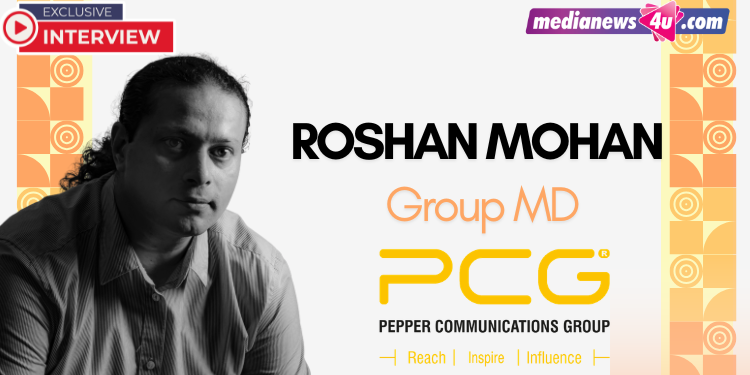
Pepper Communications Group (PCG) is an integrated communications firm built on over a decade of expertise across Public Relations, Social Media, Influencer Marketing, and Visual Communications.
It comprises the following units –
Pepper Interactive – for handling corporate communications, public relations & social media
Gig1 – for handling Influencer Marketing
StudioTronics – for handling visual communications
Pulse – for advertorial and branded content
MediaNews4U.com caught up with Roshan Mohan, Group MD, PCG
Q. PCG offered Integrated Services from the very first year. How did that strategy help win clients and scale quickly?
It was hard initially, because the industry was very clearly segmented – there were ‘PR’ agencies and there were ‘social’ agencies, and most clients were conditioned to think in those silos too. We were making an argument that hadn’t been proven at scale in India yet.
But the moment we started building case studies that demonstrated real, cross-disciplinary impact – where a well-placed editorial story amplified a social campaign, or where influencer content gave legs to a product launch – the conversation changed. Clients could see the multiplier effect.
Q. What goals have been set for PCG in 2026 and what is the gameplan to get there?
2026 is genuinely one of our most ambitious years. We established Pulse – our branded content division – in 2025, and that’s now hitting its stride. Earlier this year, we launched Tharaa Labs in Dubai, targeting the MENA region, which is focused entirely on AI visual content production – generative video, brand voice modelling, multilingual content and Influence at scale.
We’ve also partnered with FlowBlinq to offer AI visibility performance automation and ACP [Agentic Commerce Protocol] as a service, which is about helping brands understand and improve how they show up in AI-generated responses and citation ecosystems – something that’s becoming critical as search behaviour evolves.
Beyond that, we’re expanding into new cities in India, developing new formats of integrated services, and building proprietary tools for the communications sector, driven by the mainstreaming of urbanisation or further urbanisation of regions. The throughline across all of it is deeper integration into AI – not just as a utility, but as a structural part of how we deliver work.
Q. How does PCG help brands take a cross-disciplinary approach to grow?
The way we’re structured means a client isn’t working with a PR team that occasionally talks to a social team. The disciplines sit together, plan together, and report against shared outcomes. When we onboard a brand, we start by understanding their business goals – not just their communications goals – and then we reverse-engineer the right mix of earned media, digital, content, and influence to serve those goals.
The result is that a single brief can spawn a coordinated campaign across formats and channels, rather than parallel executions that happen to share a logo. That coherence is what builds brand equity over time, rather than isolated moments of coverage or virality.
Q. How is the framework of C.I.T.E – Collaboration, Integrity, Transparency, and Ethics – helping the agency command fair remuneration?
C.I.T.E is less a commercial strategy and more a statement of who we are and how we want to work. When clients see that we’re genuinely collaborative – that we treat their business problems as our own – and that we’re transparent about what’s working and what isn’t, it builds a different kind of relationship. Fair remuneration follows from that trust.
Clients don’t haggle as hard when they believe in the quality of your thinking and the honesty of your reporting. Ethics, in particular, is something we take seriously in an industry that has sometimes earned its reputation for spin. We’d rather let go of a brief than compromise on that.
Q. When you talk to clients, is declining attention spans their biggest concern in a rapidly shifting media environment?
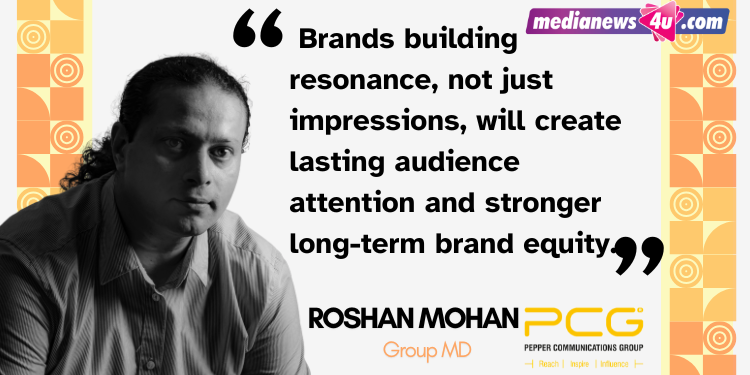
Attention spans are a concern for everyone – including us. But I’d reframe this challenge slightly. The real challenge isn’t that people can’t pay attention; it’s that they choose very deliberately what they give their attention to. The bar for earning that attention is higher than it’s ever been. So the focus has to be on creating conversations that are genuinely sticky – that land with meaning and stay in memory – rather than chasing impressions that vanish the moment someone scrolls past.
Brands that understand this shift from volume to resonance are the ones building durable equity in the minds of their audiences.
Q. In a rapidly shifting media environment, how important is it to challenge the status quo and not get complacent?
It’s existential, frankly. Complacency in any business is a slow death sentence. In communications, you cannot do a ‘formula’. What worked two years ago may be irrelevant today – formats, platforms, audience behaviours, the media landscape itself – all of it is in constant flux.
PCG has, in most instances, been ahead of these shifts rather than reactive to them. We believed in an integrated approach in 2013! We formally launched a visual communications division in 2019. We were building on AI tools before most agencies had a policy on it. Our team was being trained on AI Tools in 2021. Innovation and freshness aren’t just values we put on a slide – they’re what keeps us business relevant and competitive.
Q. When PCG pitches for new business, how much time is spent understanding the client’s business goals?
It’s the foundation of everything. We have a structured process where we spend several days – sometimes weeks – on research before a pitch. That means understanding the client’s category, their competitive landscape, their growth ambitions, where they’re struggling, and what success actually looks like for their business – not just for their communications function. We ask tough questions to the client.
A strategy that isn’t grounded in genuine business understanding is just creative wallpaper. The research phase is what allows us to walk in with thinking that feels specific and earned, rather than templated.
Q. AI is reshaping the PR and communications industry. How is PCG leveraging this?
We’ve enabled AI-driven automations wherever we responsibly can – in research, content workflows, and reporting. We use AI tools for competitive intelligence, media monitoring, and certain types of content production. But the most significant expression of our AI commitment is Tharaa Labs – our AI visual content division – which is producing generative video, multilingual content pipelines, and brand voice modelling at a scale and speed that simply wasn’t possible before.
That said, data privacy is a genuine constraint. There’s a ceiling to how deeply AI can be embedded in client work given the sensitivity of the information involved, and we’re thoughtful about where that line sits. We are working on some solutions for this and we’ll announce the same soon.
Q. As a result, does PCG focus a lot on upskilling its employees?
Absolutely, and it is both structured and ad hoc. We run internal workshops and bring in external trainers every other month for pre-identified areas. Sometimes, we also feel a lack of skills in a particular section and there are adhoc training sessions for that.
We’ve had sessions by working journalists – which gives our teams a perspective on how media professionals think and what they actually find useful. We invest in paid online programmes. And importantly, we’ve been training our people on AI tools since early 2022 – well before it became an industry conversation. The goal is that our teams are never behind the curve, and that they’re confident working with new tools rather than threatened by them.
Q. Disney recently laid off entire PR divisions. Someone said that cutting PR doesn’t make stories go away – it only means you’re not the one telling them. Your views?
That line says it all, really. PR has been a part of human society since the days of town criers – the form has always changed, the function never has. People, institutions, and brands will always need to communicate, build reputation, manage perception, and respond to the world around them. What changes is the channel, the format, the speed.
Elon Musk ‘fired’ his PR team a while ago, but that essentially means he took control of his own narrative instead of letting a team of people handle it. He also did that when he was a mature ‘brand’ himself – a perception, carefully crafted, was already established.
A brand that steps away from actively shaping its narrative doesn’t create silence – it creates a vacuum that others will fill. Cutting a PR function is a short-term financial decision with long-term reputational consequences. That story doesn’t go away. It just gets told by someone else.
Q. What role is data analytics playing in helping PCG sharpen storytelling?
Data gives us more precision and more agility. On the precision side, it means we’re not relying on instinct alone when crafting a story – we can see what angles are resonating, which journalists and publications are driving meaningful engagement, and what the audience actually responds to. On the agility side, it means we can course-correct mid-campaign rather than waiting for a quarterly review to find out something isn’t working. The combination of sharper targeting and faster iteration makes storytelling more effective – and makes it much easier to demonstrate that effectiveness to clients.
Q. A lot of brands are trying to figure out how to communicate with Gen Alpha. What tactics would work?
Every generation has demanded new formats and new approaches – that’s not unique to Gen Alpha. What strikes me is the anxiety around this particular cohort, as though the existence of many communication channels is somehow more paralysing than fewer.
If anything, there are more ways to reach and engage a young audience today than ever before. The answer isn’t a new tactic – it’s quality. Gen Alpha, like every generation before them, responds to things that are genuine, well-made, and worth their time. PCG has low tolerance for mediocrity, and that’s really the whole answer.
Q. Are brands looking at doing long-term deals with influencers and content creators? What’s the advantage?
We’ve always explored this, and we’d advocate for it. Long-term relationships between brands and creators build something that one-off activations simply can’t – trust. When an audience sees a creator consistently associated with a brand over months or years, it reads as genuine endorsement rather than paid placement.
Repeated mentions create stickiness; the brand becomes part of the creator’s world rather than a sponsored interruption. There’s also a practical benefit: the creator understands the brand deeply, which means the content gets better over time. It’s a more mature model, and we expect it to become the norm rather than the exception.
Q. In terms of tools to measure the effectiveness of PR and communications, what would you like to see happen?
The tools that exist today are largely built for Western markets and Western media ecosystems. India is a different beast – the nuances of regional media, the way influence travels through vernacular channels, the relationship between print and digital credibility here – none of that is well-served by generic measurement frameworks. We’d like to see tools that genuinely understand Indian market realities.
Beyond that, we’re developing proprietary methodologies at PCG that can give clients a clearer, more meaningful picture of communications effectiveness – one that doesn’t just count clips but actually connects to business outcomes. That’s the gap we’re working to close.