For years, residential real estate marketing in India revolved around a familiar formula—location, pricing, amenities and possession timelines. Today, however, the category is witnessing a creative shift, with developers increasingly embracing cultural relevance, differentiated storytelling and consumer insights to build stronger emotional connections with homebuyers. Among the brands leading this evolution is Casagrand, which has consistently challenged category conventions through campaigns such as “UP- ARTMENT,” “No More Swalpa Adjust Maadi” and “We Are Sorry Bengaluru,” alongside celebrity-led narratives featuring Chiyaan Vikram, Hrithik Roshan, Samantha Ruth Prabhu, Kareena Kapoor Khan and others.
In this edition of MediaNews4U Leaderspeak, Diptakirti Chaudhuri, Chief Marketing Officer, Casagrand, discusses why product truth must precede creativity, how hyperlocal consumer insights shape every campaign, the role of storytelling in accelerating business outcomes, and why creating aspiration has become as important as communicating specifications in today’s real estate marketing landscape.
Excerpts:
1) Residential real estate advertising has traditionally been dominated by location, amenities, pricing and possession timelines. What has changed in the consumer mindset that now makes differentiated storytelling and cultural relevance more important?
Diptakirti Chaudhuri: Location, pricing, amenities and possession timelines remain the fundamental pillars of every home purchase. Consumers continue to evaluate these aspects very carefully because buying a home is one of the most significant financial and emotional decisions they make, often only once in their lifetime.
However, while these functional attributes are essential, they are rarely what captures a consumer’s attention in the first place. Like every other category, real estate marketing today must first engage people emotionally before presenting them with facts. Consumers don’t respond to a barrage of specifications; they respond to stories that make them curious, evoke pride, create aspiration, or simply make them smile.
At Casagrand, we believe the buying journey begins by creating desirability. Before consumers evaluate square footage or financing options, they should feel emotionally connected to the idea of living in that home. Whether through humour, cultural relevance, emotional storytelling or an unconventional creative idea, our objective is to make the property memorable before discussing its functional strengths.
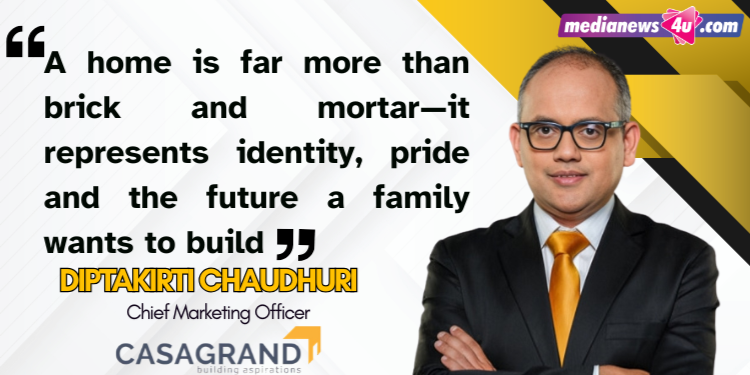
A home is far more than a physical structure. It represents aspirations, identity and a placewhere families build their future. Our storytelling reflects those emotions while ensuring the product fundamentals remain central to the decision-making process.

2) As CMO, how do you decide when a project deserves a disruptive, insight-led campaign versus a more conventional launch? Is there an internal filter or framework for that call?
Diptakirti: Given the opportunity, I would prefer every Casagrand project to have an element of disruption. However, disruption shouldn’t be mistaken for being loud, shocking or quirky for its own sake. True disruption is about earning consumer attention by presenting something fresh, relevant and unexpected.
Our objective is to create that positive interruption that encourages consumers to pause and engage with the brand. Sometimes that comes through humour, sometimes through cultural insights, sometimes through aspiration, and in other cases through celebrity-led storytelling. The creative route changes depending on the product and the audience, but the objective remains consistent—to create meaningful engagement.
Where campaigns differ is in the scale of execution rather than the philosophy. Factors such as project size, launch objectives, inventory, investment and sales targets determine the extent of media deployment, including television, print, outdoor and digital. While the launch mechanics may vary, our underlying ambition is to ensure every communication stands apart from category conventions and captures consumer attention.
3) Casagrand appears to resist a one-size-fits-all communication approach. How do you identify the central narrative or creative territory for each project?
Diptakirti: Every campaign begins by identifying the intersection between what our product genuinely offers and what the intended customer segment is seeking.
Although every homebuyer looks for quality, timely delivery and value, customer expectations differ significantly across micro-markets. Even within a city like Chennai, the needs of buyers in different locations can vary dramatically depending on family structures, occupations, lifestyles and future aspirations.
We invest heavily in understanding these nuances. Our product development team continuously studies consumer behaviour, architectural trends, urban development and demographic shifts to ensure each project is designed around the needs of its target audience.
For example, a project located near Chennai’s IT corridor naturally caters to young technology professionals who are entering a different stage of their lives compared to buyers in more established residential neighbourhoods. Their expectations around apartment configuration, future family requirements and lifestyle amenities are therefore very different.
The communication narrative emerges only after we align these consumer insights with the product proposition. Rather than imposing a creative idea onto every project, we allow the product and the target audience to define the story.
4) What comes first in your marketing process: the product proposition, a consumer insight, a cultural tension, or the creative idea?
Diptakirti: The product always comes first.
Everything begins with ensuring that the product itself addresses a genuine consumer need. Once the product proposition is clearly defined, we evaluate which features create the strongest differentiation within the market.
That process often reveals the consumer insight that will eventually shape the campaign. In some cases, the insight emerges from understanding a specific customer need. In others, it comes from recognising the most compelling way to present the product creatively.
Only after the product proposition is established do we develop the communication strategy and creative expression. The sequence is therefore quite deliberate: the product defines the opportunity, consumer insight identifies the emotional hook, and creativity brings that proposition to life in a way that stands out.
Ultimately, our creative ideas are always rooted in product truth rather than creative ambition alone.
5) Campaigns such as “UP-ARTMENT”, “No More Swalpa Adjust Maadi” and “We Are Sorry Bengaluru” are markedly different from conventional real estate communication. What is the common marketing philosophy connecting these campaigns?
Diptakirti: The common thread across all these campaigns is that they begin with a deep understanding of the customer and the product truth. Once we clearly define who our ideal customer is, based on factors such as location, price point, apartment configuration and lifestyle aspirations, we look for a distinctive way to engage them.
Rather than beginning with product specifications, we first seek to capture attention through an idea that is culturally relevant, emotionally engaging or creatively disruptive. Our objective is to make people pause, smile, become curious and ultimately want to know more about the project.
Take “No More Swalpa Adjust Maadi” for example. “Swalpa Adjust Maadi” is a phrase that almost everyone living in Bengaluru understands, regardless of whether they are Kannada-speaking or not. It reflects the compromises people routinely make in city life. We used that familiar cultural expression to communicate that homebuyers no longer needed to compromise on location, size, amenities or affordability because our project addressed those trade-offs.
Similarly, “UP-ARTMENT” emerged from a very different business challenge. As a relatively newer player in Hyderabad, we wanted to immediately signal that Casagrand was bringing something beyond the ordinary apartment experience. The campaign positioned the project as something elevated—almost literally above the rest of the market. That thinking extended beyond advertising into execution, including floating visual effects on outdoor media and a large-scale drone show over Hussain Sagar Lake, reinforcing the idea that this wasn’t just another apartment launch.
Across all these campaigns, the philosophy remains consistent. We start with the product truth, identify the strongest consumer insight and then translate it into an idea that creates curiosity before presenting the product’s functional benefits. Once we have earned the consumer’s attention, conversations around pricing, financing, apartment size and amenities become far more meaningful.
6) Casagrand operates across markets with distinct languages, cultures and home-buying behaviours. How different is your marketing playbook from Chennai to Bengaluru, Mumbai and other markets?
Diptakirti: Our marketing playbook changes significantly across markets because every city has its own cultural context, consumer behaviour and level of brand familiarity.
In Chennai, Casagrand enjoys the advantage of being a home-grown brand with more than two decades of presence and thousands of completed homes. Awareness is already high, so our communication is largely project-centric. We don’t need to repeatedly introduce the brand—we focus instead on matching individual projects with the right customer segments. Community engagement, neighbourhood activations and word-of-mouth advocacy therefore play a much larger role than simply increasing brand visibility.
As we enter newer markets such as Bengaluru and Hyderabad, the challenge is very different. Consumers first need to understand who Casagrand is before they consider buying from us. Marketing therefore has to establish credibility alongside product differentiation.
That is where cultural relevance becomes extremely important. Campaigns such as “No More Swalpa Adjust Maadi” were rooted in a phrase that is universally understood in Bengaluru, while “We Are Sorry Bengaluru” humorously addressed a local consumer reality—shrinking apartment sizes in a rapidly growing city. Our project offered significantly larger homes, so the campaign apologised, tongue firmly in cheek, for “taking up more space.”
Similarly, in Hyderabad, we partnered with personalities such as Venkatesh Daggubati, Nani and Samantha Ruth Prabhu, selecting each based on the project’s positioning rather than adopting a single communication template.
While the creative execution differs from market to market, the underlying philosophy remains constant: every campaign should be rooted in either a strong cultural insight or a universally relatable consumer truth.
7) Across Kareena Kapoor Khan, Samantha Ruth Prabhu, Hrithik Roshan, Sourav Ganguly and Genelia & Riteish Deshmukh, each campaign pairs a different celebrity with a different city and project. How is the ambassador-to-project fit actually decided? What role do they play beyond delivering reach and recall?
Diptakirti: We don’t believe in assigning celebrities simply for visibility. Every ambassador is selected because their personality strengthens the positioning of a specific project.
At the corporate level, Sourav Ganguly represents Casagrand because his journey reflects qualities we admire as an organisation—leadership, resilience, transformation and the ability to redefine established norms. Those attributes align closely with our own ambition of challenging conventional real estate thinking.
At the project level, however, the choice is entirely proposition-led.
For premium developments targeting cosmopolitan audiences, someone like Hrithik Roshan brings sophistication, aspiration and a contemporary global appeal that complements the project’s positioning.
For projects in Tamil Nadu aimed at a broad spectrum of buyers, Chiyaan Vikram offers unmatched credibility and screen presence. When he speaks about bringing a “revolution” in housing, audiences naturally pay attention because of the authority he commands.
In Hyderabad, Venkatesh Daggubati helped establish trust and familiarity during our early market entry, while Samantha Ruth Prabhu was chosen for luxury developments that required a more premium, aspirational image. Different projects demand different personalities.
There are also several Casagrand launches where we deliberately choose not to use celebrities at all. The decision is never driven by scale alone. We first evaluate whether a celebrity genuinely strengthens the communication. If they can amplify the proposition, we collaborate with them. If not, the product itself becomes the hero.
Ultimately, celebrities are not just awareness generators—they accelerate attention, enhance credibility and help consumers engage with the project’s story much faster than conventional communication alone.
8) You’ve spoken about near-sellouts and accelerated sales momentum within days of launch. Can you share what “success” looks like in hard numbers—booking velocity, cost per lead, footfall conversion—for a campaign like “We Are Sorry Bengaluru” versus a traditional launch?
Diptakirti: Success is measured across multiple business and marketing metrics rather than through a single KPI.
Naturally, every project has clear sales targets and defined marketing budgets. Alongside those commercial objectives, we closely monitor the momentum generated during the first few days of launch because that period is critical in establishing market confidence.
Strong opening-weekend sales don’t just influence customers; they also create confidence among channel partners, brokers and the broader market ecosystem. A successful launch generates positive momentum that sustains demand well beyond the initial campaign.
Campaigns that successfully break through clutter consistently produce higher footfalls, stronger enquiry volumes and faster sales velocity.
A good example is Casagrand Moon Bay, promoted through the “No More Swalpa Adjust Maadi” campaign, which became one of our fastest-selling launches in recent years. The campaign generated significant curiosity, encouraging consumers to visit the project even before they had fully evaluated every specification.
Our objective is always to maximise first-weekend buzz and footfalls. Once consumers experience the project firsthand, the quality of the product, pricing and overall value proposition take over.
Creativity, therefore, doesn’t replace performance marketing—it amplifies it. Strong storytelling creates the initial momentum, while the product itself delivers the conversion.

9) As Casagrand expands into newer markets, can marketing become the first instrument for building familiarity and trust even before the brand establishes a large physical footprint?
Diptakirti: Absolutely. The role of marketing evolves significantly when entering a new market. In established markets such as Chennai, where Casagrand has built homes for over two decades and enjoys strong brand equity, marketing is largely project-led because consumers already know and trust the brand.
However, in newer markets like Hyderabad and Bengaluru—and as we expand into Pune—the first responsibility of marketing is to introduce Casagrand as a credible, trustworthy developer before consumers even begin evaluating individual projects.
That is why our communication in newer markets focuses not only on the product but also on building brand familiarity. We use culturally relevant storytelling, carefully chosen brand ambassadors and differentiated campaigns to answer the most fundamental consumer question: “Who is Casagrand?”
As the brand matures within a market and more customers experience our developments, the communication gradually transitions from establishing credibility to highlighting individual projects and their unique propositions.
Our long-term objective is to build Casagrand into a respected and aspirational brand in every market we enter. Once that trust is established, project marketing becomes significantly more effective because consumers already have confidence in the developer behind the project.
10) How has Casagrand’s media mix evolved as the homebuyer journey has become more fragmented across search, social, video, influencers, portals and physical experiences?
Diptakirti: The homebuying journey today is no longer linear. Consumers move seamlessly between print, outdoor, search, property portals, social media, video platforms, influencers and physical site visits before making a purchase decision. Our media strategy has evolved to reflect that behaviour.
Digital today is unquestionably our largest medium because it allows us to remain present throughout the consumer journey—from awareness and consideration to lead generation and remarketing.
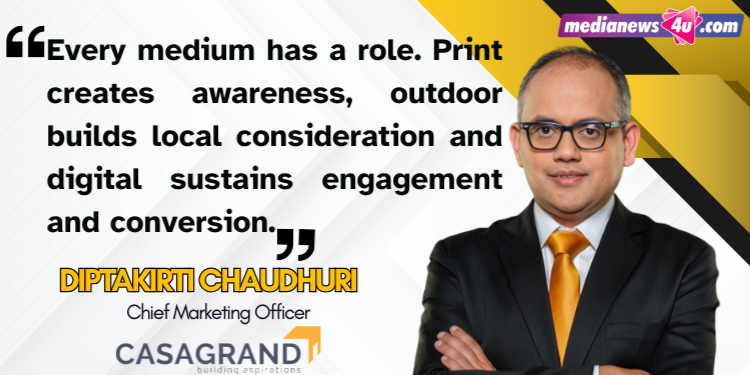
That said, every medium has a distinct role. Television, print and outdoor are primarily deployed during launches to generate maximum visibility and create initial excitement. Once awareness has been established, digital platforms sustain engagement through continuous communication and performance-led optimisation.
Outdoor remains particularly effective because real estate is inherently a location-driven business. Project-specific outdoor advertising acts as a last-mile reminder for consumers already considering a purchase within a particular micro-market, while brand-led outdoor communication reinforces Casagrand’s reputation across the city.
Print also continues to play an important role, particularly during launches. Although it may not directly generate leads, it often serves as the first point of awareness, sparking conversations and encouraging consumers to explore the project further through digital channels or site visits.
Rather than assigning fixed percentages to each medium, we build the media plan around the
launch timeline, campaign objectives, market maturity and creative assets available. The objective is to ensure every platform contributes meaningfully to the overall customer journey rather than functioning in isolation.
11) In real estate, digital marketing is often reduced to lead generation. How are you using digital platforms for brand-building and storytelling rather than only performance marketing?
Diptakirti: Performance marketing continues to remain the backbone of digital investments because it directly contributes to enquiries and conversions. However, digital today offers far greater opportunities than simply generating leads.
We increasingly use digital platforms to tell richer brand stories and engage consumers over an extended period. Instead of relying on a single advertisement, digital enables us to build sequential storytelling, where different creative assets communicate different aspects of a project as consumers progress through their buying journey.
Influencer collaborations also play an important role. Influencers often present projects in a more authentic and relatable manner, reaching audiences that traditional advertising may not engage as effectively. They help generate curiosity while showcasing the lifestyle, experience and emotional aspects of homeownership.
Our approach is therefore a balanced one. Performance marketing continues to drive measurable business outcomes, while storytelling and content marketing strengthen brand affinity, improve consideration and create deeper consumer engagement over time.
Ultimately, we see digital not merely as a lead-generation engine but as a platform for building long-term relationships with prospective homebuyers.
12) What do you expect from agency partners today that is different from what a real estate marketer would have expected a few years ago?
Diptakirti: The fundamental expectation from agency partners remains unchanged—they must continue to deliver breakthrough creative ideas that help brands stand out.
What has changed, however, is the pace at which consumers, media platforms and technology are evolving. Customer behaviour today is changing far more rapidly than it did even a decade ago, driven by digital platforms, social media, artificial intelligence and constantly shifting content consumption habits.
As a result, agencies today must contribute much more than creative execution. They need to possess a deep understanding of evolving consumer behaviour and proactively identify emerging trends before brands do.
At Casagrand, we encourage our agency partners to spend time at our project sites, interact directly with homebuyers and observe how consumers think, behave and make purchase decisions. Those interactions provide valuable insights that often shape stronger creative ideas and more relevant communication.
We also operate with a hybrid model. Casagrand has a large and highly capable in-house creative and digital marketing team, while external agencies contribute specialised thinking, fresh perspectives and additional creative capabilities. Depending on the project, we evaluate ideas from both teams and adopt the strongest solution.
Going forward, the most valuable agency partners will be those who combine creative excellence with deep business understanding and an intimate knowledge of changing consumer behaviour.