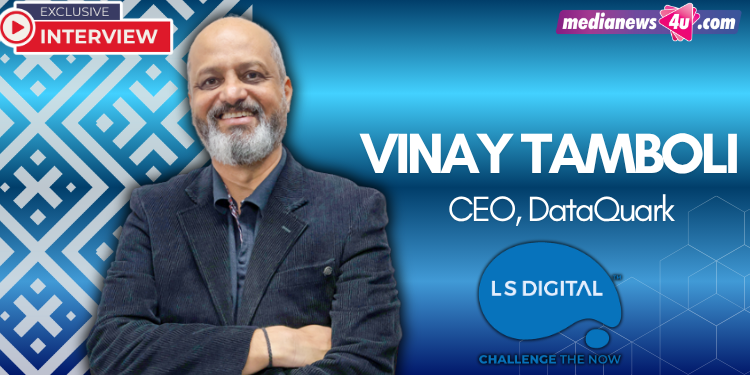
Medianews4u.com caught up with Vinay Tamboli, CEO, DataQuark, LS Digital around the recent launch of QuarkAssist, a modular data platform designed to help enterprises address data fragmentation and operationalise data across business functions.
As organisations continue to scale across multiple digital channels, data today remains spread across analytics tools, CRM systems, marketing platforms, and operational databases, making it difficult to build a unified view and drive actionable outcomes. QuarkAssist has been developed to solve this challenge by bringing together data across systems into a single, reliable source of truth, enabling faster activation across marketing, analytics, and operations.
Q: Most enterprises today don’t have a data problem, but a data fragmentation problem. How is it emerging as a key barrier to growth?
Across the industry, organisations have made deep investments in data—audience measurement tools, CRM systems, campaign platforms, OTT analytics, subscription data, and ad-tech stacks. The challenge is not data availability, but the lack of integration and continuity across these systems.
In practice, this shows up in everyday inefficiencies. A content team cannot see real-time viewer engagement across platforms. Marketing teams lack a unified view of who watched, clicked, or converted across campaigns. Sales and ad operations work with lagged or incomplete audience insights. This is data fragmentation—where rich signals exist, but remain locked in silos across platforms, channels, and teams.
For media and entertainment businesses, this disconnect has direct commercial implications. Audience behaviour and consumption signals—critical for personalization, programming decisions, and ad targeting—fail to combine with transactional and campaign data. As a result, opportunities to optimize content, pricing, and monetisation in real time are lost.
 Q. What’s the real bottleneck in moving from insight to action: is it data, or is it organizational?
It is both.
Most enterprises assume the bottleneck is data. They invest in better dashboards, faster pipelines, more models. But they already have data. What they lack is organizational coherence and alignment between the teams using that data.
When a data team finds a churn pattern, but the product team doesn’t have budget to act on it this quarter, that is an organizational bottleneck. When marketing wants to test a personalization idea but needs sign-off from compliance, legal, and privacy before activating, that is an organizational bottleneck. When an agent identifies an anomaly, but no one owns the decision to respond to it, that is an organizational bottleneck.
The organizations moving fastest are not the ones with the best data. They are the ones with the clearest decision rights, the fastest approval chains, and alignment on what matters. They know who owns what decision. They have decided in advance what agents can do without human review, and what requires escalation. They have built processes where data teams, product teams, editorial teams, and business teams move together.
Data coherence is necessary. But it is not sufficient standalone. You also need organisational coherence.
Q. In Media, Advertising, and Entertainment, audience and campaign data often sits across disconnected platforms—from CRM and OTT analytics to ad-tech and media buying tools. Is this fragmentation driving the need for a unified, real-time “single source of truth” to power better targeting, measurement, and monetisation?
Yes, but “single source of truth” is misleading. Enterprises do not need to consolidate all systems into one monolithic database. That approach of “rip and replace” fails because it is slow and disruptive.
What enterprises need is a unified logical view of customer and behavioral data, even if data lives in multiple physical systems. This is the coherence layer.
A customer’s complete picture involves data from multiple systems: transaction systems, CRM platforms, digital channels, third-party sources. These systems were built independently for different purposes. Consolidating them takes 18-24 mont[AS1] [KA2] hs and creates massive disruption.
The smarter approach: create a coherent bridge, a data layer that understands how systems relate, reconciles the same customer across different IDs, and pipes unified context to decision-makers and agents in real time. This is operationalisation without disruption.
Q. How are platforms like QuarkAssist enabling businesses to work with existing systems instead of replacing them, making adoption seamless and less disruptive?
The core principle is modularity and co-existence. QuarkAssist does not ask enterprises to rip out existing systems. It sits as a coherent layer that understands how systems relate, brings behavioral and customer data together, and activates that unified view across the organization.
Teams can keep core systems untouched and layer QuarkAssist on top to create a unified view of customer context. Different teams suddenly have access to coherent data, without the 18-month migration project. Agents can now operate on clean, unified, trustworthy data. Humans can supervise and guide those agents with full context.
Adoption becomes seamless because the change is not disruptive. Teams get access to better data without re-learning systems or losing continuity. Implementation happens in weeks, not years. Pilots can run in parallel with existing operations, mitigating risk.
 Q. How do you prevent data-driven optimisation from destroying editorial voice or brand value?[AS3]
Data-driven optimisation is incredibly powerful, but if you’re not careful, it can very quickly push you into a cycle of chasing clicks rather than building a brand. In media and entertainment, that’s a real risk—because what performs in the short term is not always what builds long-term audience trust and distinctiveness.
The way to navigate this is by setting very clear editorial guardrails upfront. Your tone, your storytelling depth, your point of view—those are non-negotiable. Data should help you amplify that voice, not dilute it.
Secondly, it’s important to differentiate between signals and decisions. Metrics like clicks or watch time are useful signals, but they shouldn’t be the sole drivers of editorial choices. If you over-index on them, you end up with homogenized, algorithm-friendly content that lacks originality.
Where data really adds value is in optimizing how you tell stories—formats, timing, distribution—not necessarily what you stand for. The best organizations create tight collaboration between editorial and data teams, so insights inform creativity without overriding it.
Finally, you have to consciously invest in content that may not win immediately on performance but builds long-term brand equity—whether that’s premium storytelling, investigative work, or unique formats.
At the end of the day, the goal is balance. The strongest media brands today are not data-led or editorial-led—they are editorially driven and data-informed.
Q. What does alignment look like between data, product, editorial, and business teams?
Data team optimizes for data quality. Product team optimizes for feature velocity. Editorial team optimizes for voice and integrity. Business team optimizes for revenue. Each is right in their own context. But if they are not aligned on shared outcomes, they will pull in different directions.
Alignment means agreement on what problem you are solving together, clarity on what each team owns, and shared metrics on progress.
For example, a streaming platform might have these shared outcomes: grow engaged subscribers (not just subscribers), increase share of watch time with original content (not just licensed content), build trust metrics alongside engagement metrics. Now different teams can own different pieces without conflict. Data owns the data pipeline and agent governance. Product owns feature development. Editorial owns content strategy. Business owns monetization. But they are all working toward the same outcomes.
Without this, you get the classic dysfunctions. Product ships a personalization feature that editorial opposes because it feels like manipulation. Data builds a churn prediction model that sales ignores because they do not trust it. Business pushes for growth at any cost while editorial draws red lines. Everyone is frustrated.
The organisations that solve this are not the ones with the best tools. They are the ones with the most mature operating model. They have explicit conversations about shared outcomes, clear RACI matrices, and regular forums where misalignment surfaces and gets resolved.
QuarkAssist enables this by being the system of record for data. If different teams are debating what the data says, at least they are debating from a single source of truth. But alignment is organizational, not technical.
Q. How do you ensure agents are operating within guardrails without human review overhead?
If you require human review of every agent action, you lose the speed benefit of automation. But if you give agents unlimited autonomy, you create risk. The answer is bounded autonomy with escalation.
Here is how it works: agents are given a clearly defined scope. They can act A, B, and C on data of types X, Y, Z in circumstances W. They maintain an audit trail of everything they do. When they encounter edge cases or exceptions, they escalate to humans.
For example, an agent might be: “Identify subscribers showing churn signals. Prepare personalised retention offers based on their viewing history. Send those offers via email.” That agent can do all of that without human review. But if the subscriber is a VIP account, or if the recommended offer conflicts with an active promotion, the agent escalates.
The key is getting the guardrails right. Too tight, and you create bottlenecks. Too loose, and you create risk. You find the right balance through iteration. You deploy an agent with guardrails. You monitor what it escalates. You learn from escalations about whether the guardrails need adjustment.
Governance infrastructure is critical here. You need systems that can enforce constraints automatically: role-based access controls, approval workflows for certain actions, audit trails of everything. You need tools that allow different teams to define their own constraints without requiring engineering changes. You need visibility into what agents are doing so you can catch problems early.
Organisations that scale automation well are obsessive about guardrails and escalation. They would rather be conservative early (escalate more) and relax constraints over time as they gain confidence. Organizations that crash on automation are the ones that tried to scale trust too fast.
 Q. How do you move faster without your data stack becoming a compliance and governance nightmare?
Compliance and governance exist for good reasons. You need to know who accessed what data and why. You need to ensure customer data is protected. You need to verify that agents are operating within bounds. You need audit trails for regulatory requirements.
But implementing compliance and governance naively slows you down. You require approval for every change. You add signing authority for every decision. You audit everything after the fact. Now you have moved from weeks to months because you are managing risk so carefully.
The answer is to build compliance into the architecture, rather than bolting it on afterward.
For example, instead of asking “can this user access this data?” after they request it, build role-based access controls that prevent unauthorized access in the first place. Instead of auditing agent behaviour after it happens, design agents so their actions are auditable by default. Instead of reviewing every decision, define clear guardrails and only escalate decisions that violate guardrails.
This requires investment upfront. You spend time thinking through what constraints matter and how to enforce them automatically. But once you have that architecture, you move fast while maintaining compliance. Teams can iterate without waiting for approval because the system enforces constraints automatically.
Different organizations have different compliance requirements. A broadcaster has different concerns than a publisher. A publisher has different concerns than a streaming platform. There is no one-size-fits-all answer. But the principle is the same: move compliance into the system, not into the approval process.
Q. How does QuarkAssist simplify workflows by enabling teams to collect, collate, and activate data across functions, ensuring automation serves decision-makers, not replaces them?
Automation should not replace human decision-makers. It should accelerate coherent data flow to decision-makers and handle routine operations at scale.
QuarkAssist automates data plumbing: collection, transformation, movement between systems, while keeping decision-making human centered. Intelligent agents extract data from source systems, reconcile it, identify patterns, and execute routine tasks. But decisions to act, choices of intervention, judgments about context those stay with humans.
In fraud scenarios, an agent flags suspicious transactions and initiates preliminary checks. The decision to block or verify remains with risk teams. In audience analysis, an agent identifies patterns and flags preferences.
Editorial decisions about content prioritisation remain with leadership. In customer engagement, an agent identifies at-risk customers and prepares recommendations. The decision to contact them, what offer to extend, what approach to take, remains with the owner.
This human-in-the-loop approach is critical. First, it maintains accountability. Decision-makers stay responsible. Second, it preserves judgment. Business decisions require contextual understanding algorithms cannot capture strategy, relationships, long-term thinking. Third, it ensures transparency. Decision-makers see what informed recommendations, what agents did, and why, and can choose differently if judgment suggests it.
The simplification comes from automating routine, low-level data operations that consumed manual time of extracting, joining, cleaning, segmenting, executing standard workflows are now freeing teams to focus on actual decisions that matter.
Q. Can you walk through what it looks like when an organization has data coherence AND organizational alignment?
We worked with one of India’s largest OTT platforms. Their problem was simple: they were optimizing content and marketing spend based on fragmented signals. Online data showed what people watched. Marketing data showed what campaigns drove subscribers. But they had no unified understanding of how marketing investments across channels actually influenced viewing behaviour and subscriber value.
We deployed Meridian, an MMM Model, on a coherent data layer that merged offline and online signals. We unified viewing behaviour, subscription data, marketing spend across all channels, customer service interactions, and retention patterns. Suddenly, they could see the true relationship: which marketing channels actually drove which types of viewers, how subscriber acquisition quality varied by channel, what drove retention beyond the initial conversion.
Meridian revealed that their content investment strategy was misaligned with marketing reality. Their marketing was optimizing for volume, but Meridian showed they needed to optimize for viewer quality and long-term retention value.
Here came the organizational alignment. Editorial team, product team, and marketing team used Meridian outputs to set shared outcomes: “We grow engaged subscribers through original content, marketed efficiently across channels, with focus on retention value not just acquisition volume.” They deployed agents to optimize marketing spend and content recommendations — but only within constraints that Meridian defined about what actually drives subscriber value.
What happened: marketing could allocate budget fast because they had clarity on what actually worked. Editorial could invest confidently because Meridian showed which content drove high-value subscribers. Product could ship features that improved the signals Meridian was using. Business revenue grew because teams moved together using the same ground truth about customer value.
The coherent data layer and Meridian made this possible. But the real competitive advantage was organizational alignment — when teams share the same understanding of causation (not just correlation), they move with precision.
This is an organizational maturity problem enabled by the sophistication to deploy MMM models on unified data. The technology enables it. But the real work is alignment.
 Q. What trends are shaping how enterprises think about automation, governance, and the role of humans in data-driven organizations?
Three shifts are happening:
First, from “let’s automate this” to “let’s automate this safely.” Organizations are moving past the initial excitement of agents and automation. They are asking: How do we scale automation without creating uncontrolled risk? This means investment in governance infrastructure, escalation patterns, and human oversight mechanisms. It means being intentional about what gets automated and what stays human.
Second, from “data team owns data” to “every team owns their own decisions.” Organisations are realizing that data access is not enough. Every team needs to understand the data they rely on, trust the decisions being made on their behalf, and have ownership of outcomes. This is pushing toward federated governance models where different teams define their own constraints within a coherent framework.
Third, from “faster is always better” to “we need to move fast AND maintain trust.” The organizations that win long-term are not the ones that optimize for velocity. They are the ones that balance velocity with integrity. They move fast, but not at the cost of editorial standards, customer trust, regulatory compliance, or team alignment. This requires deliberate choices about what cannot be optimized, what matters beyond metrics, and how to maintain those values as you scale.
All three trends converge around maturity. The competitive advantage is not moving faster than competitors. It is moving fast while maintaining alignment, governance, and trust.
For enterprises in India building for rapidly growing, digitally native audiences expecting personalized experiences, this is critical. Speed matters. But so does the ability to maintain editorial integrity, build subscriber trust, manage compliance complexity, and keep teams aligned as you scale. The organizations that solve both wins.