Radiowalla is a provider of bespoke audio and digital signage solutions, transforming in-house communication and customer engagement for brands across sectors. With a robust pan-India presence encompassing nearly 30,000+ retail outlets and a rapidly growing footprint in Digital Out-Of-Home (DOOH) advertising, Radiowalla is setting benchmarks in innovative consumer engagement.
Key Differentiators:
1. In-Store Radio Excellence
Radiowalla curates tailored audio content to enhance the in-store experience, trusted by industry giants like Landmark Group, Reliance Value Formats, Jubilant FoodWorks Ltd. (JFL), and Hardcastle Restaurants. The service ensures customer engagement is both impactful and brand-aligned.
2. Corporate Radio Solutions
Radiowalla’s corporate audio solutions are utilized by leading corporations, including Amazon, to engage employees and deliver critical communications effectively. The localized, engaging content helps organizations foster a cohesive workplace environment.
3. Expanding Digital Out-of-Home (DOOH) Network
Radiowalla is at the forefront of DOOH innovation, with dynamic digital signage solutions gaining traction in key regions such as Gujarat and Uttar Pradesh Governments. This cutting-edge technology empowers businesses to captivate audiences with visually compelling, high-impact displays.
4. Market Leadership in Audio OOH Advertising
Reaching over 100 million consumers monthly across 7,000 stores, Radiowalla operates India’s largest audio Out-Of-Home (OOH) advertising network, offering unparalleled scale and targeted marketing opportunities.
Leadership and Vision
Led by CEO Harvinderjit Singh Bhatia and co-founders Anil Srivatsa and COO, Harpreet Singh, Radiowalla is dedicated to pushing the boundaries of audio and digital media innovation. As a publicly listed company, Radiowalla continues to pioneer solutions that redefine consumer engagement and elevate brand experiences.
Medianews4u.com caught up with Harpreet Singh, COO, Radiowalla Network Limited
Q. Most people ignore store background music entirely. How do you prove to brands like Reliance or KFC that your audio channels increase sales?
Today every retailer realises that music is a very critical component of the overall customer experience. The right music sets the mood, makes customers feel comfortable, encourages them to spend more time, and helps create a stronger emotional connection with the brand. Whether it’s a premium fashion retailer or a QSR chain, the music should feel like a natural extension of the brand.
But what we do goes beyond simply playing music. We create expert curated playlists and blend them with branded audio messages that promote offers, new product launches, loyalty programs, or seasonal campaigns. Since customers hear these messages while they’re already shopping and making purchase decisions, the communication is highly relevant and far less intrusive than many other forms of advertising.
When it comes to measuring business impact, we rely on data rather than assumptions. Depending on the campaign, we work with brands to compare similar stores with and without audio campaigns, analyse sales before and after a campaign, track the performance of promoted products and study changes in average basket value. No single metric tells the whole story, but together they provide a clear picture of how in-store audio influences customer behaviour and contributes to sales.
Ultimately, our goal is to help retailers create a better customer experience while giving brands a measurable and effective way to engage customers at the point of purchase.
 Q. When you expand to 10 countries, how do you change the music styles to match what local shoppers there like to hear?
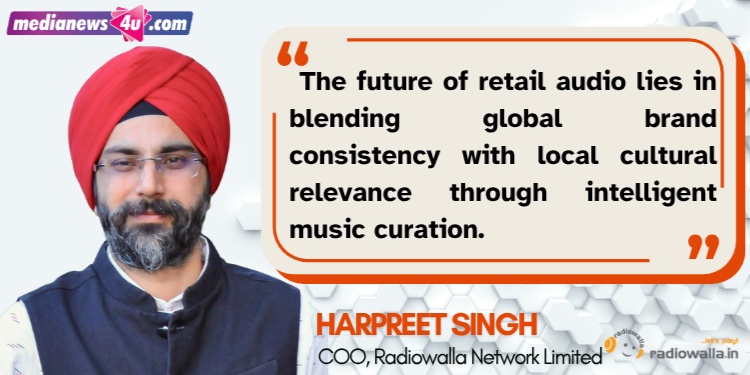
Music is deeply influenced by local language, culture and preferences. There cannot be a one-size-fit-all approach. For each new market we enter, we work closely with the local teams and music curators to understand the cultural nuances for that country or region. The music selection is based on the feedback received from a cross section of people. We even study the various radio stations playing in the region and understand the music mix.
Even as a brand may want to have consistent experience across their operating countries, the exact music selection would be tailored for different customer preferences. We also believe that playlist curation is an ongoing process. We regularly review customer feedback, inputs from store teams, and performance data to fine-tune the music. During local festivals, holidays, or special shopping seasons, playlists are updated to make the experience more relevant and engaging.
Our goal is to strike the right balance between global brand consistency and local cultural relevance
Q. You shifted your business from mass consumer radio to hyper-targeted background audio. What was the biggest technical challenge during that big operational pivot?
When we moved from mass consumer radio to background radio, the biggest challenge was to make the platform work with low last mile bandwidth. Retail stores had limited bandwidth availability and they could not support streaming audio. We had to redesign the player to ensure that the music continued to play in the store even if internet dropped.
We also had to invest heavily in building the platform to support personalization at scale. The announcements, music and playlist for each store should be customizable. Ensuring that this is possible for thousands of retail stores took a fair bit of time and investment.
Now we have a platform that can support all these requirements at scale with very limited manual intervention.
Q. Brands spend heavily on visual ads, but the company says that audio shapes behavior. Why should a major retailer cut visual budgets to fund your music systems?
I don’t think it’s a Visual vs Audio debate at all. Both mediums are important and serve different purposes. Visual media grabs attention and can convey more details with an image or a video. Audio on the other hand is a media that opens the “Theatre of Mind”. It nudges the customer even as the customer is busy shopping. Audio is a skip proof media. You cannot block your ears when you are in the store. You don’t need to take your attention away from your shopping to consume the audio messaging.
It’s the combination of both audio and visual media that creates the best retail experience. Brands know this and hence use both media vehicles.
 Q. Are you worried about a growing consumer pushback against hyper-personalisation, where people feel tracked and prefer standard, simpler shopping experiences?
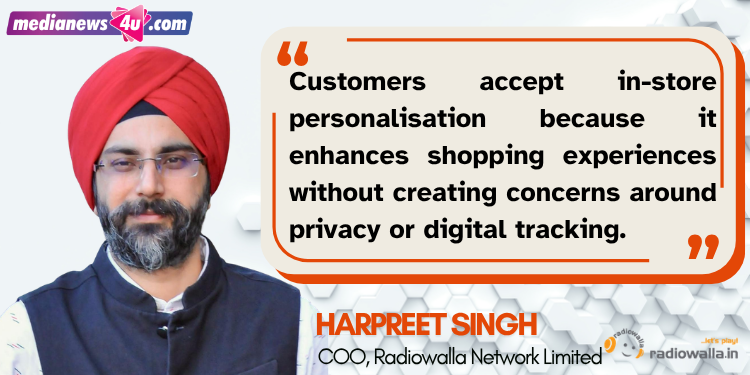
Hyper personalisation is a real challenge for digital media. When your activities online are used to target ads, as a consumer, you are bound to feel a bit of insecurity. However, in audio space, the experience is decided more by the brand preference rather than being customized for a set of customers.
Today we see a fatigue developing for digital media as users are exposed to so many targeted ads every time, they go online. Its become more cluttered than the traditional media with diminishing returns.
From audio perspective, especially in-store audio, customers feel safe as the offers / announcements are store specific and not customer specific.
Q. How does Radiowalla use AI today to predict what music or ads will make an individual shopper buy more items?
AI plays an important role in helping us make smarter programming decisions, however, it is important to clarify that we are not trying to predict what an individual shopper will buy. Retail environments are shared spaces, so our focus is on improving the experience for customer segments rather than personalizing it for individuals.
We use AI to analyse factors such as store format, customer demographics, time of day, day of the week, seasonality, and historical campaign performance etc. Based on these insights, AI can recommend the most suitable music styles, playlist selection, and the best times to play promotional messages. It also helps us continuously refine playlists by identifying what works best in different retail environments.
Q. How does the company handle the complex legal rules around music licensing when streaming different audio tracks across thousands of separate retail stores?
We work closely with music copyright owners, music labels and copyright societies to ensure that their libraries are updated in our database. Our backend systems are designed in a way to ensure licensing conditions for each store / client are adhered to at the time of music curation itself.
We create 20000+ unique playlists everyday to ensure that each store only plays the music as per their available license. This is supported by our extremely efficient cloud platform developed over the years.
Q. The company deals with digital OOH screens. How do you calculate your audience size when shoppers constantly walk past those screens?
Audience measurement for digital OOH screens is usually based on Opportunities to See (OTS) rather than assuming every shopper actually viewed the screen. We typically calculate audience size using a combination of models such as footfalls and dwell time within the screen visibility zone. The audience estimate for a particular ad also includes the duration of that ad in the loop. This provides advertisers with a realistic estimate of campaign reach rather than just total footfall
 Q. What strategies are used to keep the company’s corporate radio stations engaging so employees actually listen instead of tuning them out?
Keeping employees engaged requires content that is relevant, interesting, and personalized. Corporate radio should combine music with non-music content such as company news, leadership messages, recognition, safety reminders, wellness tips, and team achievements etc.
Engagement is further improved through interactive elements like song requests, quizzes, and polls, making the channel a two-way communication platform rather than just background audio. We regularly refresh playlists and minimize repetitions.
Live score updates for key sporting events and On-Ground activities such as RJ Meet and Greet keep the engagement going.
Q. With online shopping growing so fast in India, why are physical stores suddenly investing so much money into audio and sensory experiences?
To compete with the growing e commerce wave, offline retail has to offer something that e-commerce cannot. The experience of shopping. In addition to the touch and feel of products that they offer, the stores realize that the experience also include audio and visual cues.
Studies have shown that the right music and in-store ambience can improve customer satisfaction, increase dwell time, and boost sales. Retailers therefore view investments in audio and visual experiences not as an added expense, but as a way to enhance customer loyalty, strengthen their brand, and maximize the value of every store visit.
Q. Advertisers complain about huge measurement gaps. How does Radiowalla fix tracking gaps on its digital screens?
We provide advertisers with real-time campaign reports including screen uptime, proof-of-play logs, audience analytics, and campaign performance dashboards.
By combining verified ad delivery with audience measurement, Radiowalla offers greater transparency and accountability than traditional digital OOH reporting.
Q. The company runs audio across 30,000 stores. How do you track if a song played genuinely changes a consumer’s mind?
While it’s not possible to prove that a single song changed a consumer’s mind, we can identify if a certain genre or type of tracks impacts the sales metrics in the store by doing AB testing in select stores.
Given the vast range of stores we work with, we get an idea of what genre and type of songs work in different environments. Our music specialists constantly feed these inputs to our systems and keep refining the recommendations for next set of stores.
The objective is not to attribute a purchase to one song, but to continuously improve the overall in-store experience and business performance.
 Q. How do you plan to scale your network as experiential retail spreads from mega-malls in top cities down to smaller, tier-three Indian towns?
As experiential retail spreads beyond metro cities, our focus is on making our solutions simple, affordable, and easy to deploy for retailers of every size. Because our platform is cloud-based, stores can be added quickly and managed remotely, whether they’re in a large shopping mall or a standalone outlet in a tier-three town.
As a matter of fact, we are present in over 1000+ cities and towns of India. We also have a self-manage platform that offers a simple and intuitive interface for clients to setup the service themselves within 5-7 minutes.
At the same time, we know that shoppers in different regions have different tastes. That’s why we localize music, announcements, and content to match local languages and preferences. This allows retailers to deliver a more relevant in-store experience while giving us a scalable model that can grow alongside India’s expanding retail market.