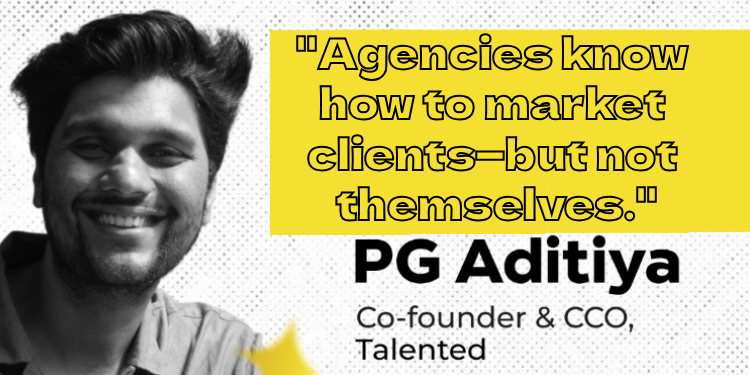
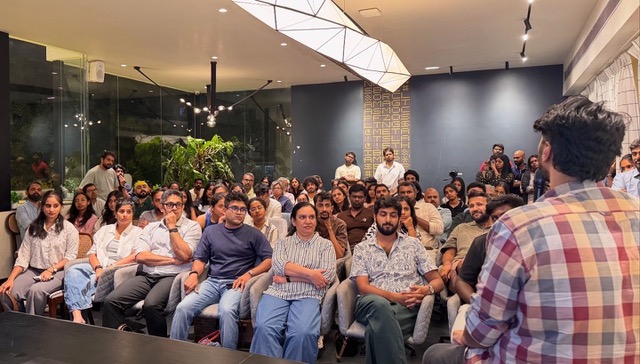
Chennai: When The Advertising Club Madras hosted its latest #ADTALKS session at Sortd Café, Alwarpet, it wasn’t another keynote presentation built around polished slides and rehearsed talking points. Instead, PG Aditiya, Co-founder & Chief Creative Officer at Talented, turned the evening into an open conversation—one where the audience dictated the direction and every question unlocked a new perspective on creativity, leadership, branding, AI and the business of advertising.
Titled “Alphabets of Ideas,” the session reflected Aditiya’s belief that advertising is best understood through curiosity rather than certainty. Over nearly two hours, he challenged industry assumptions, questioned accepted wisdom and offered an unusually candid look at the realities of running a modern creative agency.
While the discussion ranged from generational marketing and AI to entrepreneurship, awards and client relationships, one overarching message emerged repeatedly: the advertising industry needs to spend less time chasing buzzwords and more time building better work.
Consumers aren’t losing attention—advertising is losing relevance
Few topics in marketing have generated as much discussion in recent years as shrinking attention spans. Brands have become obsessed with winning consumers in the first three seconds, often reducing storytelling to a race against scrolling behaviour.
Aditiya isn’t convinced.
He argued that the industry has created a convenient narrative around declining attention spans to justify mediocre work.
“If people are willing to binge ten episodes of a television series or wait an entire week for the next episode of a show they love, attention span clearly isn’t disappearing,” he suggested. “The problem is not the audience—it’s whether what we’re creating deserves their attention.”
His criticism extended to the industry’s growing obsession with optimising openings while neglecting the larger narrative. Tactical improvements matter, but they cannot compensate for weak ideas. Great storytelling, he believes, survives imperfect execution far more often than clever execution rescues an ordinary idea.
Beyond Gen Z: Why marketers need to stop oversimplifying audiences
Another assumption Aditiya questioned was the industry’s fixation with generational labels.
Marketers frequently discuss “Gen Z” as though it represents a single, unified audience. In reality, he argued, such conversations often ignore socioeconomic differences and end up describing a relatively privileged urban demographic rather than an entire generation.
For brands, this distinction matters.
Consumer behaviour is shaped by culture, geography, aspirations and economic realities—not simply by age. Overgeneralising audiences risks creating strategies that feel relevant within metropolitan bubbles while overlooking the diversity of the broader Indian market.
At the same time, Aditiya acknowledged several positive behavioural shifts among younger consumers. He pointed to greater camera confidence, stronger self-expression and an increasing emphasis on health and fitness over traditional markers of youth culture such as smoking and excessive drinking—changes that could reshape how brands connect with younger audiences.
Buzzwords don’t build brands
If there was one industry cliché Aditiya appeared particularly impatient with, it was the word “disruption.”
When every campaign, technology and innovation is described as disruptive, he argued, the term loses all meaning.
His criticism wasn’t directed only at marketing jargon. It reflected a broader concern that the industry increasingly mistakes language for thinking.
Rather than asking whether an idea is disruptive, agencies should ask whether it solves a meaningful problem, creates commercial value or leaves a lasting impression on consumers.
Similarly, he challenged creatives to move beyond moral certainty and cultivate intellectual curiosity. Young professionals, he observed, should learn to examine multiple sides of an argument instead of quickly arriving at fixed opinions.
For Aditiya, better creativity begins with better thinking.
AI belongs to the people willing to learn—not the people willing to talk about it
Artificial intelligence inevitably dominated part of the conversation, but Aditiya approached it with characteristic pragmatism.
His advice to industry leaders was simple: spend less time offering opinions on AI and more time learning how to use it.
He believes the biggest opportunity lies with professionals who are prepared to experiment rather than speculate.
That philosophy has already influenced Talented’s own organisational evolution. Earlier this year, the independent network launched Marketing Stack, an AI-native marketing agency built around what it calls “semi-technical generalists”—professionals who combine marketing, creativity and technical capability instead of working within traditional agency silos.
Rather than viewing AI as a threat to creativity, Aditiya sees it as an opportunity to rethink workflows, accelerate execution and create new operating models.
The winners, he suggested, will be those who develop practical skills instead of theoretical viewpoints.
Creativity isn’t the opposite of business—it is good business
One of the evening’s strongest messages was directed at agency founders and entrepreneurs.
A persistent misconception within creative businesses is that commercial success requires compromising creative ambition. Aditiya disagrees.
In his view, exceptional creative work remains the fastest route to building premium pricing, stronger reputations and more sustainable businesses.
The real challenge, he argued, is that agencies often fail to market themselves effectively.
While they devote enormous effort to building brands for clients, many neglect their own visibility. Attribution matters. Great campaigns generate far greater long-term value when the industry knows who created them.
Whether through earned media, leadership visibility, awards or public conversations, agencies need to invest in their own brands with the same seriousness they expect from their clients.
As he noted during the session, agencies frequently know how to solve marketing problems for everyone except themselves.
Awards are a marketing strategy—not the destination
Aditiya also offered a refreshingly practical perspective on award culture.
Awards, he suggested, are ultimately one form of public relations.
They are valuable because they increase visibility, strengthen reputation and help attract clients and talent—not because they define creative excellence in isolation.
If agencies discover other ways to build comparable visibility, they should evaluate awards strategically rather than emotionally.
The same commercial thinking extends to unpaid creative labour.
He advocated for agencies charging for pitches and production houses charging for treatment notes, arguing that the industry must place greater value on its intellectual property and creative expertise.
Creative leadership demands vulnerability as much as confidence
Perhaps the evening’s most memorable moment came not while discussing creativity or AI, but while talking about insecurity.
Aditiya openly admitted experiencing professional jealousy when he sees outstanding work from peers.
Rather than suppressing those emotions, he has developed what he jokingly calls a “jealousy sheet”—a personal record of campaigns he wishes he had created, campaigns he’s relieved he didn’t create and the evidence that helps distinguish temporary insecurity from objective reality.
The exercise reflects a broader philosophy.
Creative professionals inevitably compare themselves with others. What matters is developing healthier ways to process those comparisons instead of allowing them to undermine confidence.
His advice extended to rejection as well.
Despite Talented’s reputation, approximately half of the agency’s ideas never make it through.
For Aditiya, that isn’t failure.
It is evidence that the agency continues testing creative boundaries.
The future won’t belong to one type of agency
Despite rapid advances in AI, automation and creator-led marketing, Aditiya doesn’t believe the industry is moving towards a single dominant agency model.
Instead, he compared advertising to the restaurant business.
Just as consumers choose between street-side eateries, neighbourhood cafés and luxury restaurants, brands will continue working with different kinds of agencies depending on their objectives.
Traditional agencies, AI-first businesses, specialist consultancies, creator collectives and automated marketing operations will all coexist.
The industry’s strength, he argued, lies in maintaining that diversity rather than consolidating around a single operating model.
Building stronger client relationships starts with honesty
The conversation also touched on agency-client dynamics.
Aditiya suggested that many difficult client relationships are shaped less by present circumstances than by negative experiences with previous agencies.
The solution is transparency.
Clients should understand exactly what working with an agency involves—its strengths, expectations and even its limitations.
He also acknowledged that Talented has occasionally walked away from client relationships when the fit no longer worked.
Sometimes, he joked, the client doesn’t even realise they have effectively been “fired.”
Underlying this approach is a simple principle: motivated agencies consistently produce better work than unhappy ones.
Advertising needs more commercial awareness
Towards the end of the session, Aditiya challenged agency employees to think beyond creative execution.
Too few professionals, he argued, understand whether their agencies are profitable, how experimentation influences business outcomes or why commercial realities shape creative decisions.
For him, creativity and business should never exist in separate conversations.
The strongest agencies are built when every employee understands both.
An industry that must learn to value itself
From questioning the attention span narrative to advocating paid pitches, AI experimentation and stronger agency branding, Aditiya’s session ultimately became less about advertising trends and more about advertising culture.
His message was not that the industry lacks talent.
Rather, it too often undervalues its own work, hides behind fashionable terminology and forgets that creativity is both a cultural and commercial asset.
For agency founders, marketers and young creatives alike, “Alphabets of Ideas” served as a reminder that the future of advertising won’t be shaped by algorithms or buzzwords alone.
It will belong to organisations—and individuals—willing to keep learning, challenge accepted wisdom, embrace discomfort and consistently produce work that earns attention rather than demanding it.