For more than twenty years, the SEO contract was beautifully simple: rank higher, and the traffic would follow. Build the right links, target the right keywords, claim a spot on page one, and clicks were the reward. An entire industry was built on that promise.
That promise is now quietly unravelling. And the marketers who understand why will own the next decade of discovery.
We are living through what some analysts already call The Great Decoupling, a moment where search demand has never been higher, yet visits to websites have never been harder to win. The two facts sit side by side without contradiction. People are searching more than ever; they are simply clicking less.
The reason is sitting at the top of nearly every results page. In a study of 21.9 million searches, 25.11% of Google queries triggered an AI Overview in the first quarter of 2026, up from just 7.64% in February 2025. When that summary appears, the behaviour change is immediate. Organic click-through rates collapse from 1.76% to 0.61%, a 61% decline, and 60% of all Google searches now end without a single click. In Google’s AI Mode, that zero-click rate reaches 93%. The answer is delivered on the page. The user has no reason to leave.
This mirrors a broader shift in how decisions get made online. Digital influence hasmoved through three phases. In the Attention Economy, the brands that got seen won. In the Search Economy, the brands that got found won. We are now entering the Recommendation Economy where the brands that get recommended will win. Consumers no longer open ten tabs to compare options; they ask ChatGPT, Gemini, Claude, or Perplexity which product to buy, which provider to trust, which option fits their needs. The AI doesn’t return a list. It returns a verdict.
Here is the part that should unsettle every team still chasing rankings: high rankings no longer guarantee AI visibility. The overlap between top-10 Google rankings and AI Overview citations has collapsed from roughly 75% in mid-2025 to between 17% and 38% by early 2026. A majority of brands ranking on Google’s first page now fail to appear consistently in AI-generated recommendations. You can rank number one and remain invisible inside the answer printed directly above your listing.
But this is not a story of decline. It is a story of redistribution. The traffic isn’t vanishing; it’s relocating to a higher-value channel. AI search visits grew 42.8% year over year, from 15.6 billion to 27.4 billion in Q1 2026, and Semrush projects AI search visitors will surpass traditional search visitors by 2028. More importantly, these visitors behave differently. AI-referred visitors convert at 4.4 times the rate of organic visitors, and AI referral sessions grew 527% year over year. The logic is intent: someone who follows an AI citation has already had the basic question answered and is clicking to verify, go deeper, or buy. Fewer visits, but dramatically more qualified ones.
So, what earns a brand a place inside that answer? Not the old playbook. AI engines interpret trust, not just authority. A Yext study of 6.8 million citations found that 86% came from brand-managed sources first-party websites and business listings and that structured data and entity clarity increased small-brand appearances by 36%. The brands surfacing in AI answers are often those with the cleanest entity data and the strongest third-party validation, not the biggest backlink budgets. This is exactly why niche players can now outperform far larger competitors in highly contextual recommendation scenarios.
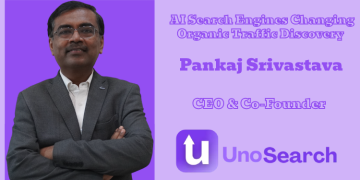
For practitioners, the response is a discipline now widely called Generative Engine Optimisation (GEO), optimising not to rank, but to be cited. Princeton research found that citing authoritative sources, adding statistics, and including expert quotes can lift AI visibility by 30-40% over unoptimized content. In practice, that means structuring content for extraction: leading every section with a direct, self-contained answer, since 44.2% of all LLM citations come from the first 30% of a piece, the introduction. It means treating freshness as a signal, building corroboration across independent publications, and creating proprietary assets original data, benchmarks, calculators that an AI cannot simply summarise away. In our own work at UnoSearch, the sites that show up in AI answers are consistently the ones that have done this groundwork, not the ones with the largest ad spend.
It also demands a new scoreboard. Only 23% of marketers currently invest in GEO measurement. The metrics that defined the last era sessions, rankings, impressions no longer tell the full story. The next generation will track AI citation share, share of voice across AI platforms, branded-query lift, and conversion by AI referral source. Traffic tells you who visited. Recommendation visibility tells you who was considered.
The deeper truth is that organic discovery is moving closer to trust than to attention. For years, brands paid for visibility. Increasingly, they will have to earn recommendations. The most valuable placement of the coming decade may not be a top ranking, a display ad, or a social impression; it may simply be a mention inside an AI-generated answer.
Organic traffic isn’t dead. It has evolved. And in this next chapter, the winners won’t be the brands that rank the highest; they’ll be the ones AI engines trust enough to recommend.
(Views are personal)