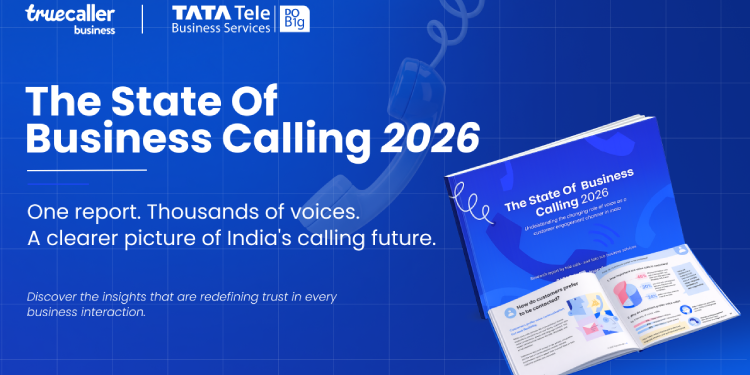
Mumbai: A new report by Truecaller, in partnership with Tata Tele Business Services (TTBS) and research firm Kantar, has revealed a growing trust paradox in India’s business communication landscape. While 76% of consumers prefer voice calls over digital alternatives for business interactions, 79% actively avoid answering calls from unknown numbers, highlighting the need for verified caller identity and contextual communication.
The findings are part of ‘The State of Business Calling 2026’, a comprehensive study that examines how businesses and consumers engage through voice calls in an increasingly digital-first environment. Based on responses from more than 500 B2B businesses and 1,000 consumers across 17 Indian cities, the report underscores that voice remains the country’s most trusted channel for business communication, particularly in situations requiring clarity, urgency and reassurance.
According to the report, despite the proliferation of digital channels, voice continues to dominate interactions where human engagement matters most. However, growing concerns around spam, inconsistent caller identity, lack of context and poorly timed outreach have made consumers increasingly selective about answering business calls.

Commenting on the findings, Priyam Bose, Global Head, Truecaller for Business GTM (Go To Market), said, “India does not have a calling problem. It has a trust and attention problem. Consumers today expect to know who is calling, why they are calling, and whether it is worth their time. At Truecaller, we are focused on enabling verified identity and contextual communication to help businesses rebuild trust and improve engagement. Our report clearly reveals the opportunities for businesses to invest in the right customer experience”.
The report found that 49% of consumers would be more willing to engage with business calls if they could schedule callbacks at a convenient time. Businesses, meanwhile, are increasingly investing in caller identity solutions, with 64% prioritising verified caller identities, verification symbols and call-purpose previews to improve customer engagement.
The study also highlights a disconnect between the value businesses derive from voice communication and the metrics they use to measure it. While 41% of businesses say trust and brand perception are the primary reasons for using voice, most continue to track operational metrics such as response rate (72%), time to resolution (57%) and cost per interaction (53%). According to the report, these measures fail to capture the broader benefits of voice, including higher customer satisfaction (42%), stronger customer retention (36%) and emotional reassurance.
The report suggests that voice continues to be managed as a transactional channel rather than a strategic relationship-building tool.

Vishal Rally, Chief Revenue Officer, Tata Teleservices, said, “Voice remains an important channel for enterprise communication, particularly when immediacy and human connection matter most. As customer expectations evolve, businesses need secure, intelligent, and context-aware communication experiences. At TTBS, we are enabling enterprises with integrated voice and digital communication solutions that strengthen customer trust and engagement.”
The report also notes that sectors such as BFSI and IT services continue to rely heavily on voice communication for verification, compliance and critical customer interactions, while e-commerce and logistics companies increasingly combine voice with digital channels to support transactional and customer service requirements.
Additionally, the study introduces three proprietary benchmarks—the Voice Adoption Index, Feature Engagement Index, and Feature Interest Index—designed to help businesses assess their voice communication maturity and identify future investment priorities as customer expectations continue to evolve.