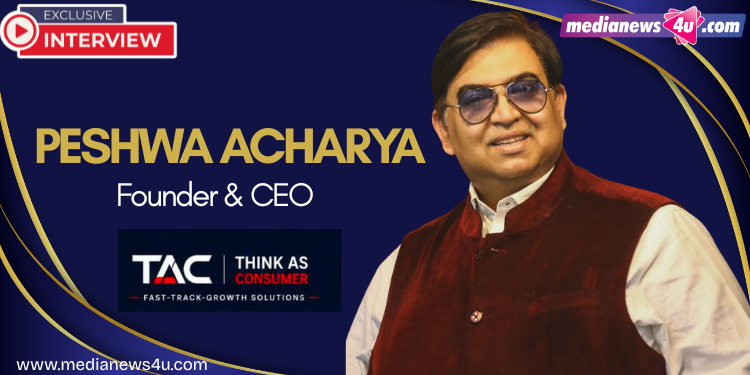
Medianews4u.com caught up with Peshwa Acharya, Founder, CEO Think As Consumer, whose three-decade journey spans building, scaling, and turning around some of India’s most significant consumer businesses.
From launching modern retail formats like Reliance Digital and Reliance Fresh, real estate sector like Housing.com, to scaling power brands such as Dettol, Harpic, Mortein, and Babool, Mr. Acharya has consistently operated with one core philosophy: sustainable growth begins with deep consumer understanding.
At a time when businesses are navigating trust deficits, margin pressures, and culture challenges, his perspective is both timely and grounded in execution experience.
Q. How are AI tools reshaping the marketing and advertising industry?
The first thing to understand is that AI isn’t really “free.” Most platforms offer limited free versions to help users get familiar with the tool before moving to paid services.
From my perspective, AI is excellent for creating first drafts of marketing and advertising content. However, the final judgment and decision-making must always remain with the marketer, CMO, founder, or business leader.
AI is a powerful support tool that helps businesses work faster and more efficiently, but success still depends on sound strategic thinking and human judgment.
 Q. Is upskilling in technology today non-negotiable for marketers and brands to stay ahead of the curve?
Technology has always been an essential part of marketing. Good marketers have consistently adapted to new technologies—from desktop computers and Lotus Notes to Microsoft PowerPoint, voice-to-text software, and now Generative AI.
As a business owner, entrepreneur, or marketing leader, you have to embrace technology. The real question isn’t whether to use technology, but where and how much to use it.
Creativity should remain largely human-driven, while technology should support tasks such as research, documentation, analysis, and presentation creation. Today’s marketing teams are expected to work much faster than before, and technology plays a critical role in reducing turnaround time.
Q. What is the biggest mistake that Indian brands continue to make when they talk to customers?
I don’t believe Indian brands are consistently making mistakes. In fact, many brands are doing a good job. Instead, the focus should be on learning how to understand and speak to consumers more effectively.
When conducting consumer research, never ask direct questions about your own brand. Instead of asking, “What do you think about Swiggy?”, ask broader questions about food delivery services to get more unbiased responses.
Another important principle is never to ask consumers why they made a particular decision. Consumer choices are often emotional or irrational, and people tend to rationalise their decisions afterwards.
For example, while researching detergent usage, many affluent households claimed they preferred a premium detergent like Ariel but continued using Nirma. The real reason wasn’t product performance. Many relied on household help for laundry and didn’t see enough value in paying significantly more for a premium detergent. These kinds of insights emerge through observation and thoughtful questioning, not by asking consumers directly what they think.
Q. How did you get regular Indian families to buy Babul toothpaste instead of Colgate?
Actually, regular Indian families weren’t the primary target. Babul primarily appealed to less affluent consumers because it offered similar functionality at nearly half the price of Colgate.
The real marketing strategy was identifying where these consumers lived. We ranked districts across India based on their affluence and focused our sales and marketing efforts on the bottom 50% of districts.
The hypothesis was simple: consumers in lower-income markets were more likely to buy a quality alternative at a lower price.
This strategy worked exceptionally well. While Colgate dominated nationally, Babul achieved market shares of over 30–40% in several less affluent districts across states such as Odisha, Bihar, Jharkhand, and parts of West Bengal.
Instead of competing aggressively in metros, Babul positioned itself as a strong non-metro brand by concentrating its efforts where its value proposition resonated the most.
Q. Why did you force your team at P&G to put the final answer at the very top of their notes?
This wasn’t something I introduced. It has been part of Procter & Gamble’s business communication system for over 100 years.
In school, we’re taught to begin with the background and end with the conclusion. P&G follows the exact opposite approach, known as the Inverted Pyramid.
In business communication, the recommendation or required decision comes first. For example, instead of explaining the background and ending with an approval request, the memo begins by stating exactly what approval is needed. The supporting details, comparisons, research, and rationale follow afterwards.
This approach exists because senior leaders have limited time. They need to understand the required decision immediately before reading the supporting information. It makes business communication faster, clearer, and more action-oriented.
Q. You often say that shoppers say one thing in surveys but buy something else at the shop. If surveys do not tell the truth, how can a new Indian start-up figure out what people really want without wasting money?
Many start-ups don’t need surveys at all. The whole idea of a start-up is to test a strong hypothesis rather than behave like an institutionalised company.
If consumer research is required, founders should be trained in consumer insights. The key principle is to observe consumers rather than ask them direct questions. Never ask why someone buys a product. Instead, observe their behaviour and draw conclusions from what they actually do.
 Q. When is it smart to replace a famous Bollywood star with a cheaper actor?
It makes sense when:
- You need a younger face for the brand.
- A more cost-effective celebrity can deliver similar brand value.
- The existing celebrity’s public image no longer aligns with the brand’s values or could potentially damage its reputation.
A good example was when Reliance Communications replaced Hrithik Roshan with younger rising stars. The decision reduced endorsement costs, aligned the brand with emerging talent, and ensured the brand remained relevant to a younger audience. For a family-oriented brand, trust is critical, so the celebrity’s public image must always align with the brand’s values.
Q. You worked 80 hours a week while building Reliance Retail. Is going through the grind necessary to win?
Companies pursuing rapid growth often require founders, promoters, and employees to work extremely hard. However, whether that is necessary depends on the organisation’s ambitions.
Reliance Retail grew into a multi-lakh-crore business in around 20 years, whereas similar global retailers took much longer to reach that scale. Compressing decades of growth into a much shorter period often requires extraordinary effort.
That said, this has to be a personal choice rather than something imposed on employees. Not every company needs this approach. It depends on what the founders define as success and how quickly they want to achieve it.
Q. Apps Daily sold mobile apps in physical retail stores like packets of chips. That idea eventually stopped working. What went wrong?
The concept worked before app stores became mainstream. At that time, downloading and configuring apps was difficult, so selling apps physically made sense.
Once app stores became widely available, consumers could download apps directly, making the offline distribution model obsolete. The concept wasn’t flawed—it was designed for a different stage of the technology lifecycle.
Q. How do you sell a luxury car to an Indian buyer who secretly cares mostly about price?
Luxury buyers do care about price, but price isn’t their primary motivation.
Luxury brands are fundamentally about owning the brand rather than functional benefits. Someone buying a luxury car isn’t primarily buying horsepower—they’re buying status, prestige, and aspirational value. This is true across markets.
The major difference in India is that luxury purchases are driven even more by flaunt value. Sales volumes remain lower because luxury cars represent a much larger multiple of average income in India than they do in developed countries.
Q. What is the fastest way to handle a bad Google review from an angry parent?
Respond promptly by acknowledging the concern and expressing a willingness to resolve the issue. Do not argue publicly or attempt to solve the problem in the review itself.
The objective is to move the conversation offline through a direct call or message. Publicly, simply acknowledge the concern and invite the person to connect privately. This prevents unnecessary public debates while demonstrating responsiveness.
 Q. What is your next big business plan for the Indian market?
India will soon have around 150 million people aged 55 and above, yet very few consumer brands are focused on serving this segment.
One significant opportunity lies in building products and services specifically for senior citizens. Personally, I’m particularly interested in developing investment, savings, financial advice, and other financial products designed exclusively for this growing segment.