Sometimes, it takes just one letter to start an important conversation.
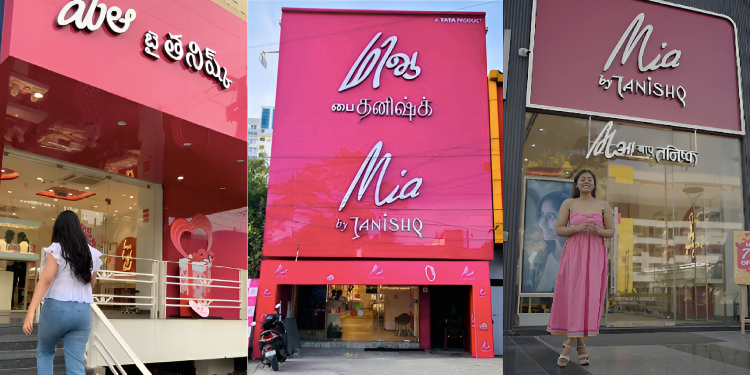
A recent LinkedIn post by Arabbhi Athreya, Co-Founder of Happy Unicorn Productions, caught our editorial team’s attention. Referring to Titan’s jewellery brand Mia by Tanishq, she observed that the brand name, when rendered in Tamil, would conventionally be written as மியா, not மிஆ. It was a simple observation, but one that resonated with marketers, branding professionals and Tamil speakers alike.
More than correcting a word, it raised a larger question: When brands speak regional languages, are they merely translating—or are they truly localising?
As national brands increasingly invest in regional markets, this distinction has become more important than ever.
Across advertising, packaging, retail signage and digital campaigns, brands are embracing Indian languages with renewed enthusiasm. Consumers today expect brands to communicate in their language—not just linguistically, but culturally. It is an encouraging shift that reflects India’s diversity.
Yet, this is also where many brands stumble.
Replacing English with Tamil, Hindi, Telugu or any other regional script is translation.
Making a brand feel naturally rooted in that language and culture is localisation.
The difference may seem subtle, but consumers notice it instantly.
When localisation is thoughtful, it builds trust. When it lacks cultural sensitivity, even the smallest detail can create unnecessary friction. Ironically, the very effort meant to make a brand feel closer can end up making it feel distant.
The discussion around Mia, however, is perhaps more nuanced than it first appears.

Brand consultant Anantha Narayan, Founder and CEO of Blue Noodles, points out that according to Titan, Mia derives from the Italian word meaning “mine.” At one stage, the brand also expanded it into the acronym “Me In Action.”
Phonetically, “Mia” and “Miya” sound almost identical. But in Hindi and Urdu, “Miya” (मियाँ) carries an entirely different meaning, referring to a man or husband. Narayan suggests that this may explain why the brand deliberately chose to render the name as मिआ instead of the grammatically expected मिया in Hindi. While the spelling departs from standard language conventions, it avoids an unintended cultural association.
If that strategic decision was indeed made for Hindi, extending the same treatment across other Indian languages—including Tamil—would have been a conscious branding choice rather than an accidental translation error.
That perspective reminds us of an important truth about branding.
Brands have never always followed the strict rules of language.
From Flickr to Tumblr, unconventional spellings have often become part of brand identity. Over time, consumers stop seeing them as grammatical anomalies and begin recognising them as distinctive brand assets.
Whether மிஆ eventually achieves that level of acceptance remains to be seen. Time, rather than grammar alone, will determine whether consumers embrace it as an extension of the brand’s identity.
Yet, that does not diminish the importance of the broader conversation.
Because while strategic departures from grammar are legitimate branding tools, they must be intentional, well-researched and culturally understood—not accidental outcomes of inadequate localisation.
This is not a new challenge.

Deepan Ramachandran, Founder of Mind Your Language!, a specialist localisation agency focused on South Indian languages, recalls a notable example from years ago.
Honda’s Hindi campaign line, “Sach kar denge sapne,” was translated into Tamil as “கனவுகளை நினைவாக்குகிறோம்” instead of “கனவுகளை நனவாக்குகிறோம்.” The difference was only a single vowel marker, yet it completely altered the meaning—from turning dreams into reality to effectively turning dreams into history.
The mistake reportedly appeared across dealership boards throughout Tamil Nadu before it was eventually corrected following feedback.
As Deepan notes, the industry has become far more sensitive to such issues over the years, and such mistakes are becoming less frequent. But they have not disappeared.
That observation is significant because localisation is often viewed as the final production step—a task assigned after campaigns have already been conceptualised, designed and approved.
In reality, localisation should begin much earlier.
It requires native copywriters, language specialists, designers and cultural reviewers to collaborate from the outset. Because language is not merely read.
It is heard. It is felt. It carries memory, emotion and identity.
Artificial intelligence has made translation dramatically faster. Today’s tools can convert words across dozens of Indian languages within seconds.
But AI still cannot replicate lived cultural intuition.
A native speaker notices what software often misses.
A misplaced vowel marker.
A missing pulli.
An awkward pronunciation.
A phrase that is technically correct but culturally unnatural.
These details may seem insignificant inside a design file. They rarely remain insignificant once they reach consumers.
Brands routinely invest months perfecting logos, typography, packaging and colour palettes because they understand that every visual detail shapes perception.
Regional languages deserve exactly the same level of precision.
Not because consumers enjoy finding mistakes.
But because language is deeply personal. It reflects heritage, identity, humour, emotion and belonging.
One brand that demonstrates how localisation can go beyond translation is Britannia. Its Milk Bikis ‘Thirukkural’ initiative did more than print Tamil on packaging. It celebrated one of Tamil literature’s greatest treasures by thoughtfully integrating it into the product experience. Every design decision reflected respect for the language and its cultural significance.
Titan itself has also demonstrated an appreciation for regional identity through watch collections featuring Tamil-inspired typography and design elements, recognising that language can itself become an expression of design and culture.
The conversation around Mia therefore should not be viewed as a debate over one spelling.
Instead, it serves as a timely reminder that as brands deepen their engagement with India’s regional markets, cultural authenticity becomes both an opportunity and a responsibility.
Regional branding cannot simply be about speaking a language.
It must be about respecting it.
Because consumers ultimately do not judge brands only by what they say.
They judge them by how genuinely they understand the people they are speaking to.
Perhaps that is the biggest lesson from one small Tamil word that sparked a much larger industry conversation.
In regional branding, perfection is not about linguistic purism.
It is about cultural respect.
Acknowledgement: This editorial was inspired by a LinkedIn post by Arabbhi Athreya, Co-Founder of Happy Unicorn Productions, whose observation on the Tamil rendering of Titan’s Mia sparked a broader reflection on localisation, language and cultural authenticity in Indian branding. We also acknowledge the valuable perspectives shared by Anantha Narayan, Founder & CEO of Blue Noodles, and Deepan Ramachandran, Founder of Mind Your Language!, whose insights enrich this discussion.