Mumbai: Brands need to look beyond traditional logos at events to leverage the experience economy. Measuring footfalls is not a metric. Evoking emotion should be a priority. Brands should look at how they can participate in an event that is so unique that only they can do it. Brands should look at how they can co-create experiences with consumers at events. Having a presence at events should not just be seen as being a media decision. It should be as seen as participating in a cultural shift. Being at an event is about creating brand love and loyalty.
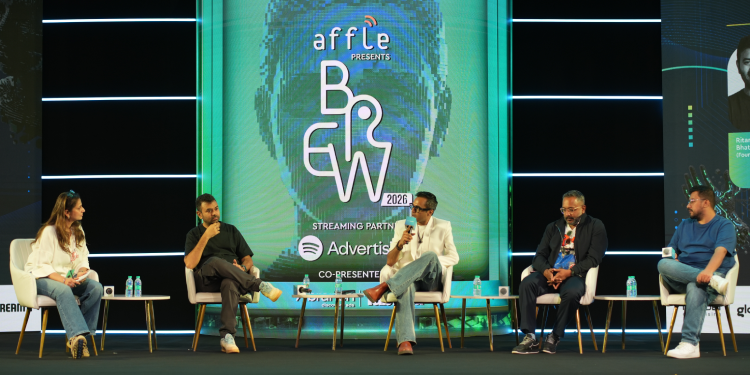
These points were made during a session at BREW 2026 organised by WPP called ‘Are Brands Sleeping on the Experience Economy Boom?’. The speakers were Ritam Bhatnagar (Founder, IFP), Laksh Maheshwari (Storytelling, Artist) Arjun Kolady (Head of Sales, Spotify India) and Anmol Kukreja (Founder, Skillbox). The session moderator was Ruchi Mathur (Cluster Lead -North, WPP Media)
Mathur noted that in a study she read which said only 22% of the brands are consistently spending in experiential marketing on a continuous basis. 44% are very ad-hoc. Maheshwari noted that brands are there, but they’re still thinking in a very traditional way. “They’re still looking for what is the impression they will get out of it, what they just want is a traditional logo space being placed. I think the overall scenario has right now moved into experiential branding, that is what a brand should think about.”
He also said that it is important to own the things that you are doing. He gave the example of Simba a beer brand that is associating with hip hop events and has thus associated with the entire community as a whole. When you think about hip hop you think about Simba. “And they’re not just sponsoring a particular hip-hop event. While they’re doing that, they’re also associating with hip-hop as a culture at large. And a very beautiful example that I gave is during the Hanumankind concert that we did they actually created, recreated that whole bar. So they were actually trying to bring in the digital part of it, the video that went so viral and trying to bring it on ground as an experience. So it’s important for brands to realise that things have moved beyond just the traditional logo space.”
Kolady noted that the first thing is that brands are applying the principles of something else to the events business. “Where’s my logo going to be? Why are you not doing an event with 50,000 people? Why is it only 500 people? I think that comes from trying to apply rules of a different game here.”
He noted that while you may have 50,000 people there the true distribution is still online. “It’s still going to be millions and millions of people who are going to see how can you really be a part of this experience.” The issue is that brands are not designing for that. It’s not just about somebody came today, saw the logo, and they’re going to be that strong. “The principles of the metrics and the questions that are asked are not designed for this.”
The second thing is it’s not just about being visible. A brand is in an event because it wants to tap into fandom. “You’re hoping to convert that fandom into some sort of outcome for you. Two, if you’re thinking of tapping into fandom, it’s not just about being visible. It’s about playing with them. You have to know that the life of the event actually is much longer than the audience itself. The audience is much bigger outside than it is in the booth.
And owning a niche and really doubling down on it, is far more important than thinking about how many people are going to come.”
He gave the example of H&M who has been a part of Lollapalooza. He had met them and even asked them, how do you do this? “Because there’s so many different touch points. There’s a merch printing station. There are private concerts happening on the side. You get to do an artist meet and greet. It’s very, very sensory as opposed to just being there to watch. And I was surprised to find they have a global head of music.
“It’s a fashion brand. If I was to design a fashion brand, I would never put a global head of music as part of a fashion brand. But the fact is that they understood Fandom, they understand the journey, they plan for it, they design an organisation in a way that can really streamline thinking about it, as opposed to it being a media decision.”
These are the three spaces that brands really need to figure out.
Maheshwari noted that the audience has evolved a lot. “Now you can’t just put a big hoarding of the brand at the top of it and then your job is done. Nowadays, audience has evolved in such a way that if you see somebody’s promoting a particular band so outright and directly, they just rebel from it. They just walk away from it.” Brands need to be present in the consumer’s head subconsciously. The key to success lies in being subtle at live shows.
A brand just has to go subconsciously and consciously in the audience’s mind, but it shouldn’t be out there in your face. That’s what brands are lacking. They want their logo to be out there, to be visible for everybody to see. If it is subtle then people can use it in their personal lives.
The issue is that brands at the pitch deck for an event from a media angle. They always look at what is the size of logo, how many logos are present, do we need a logo on the lanyard, on the cap. This applies to leading brands where visibility becomes the number one goal for them. t becomes very difficult to make them understand that visibility without an engagement is nothing for them.
The point was made that for experiences, you can’t put a metric like footfall. In 2026, footfall is not a metric. How many people did the brand evoke an emotion in after an interaction? That is key. How much time did they spend is no longer a metric on which you can build a culture driven experiences.
Kolady said, “I think more brand owners and marketers should ask instead of just talking about the logo or whatever, what can my participation in this event bring that nobody else can bring and create? I think that’s really when the true magic happens. We don’t just want to do ABC. How do we create something that only we could have created? And then that is unique and additive to the journey of a fan.”