In 2015, S.S. Rajamouli spent approximately ₹250 crore to create visual effects sequences in Baahubali: The Beginning that Hollywood studios would have charged ten times that amount to produce. The war sequences, the waterfall, the mahishmati grandeur — all achieved on a budget that would barely cover a mid-tier Marvel reshoots bill. Indian cinema did not replicate Hollywood. It found a different path to the same destination, constrained by budget but not by ambition.
That instinct — doing more with less, finding the elegant solution rather than the expensive one — is precisely what the Artificial Intelligence (AI) content revolution will reward. And it raises a genuinely open question: will Indian cinema, particularly Kollywood and Tollywood, be among the first in the world to harness AI for content creation at scale? The answer depends on choices that the Indian media industry needs to start making now.
What Indian Cinema Has Already Demonstrated
The track record is stronger than the global media industry acknowledges. RRR, Kantara, Pushpa, Kalki 2898 AD— these are not just box office successes. They are proof-of-concept productions demonstrating that Indian regional cinema can compete visually and narratively with global content, at a fraction of global production costs, for audiences who are among the most demanding and diverse on the planet.
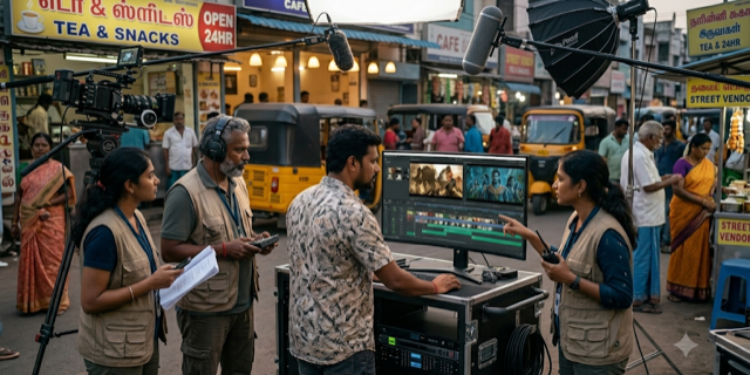
Indian Visual Effects (VFX) studios — Prime Focus, Makuta, NT Studios — have quietly built world-class capability serving both domestic productions and global streaming platforms. The talent exists. The frugal-innovation muscle exists. What is changing now is the tool layer — and AI is about to make that muscle dramatically more powerful.
AI-assisted VFX, AI-generated backgrounds, AI-driven dubbing and lip-sync across languages, AI-assisted scriptwriting and storyboarding — these tools will compress production timelines and costs further. For studios already operating lean, this is not a disruption. It is an acceleration.
The Reel Economy Is the R&D Lab
India is the world’s most voracious consumer of short video content. Recent studies show that 89 per cent of Indian Generation Z engages with Reels daily. India has more active short-video creators than most countries have internet users. And critically, this creation is happening across 15 languages — Tamil, Telugu, Kannada, Malayalam, Bengali, Marathi, Punjabi — not just Hindi and English.
This is not a distraction from serious AI content development. It is the R&D lab for it.
The Tamil comedy creator with 2 million followers who is already experimenting with AI voice cloning for regional accents. The Telugu drama channel using AI-generated thumbnails and scene transitions. The Malayalam short film collective using AI dubbing to reach non-Malayalam audiences. These are not anomalies — they are the early adopters of a wave that will reach professional production houses within three to five years.
When AI tools mature enough for professional-grade vernacular content creation, India will have the largest trained base of regional-language AI content creators in the world. That is a genuine first-mover advantage — not in building the AI tools, but in applying them at scale in a multilingual context that no other country can replicate.
What Needs to Go Right
The question mark in the title is honest. Several things need to go right for this potential to be realised.
First, Indian streaming platforms — JioHotstar, SonyLIV, Zee5, Aha — need to invest in AI-assisted regional content production rather than simply licensing global content. The platform that commissions the first fully AI-assisted Tamil anthology series will not just get content cheaply — it will build a production methodology that the rest of the world will study.
Second, the Indian VFX and post-production industry needs to retool deliberately. The studios that trained on Baahubali budgets need to now train on AI-augmented workflows. Prime Focus has already begun this journey. Others need to follow before the window closes.
Third, Indian language datasets need to be invested in as seriously as English language datasets. AI dubbing that sounds natural in Tamil, AI lip-sync that works for Telugu phonemes, AI voice synthesis that captures Malayalam tonal patterns — none of this happens without deliberate investment in Indian language AI training. This is where the government’s IndiaAI Mission and private platform investment need to converge.
The Export Opportunity Nobody Is Discussing
Here is the argument that the Indian media industry should be making loudly to global partners: India’s multilingual AI content capability is not just a domestic asset. It is an export product.
Southeast Asia, Africa, the Middle East — these are markets with enormous appetite for culturally resonant local content and almost no infrastructure for producing it at scale. Indian studios and platforms that crack multilingual AI-assisted production will have a ready market across the Global South, in markets where the content gap is even larger than India’s.
The analogy is Maruti Suzuki — a car built for Indian roads and Indian wallets that became exportable precisely because it was engineered under constraint. AI content tools built for Indian linguistic diversity and Indian production budgets will travel to every similarly complex, similarly cost-conscious media market in the world.
Will Indian cinema lead the world’s AI content revolution? Not automatically. Not without deliberate choices by studios, platforms, and policymakers. But the ingredients — the VFX talent, the creator base, the linguistic diversity, the frugal-innovation track record, and the sheer scale of content appetite — are all present.
The question is whether the industry recognises what it already has.
(Views are personal)