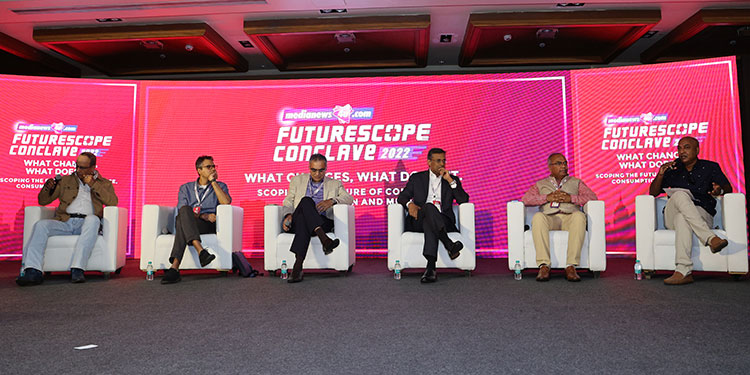
The inaugural edition of the Medianews4u.com Futurescope Conclave 2022 in Bengaluru on 15th July saw a panel discuss ‘The Future of News’.
The session was moderated by Gokul Krishnamoorthy, Independent content consultant, marketing columnist and Consulting Editor of MediaNews4u.com.
The panellists were Deepak Saluja, Director, The Times of India; Ranjeet Kate, Chief Executive Officer, Vijay Karnataka & Bangalore Mirror; R Sridharan, Managing Editor, TV9 Kannada; Sudipto Chowdhuri, Chief Revenue Officer, India TV; and Vignesh Vellore, Chief Executive Officer, The News Minute.
The discussion dived deep into the conclave theme ‘What changes what doesn’t’, probing if the value of news brands has gone up or down, and whether consumers are actively seeking out news brands or picking up what is fed to them through digital channels.
In his opening remarks on what has changed and what hasn’t with respect to news, to what will change and what won’t, Saluja quoted research from the UK where people were asked, ‘What is the world without news how do you see that?’
“70 pc of the people from that research said that the world without news will be very anxious, there will be lot of polarisation, lot of volatility and the democracy will be at risk for the whole society. I think that actually reflects what will not change because the demand for credible, trustworthy information will always be there,” he explained.
He further said, “What would change is with technology coming in, it’s got the news, the credible, trustworthy information, to reach far and wide with the smart phones and internet; what it also carries on the flipside is the negative effects like fake news. The other thing that comes out with the internet is the huge rush for eyeballs and the attention economy as we call it where the quality of content, stories or discussions are deteriorating.”
Over time, as things settle down the demand for news will continue and all forms of media will prosper, the speaker observed.
Vellore remarked, “We are a mobile-first platform and at the end of the day consumption of news only happens through the mobile and that will never change even in the future.”
With a majority of news consumption happening via social media, fake news rears its head. This is in stark contrast with news organisations which take a lot of effort into putting fact checks into their ground reports, noted Vellore. And that comes at a cost.
“What will change in the future, all newsrooms whether it’s print, television or even digital, need to go back to the basics and educate the audience to bring about a sustainable approach,” he stated.
Chowdhuri said, “The interest in news is not going to change. We need to be credible, careful about differentiating between what is right information and fake information. We should think about the objective with which a news organisation is formed, create the right kind of information delivery system; money will follow if you are on the right path.”
In his opening remarks, Sridharan observed, “News is no longer one person or even a handful of organisations’ monopoly, news has got democratised.”
Referring to the millions of users online on platforms like Twitter and Facebook, he added, “As news organisations we can’t take our position for granted because someone out there is going to deliver the breaking news.”
Things are set to change further with AI and machine learning put to use in the business of news, the speaker noted.
“You can’t tell whether something was written by a human being or a software. That is changing rapidly and inevitably newsrooms will have to adopt those technologies. On the consumer side what’s changed already is how people consume news,” said Sridharan.
Mobile is the go-to mode of consumption today, but we may go beyond the mobile phone in future with some sort of technology that allows consumption of news in a very different fashion, noted the speaker.
Kate made a distinction that underlined the relevance of news organisations. “The demand for news is very big, huge, growing and will grow. I look at news as organised news and informal news. If you look at the organised news, then the fact is we cannot take the consumers of news for granted,” he said.
While the market for informal news is huge, organised news should not follow that populist path, he cautioned. He urged formal news organisations to respect consumers and be responsible rather than chase virality with sensationalism, which would be their undoing.
What does the future hold for subscription in news?
Vellore said, “For subscription memberships to actually work, function with a hybrid model – you get your ads in place and then your membership and subscriptions. In India, around 15 pc of the population would be willing to pay for actual news. The future would be looking at a lot of consolidation of media, where small media houses come together and say that you pay for one subscriber and then you get access to all the other news publications. When the quality of content increases, consumers are more willing to step forward and pay for that. Quality of content, local, regional will work; shorter video formats too as many want to spend about 2 minutes and get the information. Not opinion-oriented but more ground-reported stories, more in-depth reportage, basically educating the reader and the audience to be a lot more informed; those will help the number of subscriptions to increase.”
According to Sridharan, “As the pressure mounts for publishers to start charging, people have no choice but to pay. Smarter strategy for media owners and publishers would be to look at a hybrid model where you give people the freedom to pay and avoid ads or choose to watch ads. Keeping subscription free is a very good strategy for the Indian market where affordability and the intent to pay is still fairly less compared to other markets.”
The speaker reiterated the need to adopt models based on the need of each organisation. A niche publication without a critical mass to attract advertisers might find subscribers who are willing to pay, for instance, he noted.
Saluja explained that the consumption of news would vary according to the time of day and need of the consumer. A relaxed viewer at home in the morning may not mind ads in the midst of his news viewing, while one on the go looking for his/her dose of information might not want to give time to ads, he observed. “I think both the models will be running and both will be available,” noted Saluja.
Kate cited the case of South Indian regional language publications which have, according to him, moved strongly towards realising substantial subscription revenues over the last 10 years. As they hold their reader numbers thanks to the consumer connect, their advertising pipe also gets inflows. There are other models in India, which are primarily advertising-driven, he noted.
“Companies and brands based on their current advertiser base and subscription or reader base may have to plan the transition but it would be hybrid definitely,” Kate added.
Chowdhuri remarked, “Paying for news will happen provided a particular process is followed; if the process is right your outcome will be exactly as you decide. The process of making enough effort to ensure organised news, eliminate fake news, educate consumers.”
Regulation of news
On the subjects of fake news and enhanced regulation, Sridharan underlined the need to distinguish between news from regulated platforms like television and newspapers or from social media where most fake news and disinformation spreads.
Vellore noted, “Regulation is definitely muzzling the voices of the free press. We are self-regulated to a large extent and also governed by the laws of the land. It’s not like we’re doing something that is completely unverified or not credible. There is no need for further regulation.”
Saluja emphasised the need for ‘guiding rails’, adding that they need to be applicable to digital media and platforms, as well as the long tail of news.
Kate observed, “We have always wanted to become a developed country and if you look at developed countries then invariably self regulation is very important. The way forward for India would be that government cannot over-regulate because we want to become a developed country and a developed country will always balance between self-regulation on priority and some government regulation.”
He further added, “I think one way of looking at regulation or one way to balance regulation is actually brand building and building trust in media. It is the most important ingredient for the news industry. I think as a society involving all components – government, consumers, advertisers, news publishers – we have to promote branding. Because branding means the need for regulation is on the lower side. As a country we have to develop great news brands.”