RunnTV is a FAST and connected TV platform focused on enabling content owners, broadcasters, and studios to launch, distribute, and monetise FAST channels at scale. Through its advanced technology platform and distribution partnerships across smart TV OEMs, OTT platforms, and connected TV ecosystems, RunnTV delivers premium streaming experiences to viewers while unlocking new monetization opportunities for content partners.
Earlier this year RunnTV announced the launch of a Time-Shift feature for FAST TV. This allows viewers to rewind and catch up on recently aired content on live FAST channels — bringing a DVR-like flexibility to the traditionally linear FAST viewing experience. The capability is powered by PlayStudio, RunnTV’s end-to-end FAST technology solution, and will also be available to broadcasters and streaming platforms looking to enhance their own FAST services.
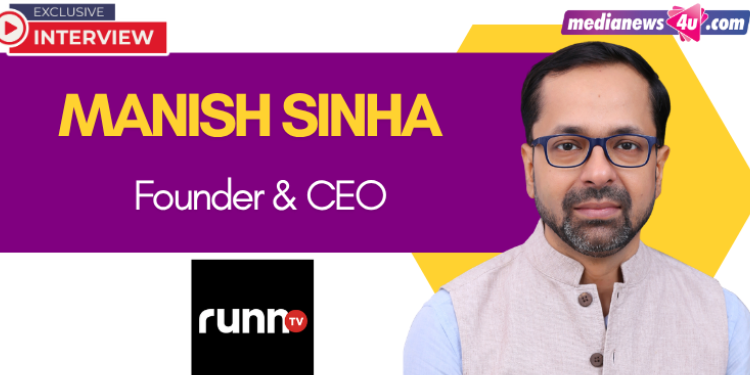
Medianews4u.com caught up with Manish Sinha Founder, CEO, RunnTV
With over 20 years of experience, he brings deep expertise across the global Media & Entertainment (M&E) industry, with a strong focus on the intersection of content, technology, and monetization. He has worked extensively with leading technology and product companies in the M&E domain, and has partnered with top broadcasters, studios, sports networks, pay-TV operators, and pure-play OTT platforms across India, North America, and other global markets.
Over the course of his career, he has led the inception, design and development of streaming platforms while consulting for leading media organizations, including broadcasters, sports networks, studios, pay-TV operators, and digital-native OTT players. He has also worked closely with FAST platforms and technology providers, while leading delivery and operations for tier-1 OTT services. His experience spans the full lifecycle of streaming businesses—from platform architecture and technology selection to large-scale deployment, operations, optimisation and revenue generation.
He possesses a deep understanding of the media value chain, including content strategy, distribution, consumer behavior, and monetization models. He is well-versed in the regulatory landscape governing OTT platforms in India and globally, and has strong expertise in streaming technologies, infrastructure, and product ecosystems. His work has consistently focused on aligning technology, business models, and consumer insights to build scalable, efficient, and sustainable streaming businesses across markets, including India and the US.
At RunnTV, he is driving the vision of democratizing streaming infrastructure and accelerating FAST adoption in India. Under his leadership, RunnTV has rapidly scaled to 70+ live channels and established partnerships with leading content studios, global OEMs, and CTV platforms. Through its proprietary platform, PlayStudio, RunnTV enables content owners to launch, distribute, and monetize FAST channels across multiple platforms with speed, efficiency, and transparency.
He holds an MBA from the Indian Institute of Management Calcutta (IIM Calcutta), one of India’s premier business schools, and is widely regarded as a thought leader in the Connected TV and FAST ecosystem. His core areas of expertise include Connected TV (CTV) and FAST, OTT platforms, content distribution, streaming technologies, monetization and AdTech, media strategy, partnerships and ecosystem building, and cloud-based streaming infrastructure.
Q. What is the opportunity for FAST that led to the launch of RunnTV?
When we started working on RunnTV around 2022, we could clearly see a major structural shift happening across both television and streaming globally. FAST was emerging as the next big evolution of content consumption, but India still did not have a serious large-scale FAST destination built primarily for Indian audiences.
At that time, apart from one global player with a very limited India-focused offering, there was no major FAST-first platform in the country. We saw a massive opportunity to build what we envisioned as the largest free TV destination for Indians — a real free OTT platform offering quality content, a premium user experience, and broad device accessibility without putting content behind subscriptions.
Several market signals pointed in this direction. SVOD growth was beginning to plateau, consumers were facing subscription fatigue, and OTT fatigue from endless on-demand browsing was becoming real. At the same time, smart TV penetration was accelerating rapidly, while traditional cable and DTH ecosystems were gradually declining. India has always been a predominantly free-content market, with more than 70% of audiences consuming free content, so we felt the long-term model had to align with that consumer reality.
What also excited us was the advertising opportunity. A large part of digital advertising was increasingly getting concentrated within walled gardens. While many saw that as a challenge, we saw it as an opportunity to help rebuild premium advertising inventory on the open internet through connected TV and FAST. As traditional TV advertising gradually shifts to digital, we believe large-screen streaming environments like FAST will become extremely important because brand impact, attention, and lean-back viewing experiences are fundamentally different from cluttered social feeds.
In fact, with AI dramatically increasing content velocity across social platforms, discovery and attention fragmentation will only intensify. We believe curated, premium, lean-back streaming experiences will become even more valuable over time.
That is the opportunity that led to the launch of RunnTV in 2023 as India’s first independent FAST-first OTT platform.
 Q. What goals have been set for 2026 in India and global markets in areas like MAUs, DAUs and what is the gameplan to get there?
For us, 2026 is a pivotal year not just for RunnTV, but for the entire FAST and connected TV ecosystem in India.
While we already operate at a multi-million MAU scale across the RunnTV distribution network, our focus right now is clearly India and Indian audiences. We believe FAST in India is still in its early formation phase, so the opportunity is not just to grow one platform, but to help build the ecosystem itself across content, technology, monetization, and access.
Our strategy goes beyond growing a standalone app. We are increasingly operating as FAST infrastructure for India by collaborating with OEMs, TV operating systems, and aggregator platforms to accelerate FAST adoption and expand premium free-content access at scale.
We are also building affordable FAST and streaming technology solutions designed specifically for the challenges of emerging markets. Much of the existing global streaming infrastructure is expensive and not optimized for markets like India, so we see a strong opportunity to build more efficient and scalable solutions for the industry.
We have set aggressive growth targets for 2026 across audience scale, engagement, watch time, and distribution footprint. At the same time, we are investing heavily in industry-first features that improve discovery, personalisation, monetization, and user experience across connected devices.
We believe the next phase of streaming growth in India will come from making premium streaming more accessible, intelligent, and free for mass-market audiences.
Q. How much R&D has gone into the Time-Shift feature?
A significant amount of R&D has gone into the Time-Shift feature because we were not just building another streaming feature, we were rethinking how live and FAST television can behave in a digital environment.
The feature allows users to restart live channels, rewind timelines, and watch previously aired content directly from the channel stream itself. The idea was to remove the rigidity of linear viewing and give users more control once they discover content they like.
The biggest challenge was making it economically viable at scale. Features like multi-hour rewind and catch-up can become extremely expensive on streaming infrastructure, especially across large channel inventories. Our tech team spent months building a fully proprietary solution optimized for scalability, costs, and user experience without breaking the economics of FAST.
To the best of our knowledge, this is an industry-first implementation globally for HLS-based FAST streams at this level. It reflects how we think at RunnTV, not limiting ourselves to traditional definitions of live, FAST, or on-demand, but focussing on solving real user pain points through streaming technology.
Q. What other tech innovations can we expect?
We are heavily focussed on solving gaps around discovery, personalization, monetisation, and distribution efficiency. We have already launched AI-driven auto scheduling that automates over 80% of the operational workflows required for FAST channel management.
On the monetisation side, we will be launching soon a new technology that will bring greater transparency to ad-tech and monetisation performance across platforms and channels — an area where the industry still lacks visibility and standardisation.
Our broader philosophy at RunnTV is to use technology not just to add features, but to fundamentally improve how streaming television operates for audiences, platforms and content partners.
 Q. How has AI been integrated into the company from product innovation to identifying market gaps?
AI is deeply integrated into how we build products and optimiSe operations at RunnTV, but we are also very practical about where we use it. We are not trying to push AI everywhere just for optics, we focus on areas where it adds real value.
One of our key implementations has been AI-driven FAST channel scheduling, which already automates more than 80% of the operational workflows involved in channel management. We are also using AI for consumer behavior analysis, identifying viewing patterns, content gaps, and generating actionable insights from large-scale audience data.
Beyond operational efficiency, AI is helping us improve discovery, personalisation, and programming intelligence. Our focus is on using AI to create smarter and more relevant streaming experiences rather than simply adding more content or features.
Q. How is the business model of ads and sponsorship being finetuned?
Our approach to monetiSation is centered around building a premium, brand-safe advertising environment rather than maximising ad load.
We are increasingly moving toward direct advertising and sponsorship partnerships with a focus on fewer but higher-quality ads that deliver better attention and impact compared to cluttered social environments. Connected TV offers a much more immersive and receptive viewing experience, and advertisers are beginning to recognize that value.
A major area of focus for us is transparency, measurement, advertiser trust, and inventory quality. We are also building technologies that improve visibility into monetisation performance across platforms and channels, which remains a key gap in the industry today.
Brand safety is non-negotiable for us. We are comfortable walking away from revenue opportunities if they compromise content quality or advertiser trust. That is why we work with reputed media brands and focus on premium curated inventory. We do not position ourselves around the highest channel count, we position ourselves around quality, trust, and a premium viewing experience.
Beyond traditional advertising, we are also seeing strong traction for channel sponsorship formats that deliver meaningful brand visibility and awareness on large-screen streaming environments.
Q. Is it basically news channels, shorts channels that adopt the FAST route?
Around 2–3 years back, FAST was definitely more news-heavy globally because news channels were among the earliest adopters. They already had live feeds running across websites, YouTube, and social platforms, so moving to FAST involved very little additional cost.
But the ecosystem has evolved significantly since then. Today, movies, entertainment, and music are growing very strongly on FAST platforms. In fact, for us, movies and music are the top-performing categories, with news coming third.
We are also seeing a steady increase in premium content entering FAST. We have partnerships with studios operating movie FAST channels featuring high-quality films that audiences may not easily find even across some subscription platforms.
The reason is simple — traditional upfront licensing gives content owners guaranteed revenue, but very limited control or upside. FAST changes that equation. Content owners retain more control over programming, scheduling, and content strategy while also participating in the long-term upside as advertising and connected TV scale further in India.
Q. How did you tackle the challenge of content discovery?
We believe FAST itself is one of the most powerful discovery engines in streaming. Unlike on-demand platforms where users often start with the pressure of deciding “what to watch,” FAST recreates the effortless lean-back experience of television where content starts playing instantly.
Users naturally browse through channels and unexpectedly land on a movie they love, a song they enjoy, or news they want to watch — often content they would never actively search for on an on-demand platform. That element of passive discovery is extremely powerful and is one of the reasons FAST engagement is growing globally.
At the same time, personalization remains critical. Out of, say, 150 channels, an average user may regularly engage with only 20–25 channels. Our personalization systems continuously learn from onboarding preferences and viewing behavior to intelligently surface the most relevant channels in the “Suggested For You” experience rather than making users browse through content they are unlikely to watch.
Our broader philosophy is to reduce decision fatigue and make discovery feel natural again.
 Q. Could you shed light on the plans for personalised channels?
Personalised channels are one of the areas we are very excited about because they represent the convergence of linear television simplicity and streaming personalisation.
We have already built and internally validated dynamically generated FAST channels that can adapt based on user viewing behaviour, watch history, and audience clustering patterns. The idea is to move beyond static one-size-fits-all channels and create viewing experiences that feel much more relevant to individual users while still retaining the lean-back nature of television.
The bigger challenge now is not the concept itself. We have largely cracked that, but optimizing the infrastructure and delivery economics to make it scalable for millions of monthly active users in a cost-efficient way.
We believe this is where streaming eventually evolves: not just choosing content on demand, but having intelligent channels that continuously adapt to what viewers actually enjoy watching.
Q. How did the partnership with Pocket Aces come about? What other partnerships are being looked at?
Our partnership with Pocket Aces came from a broader effort to bring strong digital-first content libraries into the FAST ecosystem in India. A big part of our role has been educating content owners very transparently about both the current realities and long-term potential of FAST, while also taking ownership across technology, distribution, and monetization.
We are actively working with several leading content library owners including Pocket Aces, Eros, NH Studioz, Rusk Media, and others to help bring premium content into free streaming environments for different audience segments and genres.
At the same time, FAST growth is equally dependent on distribution scale. That is why we are also building strong partnerships across OEMs, TV operating systems, and aggregators to expand reach among Indian audiences. We already work with partners such as VIDAA, Xiaomi, Skyworth, CloudTV, Airtel Xstream, and others in this area.
The broader objective is to grow the FAST ecosystem holistically — good content, strong distribution, and sustainable monetisation working together.
Q. Someone recently wrote that the concept of a subscription only service never had a chance in the country. Do you agree that the math does not add up?
I do not think subscriptions disappear in India, but I do believe subscription-only models have a natural ceiling in a market like ours.
India has over 700 million OTT audiences, but more than 70% still consume only free content. It is fundamentally not a subscription-first market at scale. Consumers are also dealing with subscription fatigue, rising fragmentation, password sharing, and high churn across platforms.
The bigger challenge is the economics. Subscription businesses operate in a constant cycle of expensive exclusive content for user acquisition and retention. At the same time, for a pure SVOD platform, every additional streaming hour increases infrastructure costs while revenue per user largely remains fixed. In some cases, very high consumption is not necessarily positive for profitability.
AVOD and FAST work differently. Higher engagement increases streaming costs, but it also increases monetization opportunities through advertising and sponsorships. So the economics scale much more naturally with consumption.
That is why we believe the future in India is likely to be hybrid, with free streaming and ad-supported models playing a much larger role than many initially expected.
Q. What marketing campaigns and activities will RunnTV be doing in the coming months to build awareness?
We are already seeing a very positive trajectory in terms of both brand awareness and user growth. A large part of that visibility has come through our distribution partnerships, along with strong organic traction driven by social media and word of mouth.
We have intentionally not gone overly aggressive on performance marketing because we are focused on building sustained and meaningful growth rather than short-term spikes. Going forward, we will be activating additional marketing levers across brand awareness, user acquisition, and engagement, including some interesting experiments in influencer-led campaigns.
At the same time, our focus is not limited to building awareness just for RunnTV as a platform. We are equally focused on increasing awareness around FAST as a category itself, helping onboard more content owners, advertisers, and ecosystem partners into the space as the market evolves.
 Q. CTV is still relatively small but some premium category advertisers prefer it to linear TV which is struggling in terms of ad revenue. Do you see this trend accelerating?
Absolutely. We believe this shift is still in its early stages and will accelerate significantly over the next few years.
Advertisers are increasingly realizing that connected TV combines the impact of television with the precision and measurability of digital. It offers large-screen immersive viewing, better audience attention, improved targeting capabilities, and much stronger measurement compared to traditional linear TV.
At the same time, consumer behavior is clearly shifting toward streaming and connected devices, especially among younger and urban audiences. As smart TV penetration continues to grow in India, premium advertising budgets will naturally follow audience attention.
Another important factor is the growing clutter on social platforms. As AI dramatically increases content velocity, maintaining user attention and premium brand environments will become more challenging on feed-based platforms. CTV and FAST offer a much more curated, lean-back, and brand-safe environment, which is extremely valuable for advertisers focussed on awareness and impact.
We are already seeing premium advertisers become more comfortable allocating meaningful budgets toward CTV, and we believe this trend will strengthen as measurement, transparency, and ecosystem maturity improve further.