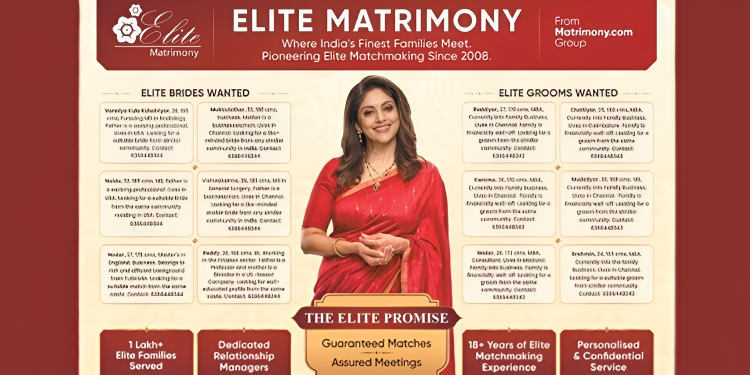
A few days ago, I came across an advertisement from a leading matrimonial platform. At first glance, it looked like any premium lifestyle advertisement. Elegant design. Aspirational imagery. A celebrity endorsing the portal.
The language of exclusivity. The promise of access to India’s “finest families.The word “Elite” dominated the communication. Elite Brides and Elite Grooms, Elite Familites etc. But as I looked closer, I realised that beneath the premium branding lay a familiar reality. Every prospective bride and groom was identified first and foremost by caste.
Vanniyar, Mukkulathor, Naidu ,Reddy,Nadar,Brahmin, Mudaliyar, Chettiar and so on and so forth and suddenly the word “Elite” acquired a different meaning.
What was being marketed wasn’t simply a premium matchmaking service. It was a premium platform for preserving social boundaries. And that raises an uncomfortable question.
In 2026, after decades of economic progress, educational advancement and technological innovation, why are we still so comfortable openly advertising caste-based matchmaking? Its like why should we carry our religion on our sleeve?
The Great Contradiction of Modern India
India today is a nation of remarkable contradictions.We proudly speak of becoming a global economic powerhouse.Our startups are building products for the world.Artificial Intelligence transforming industries.Young Indians collaborate across continents, cultures and time zones.
Students from different backgrounds study together. Professionals work together. Entrepreneurs build companies together.Yet when it comes to marriage the most personal and intimate decision of all we continue to retreat into centuries-old identities.
The same young man who works in a multinational team comprising people from different states, religions and nationalities is often expected to marry within the narrow confines of his caste.
The same family that proudly celebrates merit, education and professional achievement may still insist that their son or daughter find a partner from a particular community. The result is a strange duality. We want the benefits of a modern society while preserving the social architecture of a feudal one.
When Union actually becomes a Division
Traditionally, caste-based marriage preferences were often justified as family customs or cultural choices. Today, however, something different is happening. These preferences are no longer merely social practices. They have become commercial products. An entire industry has evolved around identifying, segmenting and matching individuals based on caste identities.
Technology that could have been used to expand possibilities is often being used to reinforce existing barriers. Algorithms sort people. Databases classify people. Marketing campaigns celebrate the classifications.
The business model is simple: identify a social division and monetize it. The more narrowly defined the category, the more valuable the customer becomes. What should concern us is not merely the existence of these platforms but the normalization of the idea that caste remains the primary filter in choosing a life partner. When this message appears repeatedly in newspapers, magazines and digital platforms, it ceases to be a preference and becomes a social endorsement.
The Meaning of “Elite”
Perhaps the most troubling aspect of the advertisement was the repeated use of the word “Elite. “ What exactly makes a family elite? Is it wealth? Education? Professional success? Social status? Or is it the ability to preserve social exclusivity? A truly elite society is not one that builds walls. It is one that breaks these walls or transcends them. A truly progressive society does not judge individuals based on inherited identities but on their character, competence and values. When caste becomes the defining criterion for matchmaking, “elite” becomes little more than a sophisticated label attached to an outdated idea. Premium packaging cannot transform social exclusion into social progress.
The Human Cost of Caste-Based Matchmaking
Defenders of caste-based matrimonial platforms often argue that they merely cater to existing preferences. There is some truth in that argument. Businesses respond to demand. But businesses also shape demand. Advertising is not a passive activity. It influences attitudes, reinforces norms and legitimizes behaviour.
Every time a young person sees a matrimonial advertisement where caste is the first and most important identifier, a message is conveyed, Who you are matters less than where you come from.Your achievements matter less than your ancestry. Your personality matters less than your surname.This is not merely about marriage.It is about how we define human worth.And that should concern all of us.
The Responsibility of Media Houses
This brings us to another important stakeholder in the conversation the media.
Media organisations frequently position themselves as champions of social progress, diversity and inclusion.Editorial pages carry thoughtful articles on equality.Newsrooms celebrate stories of social change.Campaigns are launched against discrimination and prejudice.Every media house takes a high moral standard.
Yet many of these same institutions continue to carry advertisements that openly segment people by caste.The obvious answer is revenue.Advertising sustains media businesses.
But should commercial considerations be the only standard? Media houses routinely reject advertisements that are misleading, offensive or socially harmful.
They exercise judgment in deciding what deserves public visibility.
The question therefore becomes: should caste-based matrimonial advertising continue to be treated as socially neutral?Or should media organisations begin a broader conversation about the values they choose to amplify?
Beyond Legality: The Question of Morality
The debate is not about banning advertisements.Nor is it about policing personal choices.
Individuals are free to make their own decisions about marriage.Families are free to hold their own preferences.The larger issue is whether society should continue to celebrate and commercially promote divisions that it simultaneously claims to be overcoming.
Many practices can be legal and still deserve scrutiny.The question is not “Can we do this?”
The question is “Should we continue doing this?”Progress is not merely the adoption of new technology.Progress is the willingness to rethink old assumptions and throw regressive stuff into the dustbin
The Future We Want
Every generation inherits certain social structures from the previous one.
But every generation also has a choice.It can preserve those structures unquestioningly.
Or it can challenge them.The India we aspire to build cannot be one where diversity is celebrated in the workplace but restricted in personal relationships.
It cannot be one where inclusion is a corporate slogan but exclusion remains a matrimonial criterion.And it certainly cannot be one where social divisions are rebranded as premium services and sold back to us as aspirations.The advertisement I saw may be successful from a marketing perspective.But it also serves as a reminder.For all our advances in technology, infrastructure and economic growth, some of our deepest social barriers remain stubbornly intact.The age of Artificial Intelligence is upon us.Perhaps it is time we applied a little more human intelligence to the values we choose to uphold.Because the true measure of a society is not how advanced its technology becomes.It is how many of its prejudices it has the courage to leave behind.
About the Author:
The author, K Anbuchezhian, is with Bluenoodles, a Chennai based Strategic Brand Consultancy and Problem Solving Agency. He is a Past President of Advertising Club ,Madras and an EC Member. He has earlier worked with L&K Saatchi &Saatchi, FCB Interface, Rediffusion etc
(Views are personal)