India’s media and entertainment ecosystem is undergoing its most dramatic transformation yet, as revealed in the latest industry whitepaper by Chrome OTT. The section titled “India’s Video Consumption Story — The Starting Point” provides a data-driven snapshot of how viewing behaviour has exploded across platforms, firmly establishing India as one of the world’s most converged media markets.
Cross-Media Consumption Is Now the Norm
According to the Chrome SES September 2025 study highlighted in the whitepaper, nearly the entire nation—1.27 billion individuals, or ~89% of India’s population—is actively consuming video content across one or more platforms. What stands out in the analysis is the scale and fluidity of cross-media consumption.
Indians are no longer confined to a single screen. Mobile, connected TV (CTV), and traditional television now coexist in a seamless consumption universe, with audiences switching between platforms in a manner that was unimaginable a decade ago.
Hybrid Viewers Form the Core of India’s New Media Reality
The biggest revelation comes from the Hybrid Viewership category.
As per Chrome SES data:
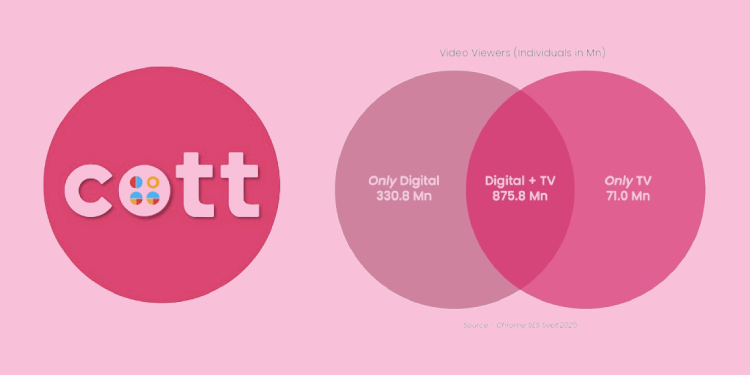
- Hybrid Digital + TV Viewers: 875.8 million
- Only Digital Viewers: 330.8 million
- Only TV Viewers: 71.0 million
- Total Universe: 1.27 billion individuals
This means that a staggering 69% of India’s video consumers watch both digital and television content.
The whitepaper’s visuals underscore this shift, portraying hybrid consumption as the new cultural habit of India’s audience. This is not a transitional phase but a structural reality: viewers prefer the convenience and breadth of digital platforms while retaining television for live events, news, and appointment viewing.
Digital Has Become Mainstream — But TV Is Far from Obsolete
While 330.8 million Indians consume video only on digital platforms, signalling the overwhelming rise of mobile- and OTT-led behaviour, the presence of 71 million TV-only viewers shows that traditional television remains deeply embedded, particularly among older demographics and rural cohorts.
The whitepaper stresses that digital is no longer the challenger—it is the mainstream medium. However, the charts also highlight that television’s decline narrative is overstated. With nearly 876 million hybrid consumers, TV continues to play a critical role in building shared cultural moments and mass reach.
The Cross-Media Explosion Is Redefining Content Strategy
This segment of the whilepaper illustrate how this convergence is reshaping platform strategies:
- Mobile remains the primary gateway for video consumption.
- CTV adoption is accelerating rapidly, backed by affordable smart TVs and internet access.
- Linear television continues to anchor household-level viewing and regional content consumption.
This multi-screen dynamic is compelling broadcasters, OTT platforms, and advertisers to rethink planning models. Instead of choosing between digital and linear, industry stakeholders must now design strategies that integrate both, given that most Indians consume both.
A Converged Future Is Already Here
The whitepaper positions India’s video landscape at an inflection point: a nation where digital dominance, television relevance, and CTV emergence coexist simultaneously. The findings make it clear that India is not migrating from one medium to another; it is expanding its consumption across all.
In essence, the data underscores a fundamental truth: India’s media market is not shifting — it is converging.
With hybrid viewership forming the backbone, India’s video consumption story is now defined by plurality, platform fluidity, and an unprecedented scale of cross-media engagement.