Introduction
Having spent three decades navigating the intricate currents of media strategy, I have witnessed firsthand how economic tides shape the very fabric of our industries. From the high stakes world of IPL advertising, where the pursuit of metrics sometimes overshadows memorable creativity, to the broader consumer landscape, the underlying pressures are always at play.
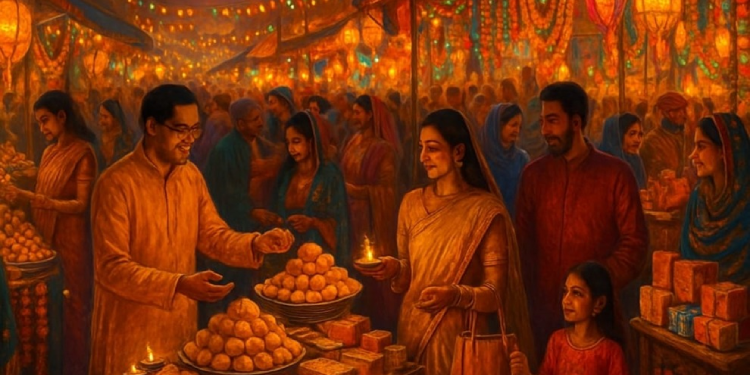
Now, as India gears up for its most cherished six week festival season, the vibrant stretch from Dussehra to Diwali, we find ourselves at a fascinating, albeit challenging, crossroads. This period, traditionally a beacon of consumer exuberance and a lifeline for brands, is unfolding amidst a complex web of economic headwinds. The question is not just about sales figures, it’s about the very spirit of celebration when wallets are tighter, jobs are uncertain, and global tariffs cast long shadows.
In this column, we will delve into what I call ‘The Great Indian Festival Paradox’ how consumers are adapting, how brands are recalibrating their strategies, and how the advertising industry itself is grappling with a new reality where every rupee spent must deliver not just reach, but genuine resonance. It’s a critical examination of how economic realities are reshaping India’s most significant cultural and commercial event.
Economic Headwinds Cast Long Shadows
India’s economic narrative in 2025 reads like a tale of two realities. While the economy demonstrated resilience with a surprising 7.8% growth in Q1 FY26, this masks underlying vulnerabilities that have emerged throughout the year. The GDP growth trajectory tells a sobering story, from a robust 8.2% in the previous fiscal year (FY24) to a projected 6.4-6.7% for FY 2024-25. Most concerning was the Q2 FY25 performance, where growth slumped to just 5.4%, marking the slowest pace in seven quarters.
This deceleration reflects deeper structural issues. Private consumption, which typically accounts for nearly 60% of India’s GDP, has been under severe strain. The Reserve Bank of India’s Consumer Confidence Survey revealed a troubling trend, household expectations across major parameters had moderated for two consecutive quarters, with the Current Situation Index dropping to 93.9 in July 2024 from 97.1 just two months earlier.
The festival season’s economic significance cannot be overstated. Historical data shows that festival consumption generates a multiplier effect with a Marginal Propensity to Consume (MPC) of 0.8-0.85, meaning every rupee spent during festivities amplifies national income by approximately 6.67 times. The 2024 festive expenditure of ₹4.65 lakh crore contributed nearly ₹31 lakh crore to GDP through this multiplier effect.
Consumer Spending: Optimism Meets Reality
Despite economic pressures, consumer spending intentions for the 2025 festive season remain surprisingly robust. Urban India is projected to spend approximately ₹1.85 lakh crore ($22 billion) during the 2024 festival season (used as a proxy for 2025 trends), with 50% of households planning to spend over ₹10,000 a significant commitment in challenging times.
The spending pattern reveals interesting behavioral shifts. While 40% of households plan to invest in home décor and 38% in beauty and fashion, there’s a notable preference for value driven purchases. The average festive budget has increased by 47% to ₹25,000 per household, but this growth comes with increased scrutiny on value for money.
However, this optimism masks significant segmentation. A stark reality emerges when examining India’s consumption landscape: approximately one billion people lack the disposable income for discretionary goods or services, highlighting the vast economic divide. This means that while aggregate numbers appear positive, the benefits are concentrated among a relatively small consuming class of 130-140 million individuals roughly equivalent to Mexico’s entire population.
The Advertising Industry’s Balancing Act
India’s advertising market crossed the ₹1 lakh crore milestone in 2024, reaching ₹1.23 lakh crore with 8.1% growth. However, this headline figure conceals a fundamental transformation that’s reshaping the industry landscape. Digital advertising has emerged as the dominant force, capturing 46% of total ad spend, up dramatically from just 24% in fiscal 2020. Digital platforms now command ₹70,000 crore in spending, more than double television’s ₹29,400 crore.
Traditional media faces an existential crisis. Television advertising declined by 6.4%, dragging overall growth down by 20 basis points. The challenges are structural, broadcasters are losing viewers to OTT platforms, while distribution networks face competition from fiber based services. The direct-to-home (DTH) segment alone lost over 10 million subscribers between December 2020 and 2024.
Print media confronts even starker realities, with circulation declining and readership migrating to digital news platforms. The decline has been precipitous, nearly 500 basis points over five years, as both readers and advertisers shift digital.
For brands, the festival season represents a critical juncture. The traditional playbook of aggressive discounting and celebrity endorsements faces scrutiny as consumers become increasingly value conscious. Brands are demanding greater accountability from media agencies, shifting focus from broad reach brand campaigns to performance marketing where every rupee spent must demonstrate measurable conversion.
Building on these shifts within advertising, the industry now faces two dramatic external disruptors directly affecting this festive season’s outlook, regulatory changes impacting key advertising spenders and a major fiscal reform poised to reshape consumer purchasing power.
The Online Gaming Advertising Blackout: A New Challenge
The arrival of the Online Gaming Bill 2025 has dramatically reshaped the advertising landscape just ahead of the festive season. This legislation has wiped out approximately ₹4,000 crore in annual advertising spend, nearly 10% of India’s digital advertising expenditure. Major players like Dream11, which had invested ₹5,700 crore in advertising over six years and sponsored the IPL with a ₹358 crore deal, have now exited cash-based contests. Concurrently, Mobile Premier League (MPL) announced significant workforce reductions, cutting 60% of its staff as revenue from India collapsed.
This disruption poses a severe challenge to agencies and brands, with an estimated 25% of IPL advertising revenue at risk, forcing a reconfiguration of advertising budgets and strategies in a critical season.
GST 2.0: The Double-Edged Festive Gift Arrives This Season
The government’s much-anticipated GST 2.0 reforms take effect from September 22, coinciding with Navratri and just before Diwali. Simplifying the tax structure from four slabs to primarily three (5%, 18%, 40%), these reforms usher in substantial tax reductions for essential and festive goods. Categories such as toiletries, small vehicles, and electronics benefit with rates dropping from 18% or 28% down to 5% or 18%, respectively, expected to reduce inflation by up to 1.1 percentage points.
Industry experts forecast a 15-20% increase in festive advertising expenditure linked to these tax benefits, driving the total ad market to possibly ₹55,000 crore in FY26. Yet, the timing during the Shraddh period (September 7-21), traditionally considered inauspicious for purchases, has generated consumer hesitation and inventory management dilemmas for retailers. Many automakers report delayed purchases as shoppers wait for the new GST rates, compressing the festive buying window into a shorter, intensified period.
Trump Tariffs: The External Shock
The imposition of 50% tariffs by the Trump administration in August 2025 has introduced a significant external variable into India’s economic equation. These tariffs, implemented in response to India’s continued purchase of Russian oil, could inflict a $55-60 billion blow to the economy.
The impact is far reaching. Nearly 66% of India’s $86.5 billion in exports to the US face these tariffs, with sectors like textiles, gems and jewelry, shrimp, carpets, and furniture potentially seeing export declines of up to 70%. The Global Trade Research Initiative estimates that Indian exports to the US could fall from $87 billion to under $50 billion, representing a devastating contraction.
The employment implications are severe. Labor intensive industries fear millions of job losses, particularly in textiles where razor thin margins make the tariffs economically devastating. This creates a domino effect, reduced export earnings lead to job losses, which in turn dampens domestic consumption, creating a vicious cycle that threatens festival spending patterns.
Economists estimate these tariffs could reduce India’s annual GDP growth by 0.6-0.8 percentage points, creating additional headwinds just as the economy attempts to recover from earlier slowdowns.
The Low-Income Household Squeeze
The most vulnerable segment in this economic landscape comprises India’s low income households, who face a triple squeeze of inflation, stagnant wages, and reduced employment opportunities. Food inflation has been particularly punishing, with certain categories seeing double-digit increases that disproportionately impact poorer families.
Research reveals that low-income households face systematically higher inflation rates than the official Consumer Price Index (CPI) suggests. The CPI exhibits a “plutocratic bias,” reflecting the consumption patterns of higher spending households while understating the cost pressures on the poor. For instance, while vegetables constitute 9.7% of poor households’ budgets compared to just 3.2% for rich households, the inflation gap can reach as high as 10 percentage points during periods of supply disruption.
The situation is compounded by structural factors. Nearly 35% of rural households and 22.4% of urban households are in debt, with significant portions of this debt taken for consumption purposes, education, medical treatment, housing, and basic consumption expenditure. This debt burden makes these households extremely vulnerable to inflation volatility.
Household savings have fallen to 18.1% of GDP in FY24, the lowest since FY17, while household financial liabilities surged to 6.2%, nearly doubling over the past decade. This indicates that families are increasingly relying on credit to fund basic consumption, a trend that’s unsustainable in the long term.
Brand Strategy Adaptations
In response to these challenging conditions, brands are fundamentally rethinking their festival strategies. The traditional approach of broad-based campaigns and aggressive discounting is giving way to more nuanced, value driven approaches.
Localisation has become paramount, with brands recognizing the imperative to tailor campaigns to regional traditions and economic realities. This shift acknowledges that India’s consuming class isn’t just economically diverse, it’s culturally and linguistically fragmented, requiring hyper-targeted approaches.
Digital innovation leads these adaptations. Brands are heavily investing in interactive content, social media engagement, and native advertising, with digital ad spending projected to hit ₹59,200 crore by year-end. However, the focus has shifted toward performance marketing, where ROI measurement is critical.
The rise of value-conscious messaging is evident across categories. Rather than emphasizing luxury and excess, successful campaigns are highlighting durability, functionality, and long term value. Brands are also incorporating Corporate Social Responsibility (CSR) initiatives into festive campaigns, appealing to consumers who increasingly prioritize socially conscious brands.
Pricing strategies have become more sophisticated, with brands offering flexible payment options, smaller pack sizes, and entry level variants to capture price-sensitive consumers without completely abandoning their premium positioning.
The Path Forward: Cautious Optimism
India’s festival season 2025 represents a critical test of economic resilience and adaptability. While the challenges are significant, from GDP slowdown to tariff pressures to household financial stress, the inherent cultural significance of festivals continues to drive spending behavior.
The key insight is that consumers haven’t stopped spending, they have become more strategic about it. The celebration continues, but it’s more intimate, focused on family and tradition rather than lavish display. Small ticket items, home improvements instead of major purchases, and experiences over expensive goods are likely to see stronger traction.
For the advertising industry, this environment demands empathy over mere promotion. Brands that successfully navigate this landscape will be those that understand the new consumer calculus, where joy and caution coexist, where tradition meets financial pragmatism, and where celebration adapts to constraint.
The festival season’s outcome will likely depend on three critical factors, the government’s policy response to support consumption, the actual implementation and duration of US tariffs, and the resilience of household finances through the crucial October-November period.
As India lights up for its biggest festivals, the true test won’t be measured in sales figures or campaign creativity alone. It will be determined by how well the entire ecosystem, brands, retailers, advertisers, and consumers, adapts to a new reality where festive cheer must coexist with economic uncertainty. The brands and strategies that emerge successfully from this challenging season will likely define the future of Indian consumer marketing.
The great Indian festival paradox of 2025 ultimately reflects the broader challenges facing emerging economies, how to sustain growth and cultural vibrancy while navigating global economic pressures and domestic structural adjustments. The answers emerging from this festival season may well shape India’s economic narrative for years to come.