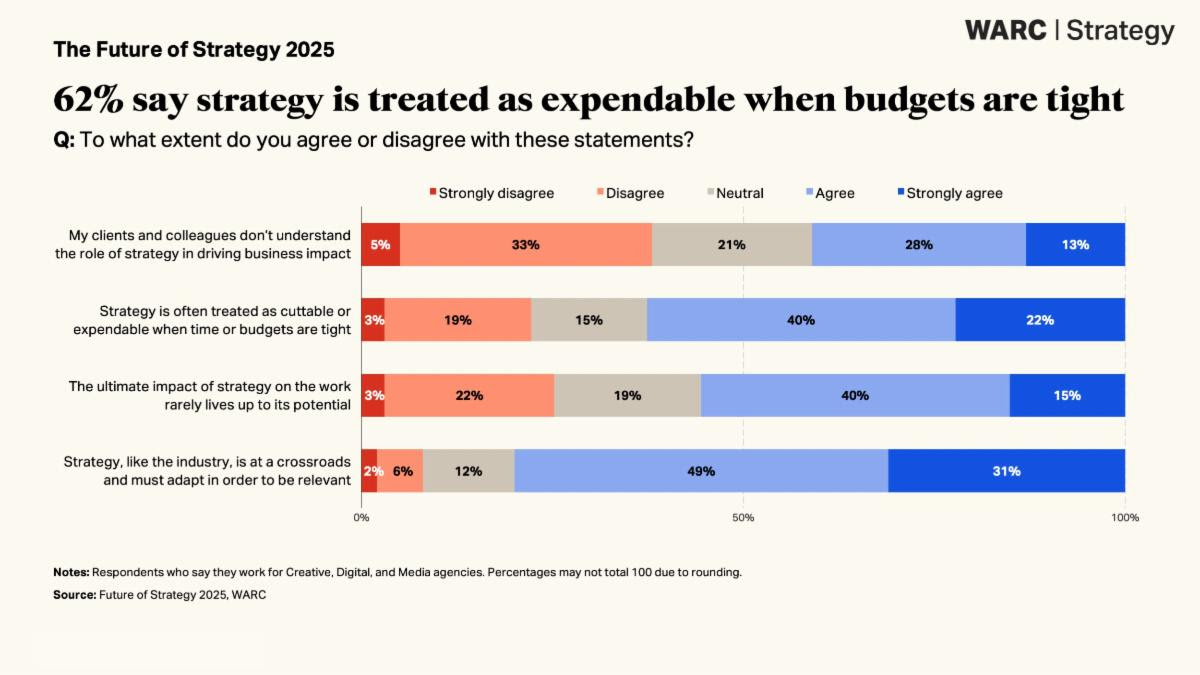
Mumbai: Strategy is at a crossroads, according to 80% of strategists worldwide, and all too often is treated as expendable. Yet, in a world characterised by uncertainty and volatility, client demand for clear strategic guidance is high. These are the key findings of The Future of Strategy 2025, released by WARC, the global authority on marketing effectiveness.
The annual study highlights the major challenges facing agency-side strategists and outlines opportunities to reignite the discipline, pivotal to the marketing ecosystem. The report draws insights from a global survey of 1,127 strategists, the majority agency-side, conducted in August 2025, along with expert perspectives from leading strategists worldwide.
Lena Roland, Content Director, WARC Strategy, said, “Our annual Future of Strategy report acts as a temperature check for how strategists are feeling about the state of the discipline. It explores the challenges in agency strategy, and the rise of independent strategists. It looks at the impact of AI and the importance of human-led research. This year’s survey makes for stark reading. It found agency-side strategists feel their discipline is at a crossroads and all too often is treated as expendable. Agency-side strategy needs to rebrand, focusing on helping clients identify where and how to grow.”
Key findings from the report include:
- The strategy paradox: 80% of strategists say the discipline is at a crossroads, 62% say strategy is treated as expendable, yet client demand remains high.
- Headcount pressures: Only 31% expect strategy headcount to grow in the next 12 months, down from 47% in 2024.
- AI’s impact: 76% reported increased use of AI tools this year, but concerns remain around originality (61%) and cultural nuance (60%).
- Career shifts: More strategists see their next role as client-side or in consultancies, with 24% of senior strategists considering consultancy roles.
Tom Morton, Founder, Narratory Capital, said, “The economic housing of strategy is coming apart, which is strange because the demand for it is as high as ever.”
Ellie Bamford, Chief Strategy Officer, VML North America, added, “We’ve become risk averse, and our clients have become risk averse… We are hiding behind mountains of data and research, and we’re not coming out strongly enough with our point of view. And that’s diminishing our value.”
On AI, strategists remain split. While 46% disagree that AI will erode their value, 37% believe AI may soon learn one of the discipline’s most valuable skills – the ability to take strategic leaps.
Oliver Feldwick, Chief Innovation Officer, T&P, said, “The challenge for strategists is not to resist AI, nor to blindly embrace it, but to partner with it. This is not about abdicating our role. It’s about evolving it. Reclaiming strategy from the grind and rediscovering the joy of thought.”
The report also emphasises the need for imaginative, disruptive thinking that goes beyond frameworks.
Joseph Burns, Strategy Lead, Quality Meats Creative, commented, “Strategy regains relevance when it stops polishing symmetry and starts opening up advantages: gaps in understanding (insights no one has), in access (places others can’t go), and in timing (moves others can’t match).”
Steve Walls, Planner, Moon Rabbit, added, “Planning needs to stop trying to be right and start trying to be useful. It needs to take leaps of faith and to convince others to follow it into the unknowable. Strategy should be infused with empathy, imagination, ambition and truth.”
Rebranding agency strategy as a growth partner emerges as a clear priority.
Tomas Gonsorcik, Global Chief Strategy Officer, BBH, said, “We have to rebrand strategy – not as a back-office function, not as a luxury, but as a service: clear, accountable, and indispensable. Strategy should operate as a standalone service inside the agency. Its primary customers are creatives and CMOs, and its purpose is to deliver growth clarity, not just decks.”