Indriya, the jewellery retail brand from the Aditya Birla Group, is recalibrating its media strategy as it rapidly expands its store footprint across India. While digital currently accounts for 55–60% of total media spends—largely led by Connected TV (CTV)—the brand expects to progressively increase investments in linear television as physical presence deepens across markets.
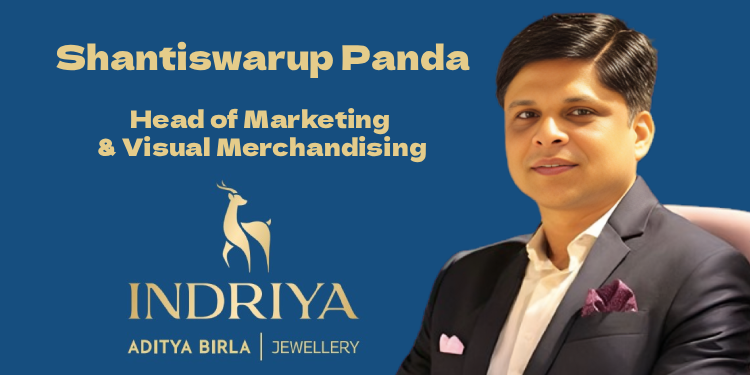
Speaking at a media roundtable, Shantiswarup Panda, Head of Marketing & Visual Merchandising at Indriya, said the brand’s media mix is closely tied to its retail expansion model and catchment-driven reach strategy.
“About 55% to 60% of our media spend goes toward digital. When I say digital, that includes Connected TV. We’ve been pioneers in using large-screen internet TV instead of satellite television, which allowed us to limit media spillover to only the cities where we have stores,” he said.
Rapid retail expansion drives media recalibration
Indriya marked a major milestone on 27 February by crossing 50 stores—one of the fastest scale-ups in organised jewellery retail. The brand launched in July 2024 with four stores across Jaipur, Delhi and Indore and expects to cross 75 stores by March-end.
Panda noted that jewellery retail expansion is structurally capital-intensive and location-dependent.
“In jewellery, expansion isn’t easy because stores require precise catchment selection, specialised layouts and significant inventory investment. Crossing 50 stores in such a short time is a big achievement for any jewellery retailer,” he said.
He attributed the pace of growth to strong consumer response and brand acceptance.
“The love and satisfaction of customers is encouraging us to expand much further,” he added.
From CTV precision to linear TV scale
Indriya’s early media strategy relied heavily on CTV to align communication reach with store presence. Panda explained that linguistic TV clusters often create unwanted spillover for emerging retail brands.
“If I buy a Marathi channel on satellite TV, I reach the entire state and even audiences outside India. But with CTV I can buy only Mumbai and avoid towns where we don’t have stores. That precision made sense when our footprint was limited,” he said.
However, with store expansion accelerating, the economics are shifting.
“As we scale, satellite TV becomes more judicious in cost per reach and recall. The spillover concern reduces as our footprint increases. So our media strategy will shift gears toward linear TV,” Panda said.
He emphasised that channel choice is driven by efficiency rather than digital bias.
“It’s not that we love digital. We use it because it serves our media efficiency.”
Brand saliency over performance in early lifecycle
At just 19 months old, Indriya is prioritising upper-funnel brand building over performance marketing.
“Performance for us today is softer—store directions or map clicks—because we don’t have e-commerce yet. Right now we must invest more in impact, memorability and brand love,” Panda said.
The brand correlates upper-, mid- and lower-funnel spends with store footfall, though performance contribution remains modest at this stage.
Campaign effectiveness is measured across four key indicators:
-
Reach and frequency (OTS curves)
-
Awareness and consideration (Kantar dipsticks)
-
Social engagement
-
Digital cost metrics (CPR, CPV, CTR)
“Jewellery purchases are infrequent. The key question is whether consumers consider Indriya among the brands they would visit when ready to buy,” he explained.
Influencer strategy shifts to short-term, micro-led model
Indriya has also reworked its influencer approach as the brand scales across regions.
“Influencer relevance is extremely time-bound. Signing creators for a year didn’t work because someone perfect today may not fit the brand six months later,” Panda said.
The brand now adopts a rolling selection model—choosing influencers one to two months ahead for specific content bursts.
“We’re focusing more on micro-influencers because their audiences are highly loyal and regional. That helps language-led content and drives consideration rather than just reach,” he noted.
Cinema remains high-impact medium for jewellery
Cinema continues to play a strategic role for Indriya, particularly in high-movie-consumption markets and mall-based store locations.
“Jewellery is an aspirational visual category that works beautifully on large screens. The best combination is cinema advertising when you also have a store in the same mall,” Panda said.
The brand selectively aligns cinema buys with predicted blockbuster releases and regional viewing behaviour.
“In Telangana, consumers may watch three films a month, so cinema becomes obvious. In other states, we choose only major releases. We analyse occupancy potential before investing,” he explained.
Indriya has also experimented with cinema-led experiential activations, including an Aurora-themed rooftop lighting installation for its Aasmaniyat collection launch.
“Cinema gives a captive audience. When the activation itself becomes shareable, memorability multiplies,” Panda said.
Social engagement outpaces category benchmarks
Despite being a young brand, Indriya reports engagement levels nearly three times category benchmarks, driven by a craft-led content narrative.
The brand currently has:
-
967K Instagram followers (expected to cross 1M shortly)
-
1.4M Facebook followers
“Our content celebrates the karigar and karigari. It’s not just advertising—it’s something people want to watch and share. That’s why engagement remains high,” Panda said.
Loyalty integration to strengthen repeat purchase
To deepen consumer relationships, Indriya recently integrated its ecosystem with a loyalty and marketing automation platform under its ReachVille programme and Sparkle app.
The system connects store visits, transactions and customer data to enable targeted engagement, referrals and reward-driven repeat visits.
“Everything from store entry to billing is now connected. We can engage meaningfully across the lifecycle and build a strong repeat-purchase base,” Panda said.
Media strategy remains footprint-led
As Indriya transitions from a launch-phase brand to a national jewellery retailer, Panda reiterated that media allocation will continue evolving alongside physical presence.
“Media strategy is dynamic. When footprint is small, precision channels like CTV work best. As presence expands, scale media like linear TV becomes more efficient. We will keep adjusting based on where we are in growth,” he said.