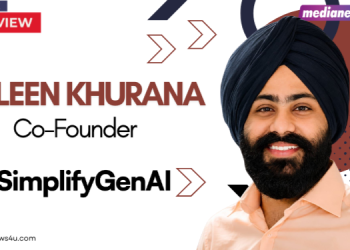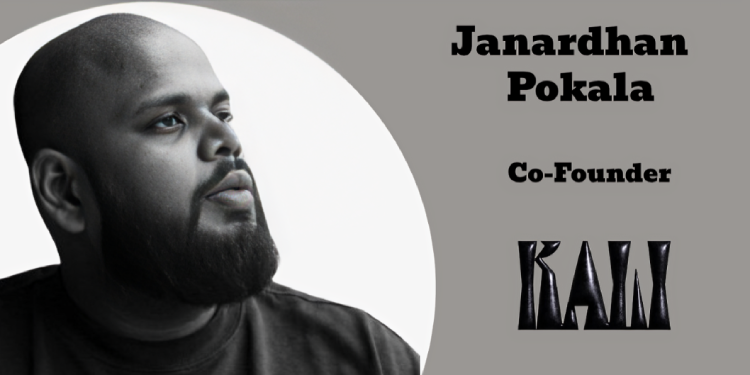
Janardhan Pokala, former Brand Head of Atlys, has co-founded KALI, a multidisciplinary creative agency working across brand strategy, mainline advertising, digital, film, still production, and emerging technologies.
KALI aims to be a response to how fragmented the work has become. In this agency creative, strategy, and execution sit at the same table. The people who create the work are involved from the first conversation to the final output. And where ideas aren’t diluted as they move through layers.
Before founding KALI, Janardhan served as Brand Head at Atlys, where he led brand and creative strategy across Indian and global markets. Prior to that, he spent more than a decade across leading agencies and brands, shaping identities, narratives, and campaigns across categories and geographies.
KALI is headquartered in Delhi and works with brands across the country.
Medianews4u.com caught up with Janardhan Pokala Co-Founder KALI
Q. What is the difference between a great creative agency and a merely efficient one?
Most agencies are built to be efficient. They deliver on time and within scope. They optimise processes, scale output, and reduce risk. That’s useful, but it’s not the same thing as being effective.
Great agencies are organised around responsibility. Not just for delivering work, but for what that work does once it’s out in the world. They question the brief, push against assumptions, and accept that getting something right sometimes takes longer than getting it approved.
Efficiency improves what already exists. Great work changes what exists. That requires judgment, conviction, and the willingness to stand by difficult decisions.
 Q. KALI is an agency where creative, strategy, and execution sit at the same table. What does this entail? How confident are you that this strategy will lead to greatness?
It means one thing: responsibility doesn’t change hands.
When responsibility is split across strategy, creative, distribution, and media, decisions get made in parts. Each part makes sense on its own, but the whole rarely holds together. Not because anyone did a bad job, but because no one was responsible for the outcome as a whole.
At KALI, the people who help define the problem stay involved through execution. That changes how decisions are made, because you live with the consequences of them.
Q. Does this mean that creative risk is embraced because responsibility will not be fragmented?
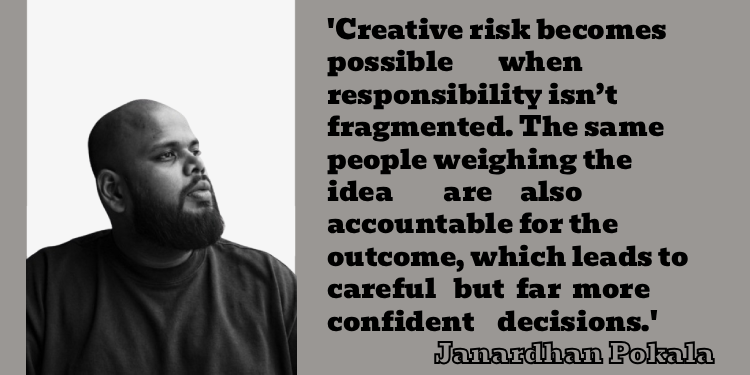
When responsibility is fragmented, risk becomes harder to take.
If an idea passes through enough hands, the safest decision at every step is to make it easier to approve. Not because people lack conviction, but because the cost of pushing back is personal. Over time, decisions optimise for agreement rather than outcome.
When responsibility sits with the same people end to end, that changes. Risk isn’t something to manage away. It’s something you weigh. The people making the calls are also the ones who live with the result, so decisions are more careful, but also more decisive.
Q. What goals have been set for 2026 and what is the game plan to get there?
The goal for 2026 isn’t growth in the conventional sense. By the end of the year, KALI should be recognised for a clear way of working, a consistent point of view, and a body of work that reflects both. If the work doesn’t reflect how we think, nothing else matters.
Getting there is deliberately unglamorous. We stay close to the work, and closer to the problem. That means choosing partnerships where trust and long-term thinking are valued, and avoiding growth driven by opportunism. As the business grows, it stays senior-led, ownership remains continuous, and responsibility doesn’t thin out. Any structure where the business matters more than the work is a problem.
Every decision is tested the same way: does this make the work better, or just the business bigger?
Q. The creative agency business is seeing consolidation. Are tech advances driving this and what does this imply for independent agencies?
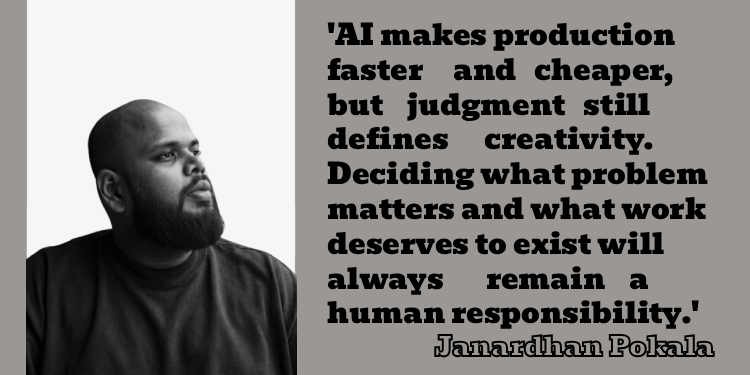
Consolidation is happening, and technology has played a role in it. Platforms, automation, and AI have made production faster, cheaper, and easier to centralise.
At scale, that creates clear operational advantages, and consolidation has become a way for large networks to protect efficiency in a market that increasingly rewards it.
What’s more telling than consolidation itself is what it reveals about priorities. In the process, many network agencies have diluted, merged, or retired their own brands with relative ease. When an agency doesn’t protect the brand that represents its own values, culture, and way of thinking, it raises a simple question: how seriously will it protect a client’s? The speed with which these decisions are made points to a shift away from stewardship and toward efficiency as the primary goal.
For independent agencies, this isn’t a threat so much as a test. Independence isn’t about rejecting technology or scale. It’s about being clear. As consolidation increases sameness, the agencies that matter will be the ones that protect their identity, stay close to the work, and remain accountable for the brands they help build.
 Q. Is the focus of KALI going to go beyond merely creating campaigns and creating a content system that compounds in value over time?
Most brands today still treat digital as an extension of mainline thinking. Big ideas are broken down, scheduled, and pushed out, as if consistency comes from repetition rather than behaviour. That’s where things start to break.
We have each spent years being part of brands that had to build themselves from the ground up in these environments. That experience changes how you think about brand building on digital. The systems we’re building at KALI are designed for that reality. They’re not content calendars or campaign extensions. They’re frameworks for behaviour: clear creative rules, tonal boundaries, and formats that can evolve without breaking the brand. Systems that allow a brand to participate in culture every day without needing a reset or reinventing itself.
Q. What role will AI play in shaping creativity at the agency and in the industry?
Tools have always changed. That’s not the interesting part.
What matters is still the same thing: knowing what problem you’re solving and having the judgment to decide what’s worth putting into the world. AI makes things faster and cheaper, but it doesn’t make those decisions for you. It doesn’t know when an idea is clear enough, or sharp enough to stand on its own.
At KALI, AI is used where it genuinely helps. To explore multiple creative directions early, to prototype films, visuals, and formats before committing production budgets, and to test variations of tone, structure, or pacing before something goes live. It’s also used to strip out repetitive work that doesn’t benefit from human judgment.
But deciding which direction is worth pursuing, what the work should say, and what it’s meant to do still sits with us.
Q. Are we in a situation where no campaign is started today without a clear line of sight to business outcomes?
Yes. Or at least, it should be.
A campaign exists to serve a business objective. Without that, it’s not really a campaign. You can’t create meaningful work if you haven’t first agreed on what it’s meant to change. Having a clear line of sight to business outcomes isn’t about reducing creativity to metrics.
It’s about defining the problem properly. When you know whether the job is to drive growth, shift perception, change behaviour, or build momentum, creative decisions become clearer and more intentional.
The question isn’t whether campaigns should be tied to outcomes. That’s a given. The real work is being honest about those outcomes early, so creativity has something solid to push against.
 Q. Which are the clients and sectors that KALI is working in?
We’re working with a few national brands across real estate, jewellery, beauty, and FMCG, on both projects and retainers.
The work spans brand thinking, creative development, and execution across platforms.
Q. To get fair remuneration is it key that KALI first thoroughly understands the business objective of a client?
Yes. Obviously.
We don’t expect a doctor to diagnose or treat us without first understanding what’s wrong. An agency isn’t any different. If the business objective isn’t clear, everything that follows is guesswork.
Fair remuneration comes from understanding the problem, not counting the effort. Without clarity on what the work is meant to change, you’re not really pricing a solution. And that’s never a fair starting point for either side.
Q. Is the big challenge facing creative agencies today is not declining attention spans but the fact that consumers are not being given enough content from brands that is worth their time?
Yes. And it’s an uncomfortable truth for the industry.
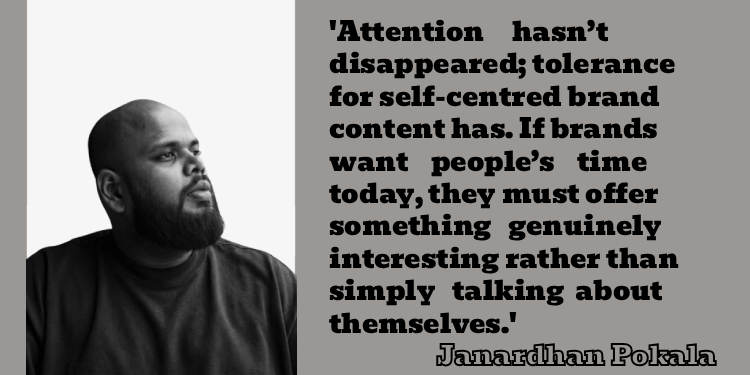
The problem isn’t attention. People will happily spend hours with a podcast, a film, or a creator if what they’re engaging with is genuinely interesting. Attention hasn’t disappeared. Tolerance for self-centred brand content has.
If brands want to belong in these spaces, they have to change what they’re offering. Content can’t exist only to talk about the product. It has to earn time in its own right. When it doesn’t, people don’t tune out because they’re distracted. They tune out because there’s no reason to stay.
This isn’t about shorter formats or smarter media buying. It’s about accepting that brands are guests in these environments. And guests only get listened to when they bring something worth listening to.
Q. Is being a slave to the algorithm which hinders creative risk taking another challenge?
No. That’s a convenient excuse. The algorithm doesn’t decide whether work is good or not. People do. It simply reflects what people choose to spend time with.
When teams say the algorithm limits creativity, what they’re really saying is that they don’t yet understand the behaviour they’re designing for. The teams that consistently do well don’t treat it as a constraint.
They understand the audience deeply enough that the algorithm becomes irrelevant. If the work is interesting, it will garner attention. If it isn’t, no amount of optimisation can save it.
Q. Is KALI going to focus on meaningful storytelling that resonates as opposed to viral content for the sake of it?
Chasing virality as an objective usually leads to work that burns bright and disappears just as quickly. It might travel, but it rarely builds anything.
Over time, it also nudges agencies into making decisions based on what might spike, rather than what’s actually sound for the brand.
Work with a clear point of view and a defined role for the brand can travel just as far, and last much longer. At KALI, we’re not interested in choosing between storytelling and scale. The goal is to make work that earns attention and leaves something behind. If it travels, great. If it doesn’t, but strengthens how a brand is understood and remembered, that matters more.
Virality is an outcome. It can’t be the brief.
Q. What role will data and predictive analytics play in KALI’s ability to read the consumer?
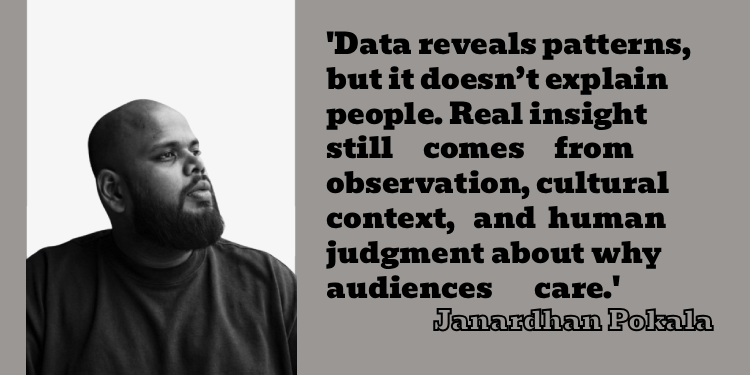
Data and predictive analytics are tools. Useful ones. But they don’t read people. They read patterns.
They help us understand what’s happening at scale. What’s repeating, what’s shifting, where behaviour is changing. That’s valuable, especially when you’re making decisions across platforms and volumes of work.
But patterns aren’t insights. Data can tell you what people did. It can’t tell you why people care, or what they’ll care about next. It doesn’t understand context, culture, or contradiction.
At KALI, data helps us ask better questions and avoid obvious blind spots. It informs the work, but it doesn’t lead it. Understanding people still comes from observation, judgment, and paying attention to how the world actually behaves, not just how it reports itself.
 Q. Microdramas are competing with short form videos for consumption. Will KALI be working in this area? What is the opportunity that microdramas offer brands?
Microdramas aren’t interesting because they’re a format. They’re interesting because they signal a shift in how people want to spend time.
Short-form video optimises for speed and repetition. Microdramas optimise for immersion. People aren’t just consuming them, they’re committing to them. That tells you something important: audiences are willing to stay when there’s a narrative payoff.
For brands, the opportunity isn’t to treat microdramas as another format to adopt. It’s to recognise what they’re doing right. Sustained storytelling, character, tension, progression. Things advertising quietly moved away from when everything became about speed and output.
At KALI, we’re interested in formats that allow brands to build meaning over time. If microdramas are the right container for that, we’ll work in the space. But the goal isn’t to make branded microdramas. It’s to create work that people choose to come back to.