In many aspects of daily life, people are often guided by long-standing beliefs associated with the number three – whether it is three people travelling together, or three people embarking on a task. This sentiment finds expression in a familiar phrase, “Teen tigda kaam bigda” (“Three’s a crowd”), that we simply follow.
Building on this insight, HSBC Mutual Fund recently introduced a new digital film, ‘Teen Tigda Kaam Tagda’, emphasising the strategic advantages of the ‘Power of Three’ of investing in Multi Cap funds. This initiative aims to reinforce the value of diversification for investors seeking balanced long term portfolio growth with HSBC Multi Cap Fund.
The film Teen Tigda Kaam Tagda is a creative initiative that reinterprets the belief around the number three and presents them in the context of smart investing. In the world of investing, the number three, as captured in the film, reflects the strength of Multi Cap funds, which invests across large cap, mid cap, and small cap stocks. This diversified approach helps investors balance risk and reward, capturing growth opportunities across the market spectrum.
The ‘Teen Tigda Kaam Tagda’ campaign has been rolled out across multiple media platforms, including digital, print, and outdoor.
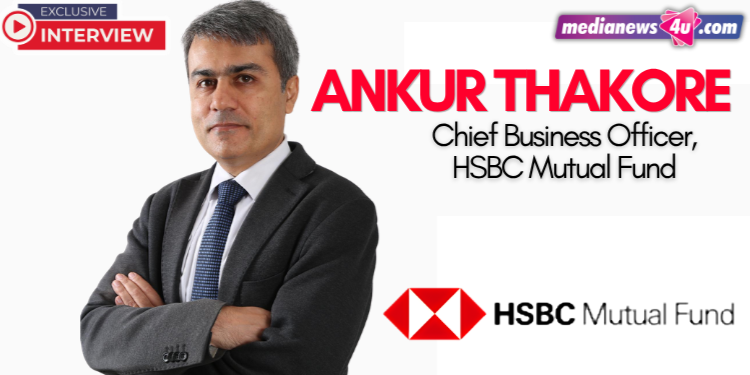
Medianews4u.com caught up with Ankur Thakore, Chief Business Officer, HSBC Mutual Fund
Q. Earlier the campaign messaging and the tone adopted in the BFSI sector used to be formal. Are we now seeing more creativity in terms of campaigns in the BFSI sector where things like humour are being adopted?
Yes, there is a clear move towards more creative campaign styles in the BFSI sector, while still recognising that financial services remain a serious and trust-led category.
Humour is increasingly being used as a strategic tool, not to trivialise financial products, but to make communications more noticeable, relatable, and memorable. When used carefully, subtle humour can help simplify complex financial concepts, make messaging more accessible, and strengthen audience connection—while still maintaining a professional tone and reinforcing confidence in the brand.
The intent is to avoid financial messaging feeling overly technical or dull. When done well, humour can help improve comprehension and connection without undermining credibility.
 Q. Is the goal of marketing in 2026 by HSBC MF to promote better knowledge on the mutual fund industry?
One part focusses on informing and educating customers on various aspects of mutual funds—this could range from better retirement planning to helping investors differentiate between various product categories, which can often seem jargon-heavy.
At the same time, there will be campaigns focused on building the brand proposition and some that are product-led, such as the multi-cap campaign. We have also done campaigns like the retirement one, which was more educational in nature and aimed at shifting investor mindset.
Overall, it is a combination of both—education as well as product-led communication. In a way, it is also about de-jargonising industry terminology. While investors are familiar with SIP, they may not be as clear about concepts like SIP Top Ups. These are not complex but simplifying them helps improve understanding.
Q. Is lack of financial literacy, misinformation as a result of hard selling products a big challenge? What should the way forward be in the coming three years?
Lack of financial literacy is definitely a significant challenge.
The industry’s endeavour has been to create more informed customers, where information includes understanding both risk and reward and not just focusing on returns. Mutual funds have consistently communicated that while there can be risks to capital in certain product categories, they can also be rewarding if invested in over the long term.
Currently, penetration remains low, with less than 5% of the population invested in mutual funds. However, there has been gradual progress. Over the last five years, penetration has moved from roughly 3–3.5% to around 6%, which is a gradual but positive development.
This is a long-term journey. We cannot make the entire country financially literate in a short period. The effort needs to continue with the same intensity over a sustained period of time.
Q. In 2026 will HSBC MF grow its ad spends. If so will growth for each medium take place be it traditional or digital? Kindly elaborate.
We expect overall advertising spend to remain broadly stable, with no significant increase. Our focus is to optimise the media mix to better meet investor needs – maintaining a strong digital presence while increasing our use of traditional channels such as television and print where they add reach and credibility. In short, the shift is about broadening and balancing traditional and digital media, rather than increasing total spend.
Q. Is Jan-March the most important marketing period? Or will marketing activities take place across 2026?
Ans: For us, marketing activity is spread across the year rather than being limited to a specific period.
 Q. HSBC MF recently launched a campaign on ‘Teen Tigda Kaam Bigda’ with Multi Cap Fund campaign. Could you talk about the brainstorming with the creative agency that led to the campaign?
This links back to the use of humour in communication, ensuring that financial messaging does not come across as overly serious.
“Teen Tigda Kaam Bigda” Is a familiar phrase that is widely recognized. Our campaign, “Teen Tigda Kaam Tagda” uses self-aware humour to connect with viewers, never mocking beliefs but gently encouraging viewers to think differently when it comes to their financial decisions.
The campaign emphasizes the strategic advantages of the ‘Power of Three’ of investing in Multi Cap funds. The initiative aims to reinforce the value of diversification for investors seeking balanced long term portfolio growth with HSBC Multi Cap Fund.
It resonates well with audiences as it builds on a familiar phrase while giving it a new meaning. It essentially puts a fresh spin to a well-known proverb, making the concept more relatable and easier for audiences to connect with.
Q. Print is one of the legs of the campaign. Is this vehicle important because BFSI consumers trust newspapers and financial magazines for their authenticity and credibility?
Yes, print continues to be an important part of the campaign mix.
There is a level of trust associated with newspapers and financial publications, especially in the BFSI space. As a result, print carries a fair share of the marketing allocation and continues to be a critical medium.
Q. Could you shed light on what HSBC MF’s social media strategy looks like in 2026? Is an understanding of the subtle nuances of each platform like Instagram, Facebook, LinkedIn, YouTube key to success?
Our social media strategy is centred on brand building and financial education, not direct product promotion. The broader approach is to use digital media to communicate with audiences, often younger segments—in a way that helps them understand financial concepts better.
Platforms that are more closely linked to the investment ecosystem are used more actively to amplify educational content. Overall, social media functions primarily as a brand presence and servicing channel, rather than a product-push vehicle.
 Q. What marketing tactics will be adopted to forge a better connection with Gen Z who are starting to earn?
Gen Z consumers who are beginning to earn are significantly more engaged on digital-first and social media platforms than through traditional advertising channels. As a result, our marketing approach prioritises digital communication as the primary route to reach, engage, and build relevance with this audience segment.
To connect effectively, it is equally important that our messaging is clear, accessible, and easy to understand. This means using plain language, reducing unnecessary jargon, and presenting information in a more simplified and relatable way. By combining a strong digital presence with straightforward communication, we can create more meaningful connections and improve resonance with Gen Z as they enter the workforce and begin making financial decisions.