The advertising industry has seen acquisitions, mergers, and technology integrations for decades. Yet every once in a while, a deal triggers something larger than a business headline. It triggers anxiety, excitement, speculation, and ecosystem-wide interpretation.
The acquisition of LiveRamp by Publicis Groupe, announced on May 16, 2026, in an all-cash transaction valued at $2.5 billion, appears to be one such moment.
What is interesting is not merely the deal itself, but the intensity of the conversations it has sparked. From LinkedIn thought pieces to senior industry WhatsApp groups and boardroom discussions, this acquisition is being read less as a corporate transaction and more as a declaration, a signal of where advertising’s future infrastructure is heading, and more critically, who will control it.
Some are calling it the consolidation of an open data ecosystem under private ownership. Others see it as the definitive shift toward identity-led advertising in the post-cookie era. A few are already drawing uncomfortable comparisons to the early formation of walled gardens, except this time, the acquiring party insists everything will remain interoperable and neutral.
That insistence is precisely what the industry is debating.
What Publicis Actually Bought
To understand why this deal has landed with such weight, it helps to understand what LiveRamp actually is, and why many outside adtech circles may have underestimated its strategic value until now.
LiveRamp is a global data collaboration platform connecting over 25,000 publisher domains and 500-plus technology and data partners across 14 markets. It enables brands, retailers, media platforms, and data providers to collaborate and share data effectively, efficiently, and securely. It transforms fragmented, disconnected data into a unified, actionable asset built for insight, activation, and measurement.
In a digital ecosystem where third-party cookies are fading and platforms are tightening their walls, knowing who your audience is and how to reach them without depending on any single platform’s permission, has become the most contested layer in modern advertising.
Publicis did not buy a technology vendor. It bought the connective tissue of the open internet’s advertising ecosystem.
The Strategic Logic and the Larger Ambition
This acquisition does not exist in isolation. It is the second major infrastructure move in Publicis’ deliberate, decade-long transition away from being a traditional holding company.
After acquiring Epsilon in 2019, positioning it as the tool to help brands take back control of their data from platform giants, shifting from cookie dependency to durable identity, Publicis is now making the next move in that sequence.
Combined with Epsilon’s capabilities, LiveRamp’s clean rooms, data connectivity, marketplace, and partner network will build what Publicis describes as a leader in data co-creation. The promise: smarter AI agents, new insights without data movement, and stronger end-to-end measurement of advertising performance.
The framing is deliberate. With Epsilon in 2019 and LiveRamp now, Publicis has made a sequence of moves that no traditional holding company has matched, acquiring not campaigns, not talent, not creative reputation, but infrastructure. Data infrastructure. The kind that sits underneath every campaign, every platform, and every transaction in the ecosystem. By any honest reading, Publicis is no longer a media or creative company that uses technology.
It is a technology company that owns agencies.
The Neutrality Claim and Why the Industry Is Not Entirely Convinced
Here is where the conversation becomes genuinely complicated.
Publicis has stated that LiveRamp will continue operating as a neutral, interoperable platform. No current or prospective customer will be prohibited from or restricted in accessing its services. Client, partner, and publisher data will remain protected under existing contractual commitments and will not be used beyond what those agreements expressly permit.
These are significant commitments. LiveRamp’s CEO Scott Howe will continue leading the business, reporting directly to Publicis Groupe CEO Arthur Sadoun. That structure signals that operational independence is, at least formally, being preserved.
But there is a distinction the industry is quietly drawing. Commitments made at the moment of announcement are one thing. Commitments maintained under sustained commercial pressure across years, at scale, in an AI-driven competitive environment are another. The industry has seen this pattern before. Neutrality is easiest to promise at the beginning.
The deeper question is not whether Publicis intends to restrict access today. It is whether the gravitational pull of commercial incentive will, over time, tilt what was once neutral infrastructure toward preferential outcomes for Publicis clients.
That is not an accusation. It is a structural reality every stakeholder must now factor into their planning.
The Broader Transformation This Deal Reflects
The Publicis–LiveRamp acquisition is not an isolated event. It is a visible marker in a larger pattern reshaping the industry.
Agencies are no longer positioning themselves purely as communication partners or media buyers. The holding companies that survive the next decade will be those that have built, or bought, capabilities across data, audience intelligence, AI-driven activation, and commerce media. This transaction signals that the build-or-buy phase is no longer theoretical. The infrastructure is being locked in now.
For brands and publishers that spent years building first-party data capabilities to reduce platform dependence, a new concentration point in the data layer raises legitimate questions. The post-cookie era was meant to distribute power more evenly. The risk is that consolidation at the infrastructure level quietly recreates the same dynamics under different ownership.
For competing holding companies, this deal will accelerate parallel searches for comparable assets. What Publicis has done with Epsilon and LiveRamp, others will attempt to replicate — or counter.
What This Moment Actually Represents
The reactions to this deal reveal something larger than any single acquisition. Advertising is no longer primarily a business of creativity, media planning, or campaign distribution. It is increasingly a contest over authenticated audiences, data collaboration, AI-driven decisioning, and ownership of consumer intelligence.
The most valuable asset in this new era is not inventory. It is the layer that connects data, audience, and trust across a fragmented ecosystem and determines who can access that connection, on what terms, and at what price.
At $2.167 billion in enterprise value, representing a nearly 30% premium to LiveRamp’s market price, Publicis has made its view of that value unambiguously clear.
The Publicis–LiveRamp acquisition may eventually be remembered not as a corporate transaction, but as the moment the industry acknowledged, openly and irreversibly, that the battle for advertising’s future is a battle for the data layer and that the data layer now has an owner.
Whether that owner exercises its position with the restraint it has promised is a question only time, and competitive pressure, will answer.
ABOUT THE AUTHOR
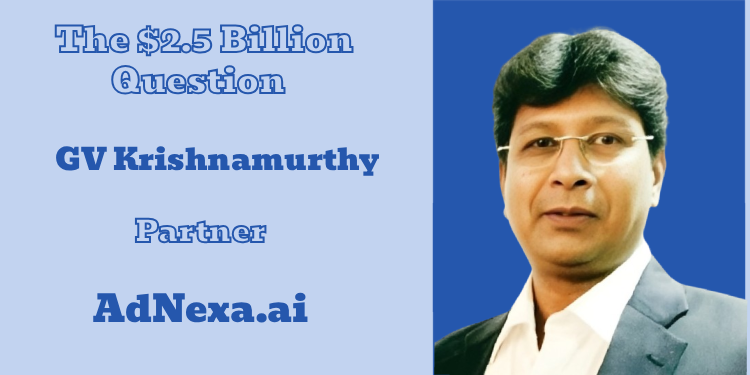
GV Krishnamurthy (GVK) is Partner at AdNexa.ai and a veteran media strategist with over three decades of experience spanning broadcast, print, digital, and advertising strategy across India. A committee member of the Advertising Club Bangalore, GVK writes regularly on media accountability, measurement gaps, and structural shifts in India’s advertising ecosystem. Views expressed are personal.