Why the future of marketing will be won not by better dashboards, but by better sensing systems.
1. The Lesson Hidden Inside the FIFA Ball
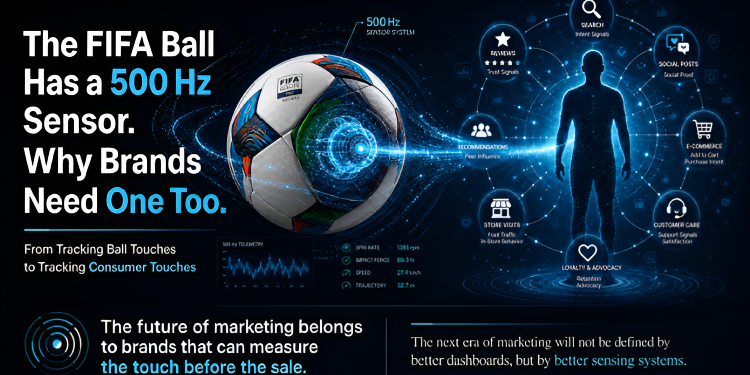
The most significant innovation in football today is invisible. Embedded inside the FIFA World Cup ball is a sensor capable of capturing movement 500 times every second, recording every touch, spin, acceleration, impact and directional change in real time and transmitting it instantly. For decades, football attempted to improve officiating through better observation—more referees, more cameras and more replays. Yet FIFA realised the real challenge was not observation but information. By instrumenting the ball itself, football made the invisible visible. Many industries, including marketing, continue to invest heavily in observing outcomes while investing far less in understanding the signals that create those outcomes. The FIFA sensor demonstrates that competitive advantage often comes not from seeing more clearly, but from sensing more deeply. Marketing today stands at a similar crossroads, where the winners may not be those with the most dashboards, but those with the best sensing systems.
2. Why Traditional Marketing Measurement Is No Longer Enough
Over the last two decades, marketers have built extraordinary measurement capabilities. We can track sales, optimise campaigns, analyse customer acquisition costs and monitor performance with unprecedented precision. Yet most of these metrics are outcomes. They tell us what happened after consumers made their decisions. Today’s consumer journey is no longer linear. A product may be discovered on social media, researched through search engines, validated through reviews, compared with competitors, discussed with friends and only then purchased. The transaction is merely the visible end point of a much longer decision-making process. Most systems capture the final event but miss the behavioural evolution leading to it. As a result, organisations often manage future growth using rear-view mirrors. The future requires understanding not only what consumers bought, but how they arrived at the decision to buy.
3. The Martech Paradox: More Data, Less Foresight
Paradoxically, marketing has never had more technology. Google Analytics, Adobe Analytics, Salesforce, Nielsen, Kantar, attribution systems and marketing mix models all provide valuable information. Collectively, they have made marketing one of the most measurable functions in business. Yet despite this abundance of data, many organisations still struggle to anticipate change. Measurement and foresight are not the same thing. Most platforms were designed to explain the past rather than predict the future. They tell us where consumers were, what they clicked and what they purchased. They do not necessarily reveal where demand is heading. This creates the Martech Paradox: executives are drowning in metrics while still searching for insight. What businesses increasingly require is not another dashboard, but systems capable of identifying emerging behavioural patterns before they appear in sales reports.
4. The Rise of Behavioural Sensing
Every purchase begins long before the purchase itself. It begins with intent, and intent leaves signals. Search queries, review consumption, competitor comparisons, pricing checks, store visits and recommendations are all indicators of future behaviour. Historically, organisations struggled to connect these signals because they were scattered across platforms and channels. Artificial Intelligence changes that equation. AI can analyse millions of interactions simultaneously and uncover patterns invisible to human analysts. Intent becomes measurable. Confidence becomes measurable. Advocacy becomes measurable. Purchase probability becomes measurable. Demand itself becomes measurable. This shift from measuring transactions to sensing behaviour may become one of the defining characteristics of next-generation marketing. The organisations that master behavioural sensing will gain the ability to detect change before competitors do.
5. Marketing Capital Intelligence and StrataPilot AI
As marketing evolves, a new discipline is beginning to emerge: Marketing Capital Intelligence. Historically, marketers managed budgets. Tomorrow, they will increasingly manage capital. Budgets are spent; capital is invested. Investment decisions require prediction. Yet much of marketing still relies heavily on historical analysis. StrataPilot AI was created to address this gap. Most organisations already have access to data, but they lack a system capable of transforming fragmented signals into predictive intelligence. StrataPilot acts as a behavioural sensing layer sitting above the existing marketing ecosystem. Rather than replacing analytics, CRM or research platforms, it connects their signals and converts them into foresight. If traditional platforms explain what happened, StrataPilot seeks to help organisations understand what is likely to happen next. It focuses on the touches that create the goal, not just the goal itself.
6. The Next Race in Marketing
For years, marketing technology companies competed to measure more accurately. The next race will be to predict more accurately. Growth is rarely created at the moment of purchase. It is created through thousands of interactions that occur beforehand—every search, review, recommendation, comparison and moment of consideration. The organisations capable of sensing these shifts first will allocate capital more intelligently, respond faster to market changes and identify opportunities earlier. Football discovered this lesson through a 500 Hz sensor embedded inside a ball. Marketing is beginning to discover the same lesson through behavioural sensing and predictive intelligence. The future belongs to brands that can measure the touch before the sale, detect change before competitors and allocate capital before the market recognises the opportunity. Competitive advantage belongs to those who can sense the game while it is still being played.
About the Author:

Ashok Vidyasagar, Founder & CEO of Strata7 Consulting LLP and StrataPilot ai.A consulting firm which predicts Marketing Capital Allocation for Enterprise brands before investments are made, a first of its kind .He is a seasoned veteran with over two decades of experience leading marketing and capital strategy of global and local brands .Former Management consultant and Director at EY-Parthenon.
StrataPilot’s Agentic-AI & RAG-based Intelligence is the only AI application in the market today for Predictive Marketing Capital Allocation to unlock pre-spend ROI with certainty, and serves as a decision cockpit for CEO/CFO/CMO across industries with large marketing spend. StrataPilot’s AI application serves as a predictive intelligence engine for market capital allocation before investments are committed by unifying creative, media, and market signals into one predictive decision layer.
(Views are personal)