Three months ago, I asked whether India’s micro-drama boom was a structural shift or a context driven spike. The market has spent the last ninety days answering. Not in the way the optimists hoped.
In March 2026, I made five calls on this platform. Retention was unconfirmed. Genre concentration was a medium term risk. RMG attention migration was an underacknowledged tailwind. Production economics were unclear at scale. And advertising investment would follow retention data, not acquisition headlines.
Three months later, every one of those calls has been validated. This is not a victory lap. It is the harder conversation that follows when the room fills up faster than the fundamentals can justify.
The Room Filled Up. Fast.
The entry velocity since March is itself the story. Yash Raj Films committed approximately ₹150 crore. MS Dhoni joined Kuku as investor and brand ambassador. JioHotstar launched Tadka. Amazon, ZEE5, Balaji, Hoichoi, and Tata Play Binge all entered with dedicated verticals. Players in this space raised approximately $44 to $48 million through seed rounds in 2025 alone.
In May, Karan Dayanidhi Maran launched KadhaiShorts, Tamil Nadu’s first micro-drama platform, pay-per-series from ₹20. And just days ago, Manish Singhal, Director at Enterr10 Television, announced on LinkedIn that Dangal TV’s network will soon expand into micro-drama. Dangal built itself into India’s most-watched Hindi entertainment channel by genuinely owning the heartland audience, without a Reliance or Sony behind it. That is precisely the audience this format is fighting for.
This is no longer a startup ecosystem. It is a full-spectrum land rush, and when this many credible names enter a category this fast, the FOMO has usually outrun the fundamentals.
The Economics Nobody Is Saying Out Loud
Subscription plans sit between ₹150 and ₹200 per month. CAC, the amount spent primarily on Meta to acquire that user, is by one platform founder’s own account running at 140% of revenue generated. Some platforms reportedly generating upwards of ₹250 crore in revenue are spending approximately ₹140 crore on marketing, 56% of gross revenue going to Meta before a rupee of content cost. During IPL or World Cup windows, that CAC reportedly rises to ₹500 to ₹700 per user, against a ₹150 to ₹200 monthly subscription, in the same month.
The model is a bet on lifetime value. So the next question is obvious: how is retention actually performing?
The AutoPay Number That Doubles as a Confession
According to the FICCI EY report, 70 to 80% of micro-drama subscribers authorise UPI AutoPay mandates. Up to 60% are likely to drop without it.
A format whose retention strategy is a recurring payment mandate that users in Tier-II and Tier-III cities, who make up 60 to 75% of the user base, may not fully understand they have authorised, is not product-market fit. It is payment architecture fit. Those are not the same thing.
In March I wrote that a platform with strong acquisition and weak retention is a funnel, not a flywheel. Here is what thirty years in media revenue tells me about a business held together by payment mandates: the moment a competitor offers the same content free, even briefly, the mandate cancels. I have watched DTH operators, cable networks, and OTT platforms all discover this.
Stickiness built on friction is not retention. It is delay. The micro-drama platforms are not building subscribers. They are building a queue of future churners.
The Global Comparison That Does Not Hold
Every boardroom conversation about micro-drama begins with China, whose market generated approximately $5 billion in 2023. The argument: India is simply China three years earlier. I think that comparison is being used to justify decisions the Indian market cannot yet support. China has WeChat Pay woven into every content interaction; India’s paying base for digital content remains thin, and the AutoPay data above is the evidence. China’s genre traditions run deep; India’s sits on three decades of television soap opera and has not found a grammar of its own. And Douyin built its own distribution over years; India’s platforms are renting Meta’s. India is not China three years earlier. The comparison is a fundraising narrative, not a thesis.
Discovery, Not Intent
Ormax and Meta released joint research in March 2026 worth pricing this category against. It found that 65% of micro-drama viewers discovered the format within the last year. Most still call it “short story videos.” They do not know the term “micro-drama” exists. They did not search for this format. The algorithm served it to them.
A category sitting on $300 million in revenue that its own audience cannot name is not a brand relationship. It is an accident still in progress.
Discovery through algorithm is among the most fragile forms of audience acquisition there is. The feed that surfaces micro-drama today will surface something else tomorrow. Every platform here is one algorithm update away from losing the only channel bringing it users.
What Advertisers Are Actually Doing, Not Saying
Brands including AJIO, HUL, Renee Cosmetics, Swiggy, Zomato, and Haldiram’s have started experimenting with micro-drama placements. That sounds like validation. It is not.
Every brand named above is allocating test budgets, not committed spend. A media head at a multinational brand has said publicly that their approach would not involve integrating into pre-existing concepts on open platforms. A marketing consultant in the same conversation was blunt: for pure acquisition, he would still put the money into Reels or YouTube Shorts. Micro-drama works for brands only inside controlled environments, a Myntra, a food delivery app, where the surrounding content can be managed.
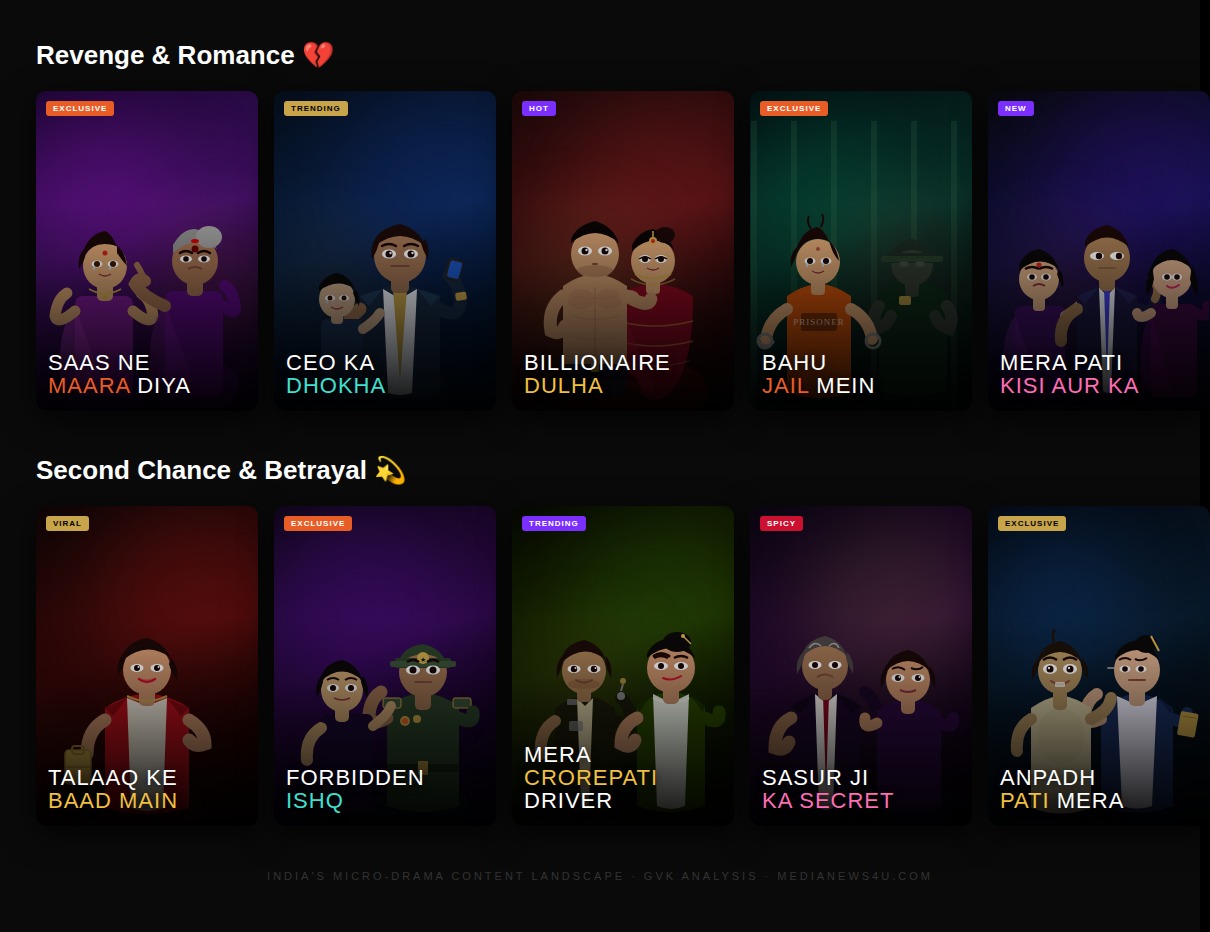
On a platform whose top-performing titles read like tabloid headlines, brand safety is not a positioning question. It is an algorithmic trust question.
That is the real advertiser verdict, not what brands say in panels, but where they put committed annual budgets versus where they run three-month tests with an exit clause.
The Exit That Speaks Louder Than Every Entry
On June 25, 2026, Pocket FM shut down Pocket TV, its micro-drama vertical, after five months. The company is valued at $750 million and had reached $450 million in annualised revenue from its core audio business. This was not a failing company running out of road. This was a data-driven organisation that ran a controlled experiment, read the results, and walked away.
The next day, co-founder and CEO Rohan Nayak posted on LinkedIn:
“We don’t think the current micro drama model works. The hardest part wasn’t getting people to try the product, it was getting them to come back. User acquisition isn’t the challenge in micro drama today, long-term retention is.”
“Much of the category today is being supported by aggressive user acquisition budgets, dark patterns and auto-renewal mechanics. If your business only works because cancelling is intentionally difficult, you don’t have product-market fit, you are a marketing arbitrage platform.”
“More than 50% of our users are still with us after 12 months. We have a higher DAU than any dedicated micro drama platform, despite spending a fraction of what the category spends on marketing. Retention is a strategy. Virality is an event.”
Nayak did not say micro-drama has no future. He said the current model does not work. A $750 million company ran the experiment and delivered the verdict publicly. The headline called it a shutdown. I would call it the most honest thing anyone in this category has said all year.
What I Believe Now
Micro-drama in its current form is primarily a money transfer mechanism from VC balance sheets to Meta’s advertising revenue. VC funds platform. Platform spends on Meta. Users pay ₹150 to ₹200. A significant share goes back to Meta to acquire the next user. Retention is held by AutoPay inertia. The cycle repeats until the VC runs out of patience or the market consolidates.
The platforms that survive will be the ones building distribution outside Meta’s auction, through vernacular community ownership, carrier bundling, brand-funded IP, audiences earned rather than rented. JioHotstar’s Tadka has the only structurally defensible position because it does not need Meta. KadhaiShorts and Enterr10, with owned audience relationships already in place, have the same potential.
The format is real. The demand for mobile-first episodic storytelling is structural. But the business built on top of it, right now, largely is not.
The industry is not at an inflection point. It is at a reckoning point. And as Rohan Nayak put it better than I could, retention is a strategy. The rest is noise.
About the Author
GV Krishnamurthy (GVK) is Partner at AdNexa.ai and a veteran media and marketing strategist with over three decades of experience across broadcast, brands, and digital in India. A Committee Member of the Advertising Club Bangalore, GVK brings a practitioner’s perspective to questions of platform strategy, media investment, and the structural gaps that large scale narratives tend to obscure. Views expressed are personal.