Knauf offers Drywall and Ceiling Solutions. It was founded in 1932 by Dr Alfons and Karl Knauf to introduce gypsum-based building materials, so people could build faster, better and cheaper. The company is headquartered in Iphofen, Bavaria, Germany with 300 plants spread across 90 countries in Europe, the Middle East, Asia, USA, Latin America and the Indian sub-continent with a workforce of more than 40,000.
Through their people and state-of-the-art plants, Knauf produces high-performing solutions ranging from drywall systems, plasters and insulating materials all the way to external thermal insulation composite systems. And as a company committed to sustainable building, the team ensures every product that comes out of the line is rigorously tested, certified, approved and socio-environmentally responsible.
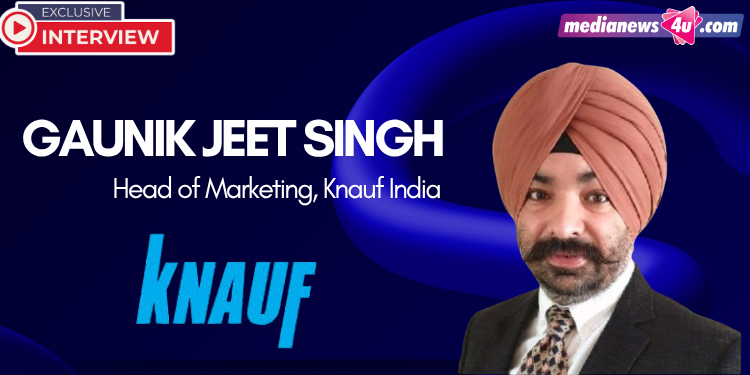
Gaunik Jeet Singh has been serving as Head of Marketing at Knauf India. With over 19 years of experience across brands like Hero MotoCorp, AkzoNobel (Dulux), Airtel, and now leading marketing at Knauf India, Gaunik brings a unique perspective on building premium brands across diverse sectors and driving integrated, multi-channel marketing strategies. At Knauf India, he is focussed on strengthening brand visibility and shaping communication strategies that align global vision with India’s evolving construction and design ecosystem.
Medianews4u.com caught up with Gaunik Jeet Singh, Head of Marketing Knauf India.
Q. What goals has Knauf India set for 2026, and what is the roadmap to achieve them?
At Knauf India, our goals for 2026 are centred on accelerating our sustainable growth model, reinforcing our leadership in ceiling and drywall solutions, expanding our innovation and manufacturing capabilities, and supporting India’s growing demand for efficient, sustainable construction.
Our roadmap includes expanding our product and system offerings, investing in advanced manufacturing, driving sustainability initiatives including carbon reduction and circular construction, scaling installer training programmes, and leveraging innovation to enhance construction efficiency and quality across the country. We are also focused on expanding customer-centric services and building a more skilled, future-ready workforce.
 Q. How will Knauf India sharpen storytelling to create compelling narratives in 2026?
We are moving away from feature-driven, jargon-heavy communication toward value-based, purpose-led narratives — ones that highlight sustainability, innovation, and real-world impact. Our content will spotlight genuine success stories from contractors, architects, developers, and channel partners, and communicate why lightweight dry construction delivers better outcomes: superior fire and acoustic performance, faster timelines, cleaner finishes, lower dead loads.
Our approach combines stronger thought leadership, digital-first communication, and regional outreach to make our technical solutions more relatable across a diverse audience. The goal is deeper stakeholder trust and sharper brand visibility — achieved by blending human-centric storytelling, on-ground case studies, and industry insight.
Q. Is the focus of marketing moving beyond product brochures?
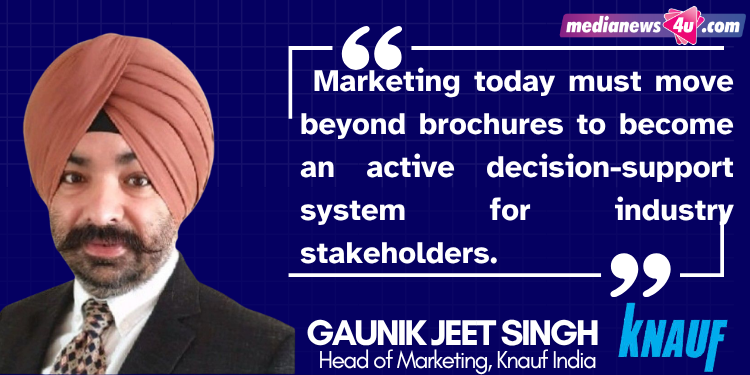
Absolutely — and it has been for some time. Industry stakeholders no longer want passive information; they expect meaningful engagement, knowledge-driven solutions, and communication that speaks to real business and sustainability challenges.
At Knauf India, we have moved from passive information sharing to active decision support. We invest in thought leadership, digital content, case studies, immersive experiences, and project-led storytelling — not just product specifications. We work with contractors who need to deliver on time and on budget, and architects designing buildings that will stand for decades. Our marketing serves both — not by making our products sound more impressive, but by making it easier to specify correctly, install confidently, and build better.
Q. Could you shed light on the brainstorming process with the creative agency that led to the campaign ‘What makes great architecture possible across South India?’
The campaign was rooted in a genuine understanding of South India’s distinctive construction needs and rapidly evolving architectural landscape. Working with our creative agency, we set out to move beyond traditional product communication — and instead celebrate the convergence of sustainability, innovation, design, and execution that enables great architecture.
Our brainstorming focused on identifying authentic stories from the region’s growing infrastructure and urban ecosystem, while spotlighting the role of modern building solutions in shaping these spaces. We gathered perspectives from architects, developers, and industry stakeholders to ensure the campaign stayed solution-focused and relatable. The central insight was that great architecture is never the result of a single product — it emerges from an ecosystem of design vision, quality materials, efficient systems, and skilled execution working in harmony.
Q. What other campaigns and marketing innovations can we expect in the coming months?
Building on the momentum of our South India campaign, we are extending our storytelling approach to new geographies — with campaigns rooted in the specific construction culture and challenges of each region. India does not have one construction market; it has many, and our communication will reflect that.
On the innovation front, we are investing in on-site demonstration events, installer and applicator engagement programmes, and a digital content series focused on modern construction methods. We are also deepening our specification marketing efforts — working closely with architects and consultants through knowledge-sharing platforms and technical workshops that support better decision-making at the design stage. Short-form video will remain a strong pillar, with sharper focus on product application, system performance, and sustainability impact. The ambition is a marketing function that is visibly and measurably tied to business outcomes.
Q. How does focussing on market impact, purpose, and outcomes in the marketing message build brand relevance and loyalty?
Today’s stakeholders look beyond products — they want to understand the value a brand creates for industries, customers, and communities. When marketing sheds light on innovation, real-world impact, problem-solving, and sustainability, it builds a stronger professional and emotional connection.
Purpose-driven communication helps brands stand out in a competitive market by demonstrating long-term vision and authenticity. Outcome-based messaging builds credibility because customers increasingly prefer brands that can show measurable efficiency, value, and positive impact. Together, these strengthen trust and loyalty over time — audiences are far more likely to engage with brands contributing meaningfully and consistently, rather than those simply promoting themselves.
 Q. Will the media mix be driven by digital?
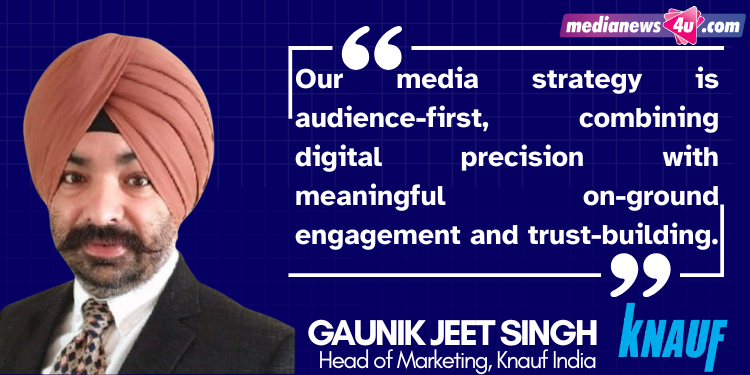
Digital will be a dominant and growing force in our media mix — but our approach is not purely digital-first, it is audience-first. Our stakeholders span a wide spectrum: architects and developers in highly connected urban environments, and contractors and channel partners in Tier 2 and 3 markets where on-ground engagement still carries significant weight. Our media mix reflects that reality.
Within digital, we prioritise LinkedIn for professional and specification-led conversations, YouTube and Instagram for visual project and product storytelling, and targeted campaigns that reach decision-makers at the right stage of their journey. We are also investing in content marketing and SEO for long-term discoverability.
At the same time, trade events, installer meets, dealer programmes, and site activations remain integral to how we build trust. The most effective mix for us is one where digital amplifies what happens on the ground — and on-ground experiences feed the stories we tell digitally.
Q. Why is the theme of sustainability so important in construction marketing?
The construction industry is under real pressure to reduce its environmental footprint, build responsibly, and support long-term urban development goals. Architects, developers, policymakers, and customers are actively seeking solutions that reduce waste, improve energy efficiency, and contribute to greener buildings.
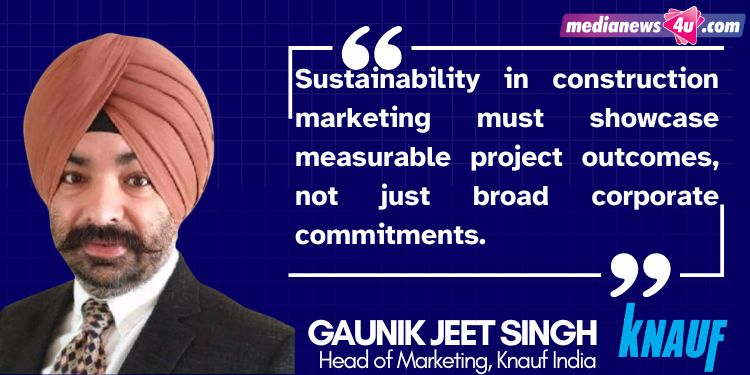
Construction marketing can no longer focus solely on product performance — it must demonstrate how solutions contribute to sustainable practices, regulatory compliance, operational efficiency, and occupant well-being across a building’s lifecycle.
At Knauf India, we believe sustainability-backed messaging builds stronger stakeholder trust because it reflects both evolving customer expectations and industry priorities. We have made a conscious choice to drive our sustainability narrative through project-level outcomes — not corporate pledges.
Q. Is the importance of short-form videos growing in communicating technical language?
Rapidly — and it makes complete sense. In a sector like building materials, where products, processes, and innovations can feel complex, short-form video simplifies technical concepts into digestible, engaging narratives. Audiences today want content that is visual, quick, and easy to act on.
For us at Knauf India, these formats are invaluable for demonstrating installation techniques, product applications, sustainability features, and performance benefits in a relatable way. They bridge the gap between technical expertise and practical understanding — for contractors, architects, channel partners, and end consumers alike. The focus has shifted from simply communicating technical information to making it memorable, visually impactful, and accessible across a fast-moving digital ecosystem.
Q. Microdramas are competing with short-form videos in terms of consumption. Do you see them playing an important role in B2B marketing in the coming three years?
Microdramas are emerging as a powerful storytelling format — blending entertainment with concise, high-engagement content. As audience behaviour shifts, brands are right to explore emotionally engaging, narrative-driven formats. In the coming years, microdramas have real potential in B2B marketing — particularly in humanising technical concepts like workplace safety, sustainable construction, project execution, and innovation.
The opportunity lies in using storytelling to show real-world challenges, on-site scenarios, and customer experiences through captivating short narratives — rather than product specifications. That said, credibility and value remain non-negotiable in B2B. Microdramas will not replace informative content, but they can effectively complement educational videos, expert communication, and case studies. The key is maintaining a balance between compelling storytelling and industry authenticity.
Q. Is Knauf India looking at podcasts as a way to get the message across?
Yes — podcasts are gaining strong recognition as a platform for industry conversation and thought leadership, especially in B2B. At Knauf India, we see genuine potential in podcasts as a medium for engaging architects, developers, consultants, and contractors through purposeful, in-depth discussions.
Unlike short-form content, podcasts allow for exploration of topics like innovation in building materials, sustainable construction, evolving customer needs, and future-ready infrastructure. They build credibility by facilitating conversations with industry experts and project leaders. The flexibility of on-the-go listening makes them particularly suited to busy professionals. While podcasts will not replace visual formats, they are a strong complement to a broader content strategy — helping brands establish themselves as knowledge-driven, insight-led organisations.
 Q. Is maintaining a consistent brand voice across platforms the big challenge in B2B marketing in 2026?
It is certainly one of the key challenges. Brands today communicate across short-form videos, social media, industry events, podcasts, websites, newsletters, and partner ecosystems — each with its own content format and audience behaviour.
The challenge is not just visual consistency, but ensuring the brand’s expertise, positioning, and values are communicated clearly across every interaction. In B2B, trust is built over time, and inconsistent messaging can quietly erode brand perception.
Importantly, consistency does not mean using the same communication style everywhere. Tone and format can evolve with the platform — but the core message, purpose, and brand philosophy must remain aligned. In 2026, the brands that win are those balancing adaptability with a strong, recognisable identity that audiences can count on, wherever they encounter it.