NYX is an autonomous AI platform that aims to fundamentally rewire how brands run performance marketing.
In a market flooded with AI tools that promise efficiency but deliver incremental gains, NYX is doing something meaningfully different: replacing the entire operational layer of digital advertising with agentic AI. From generating high-converting ad creatives (image and video) to managing multi-channel campaign optimisation, NYX handles it end-to-end, in real time.
The results brands are seeing are hard to ignore:
– 40% higher Click-Through Rates
– 30% lower Customer Acquisition Costs
– 75% faster creative turnaround
– 85% reduction in manual operations
NYX’s product suite spans ImageCraft AI (text-to-image ad creatives), VideoVista AI (script-to-video ads), CamPulse AI (campaign automation and intelligence), and an Agentic AI layer that ties it all together, functioning, quite literally, as a marketing co-pilot that never sleeps.
The platform has already earned recognition from NVIDIA, Microsoft, and Startup India and is gaining traction with brands that are done trading headcount for mediocre results.
Medianews4u.com caught up with Amit Verma, Founder NYX
Q. Is the era of experimental AI over?
The experimental phase of AI is rapidly coming to an end — especially in marketing. Over the last two years, most brands were exploring AI through isolated pilots, content generation tools, or workflow automation. But today, the conversation has shifted from “Can AI do this?” to “Can your business operate competitively without AI?”
At NYX, we believe the next phase is operational AI — where AI is no longer a support layer, but the core decision-making infrastructure behind performance marketing. The winners in the next three years will not be brands that merely use AI tools, but brands that fundamentally redesign how marketing operates using AI systems.
The market is moving from experimentation to autonomous execution.
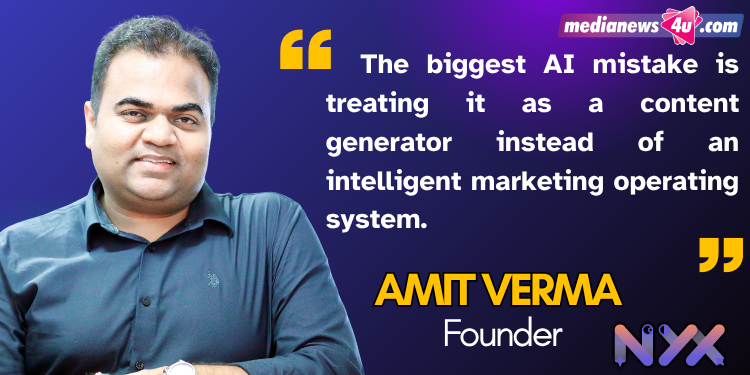 Q. What is the big mistake that brands continue to make when it comes to AI?
One of the biggest mistakes brands make is treating AI as a content tool instead of a business operating system.
Most companies are still using AI tactically — generating creatives, writing copy, or automating reports — while continuing to run the same fragmented marketing workflows underneath. That limits AI’s true potential.
The second mistake is over-indexing on automation without building intelligence. AI should not just make processes faster; it should make marketing smarter, more predictive, and more adaptive in real time.
At NYX, our focus has been to build agentic systems that can analyse, optimise, allocate budgets, generate learnings, and evolve campaigns continuously — almost like a self-improving marketing engine.
Q. What is the impact on marketing that NYX is looking to have in the coming three years?
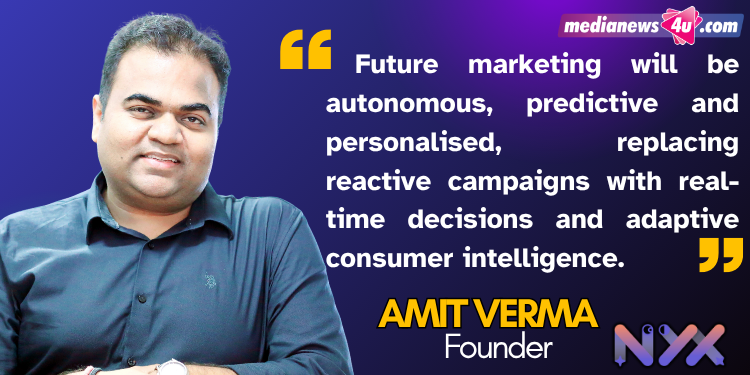
NYX is building toward a future where performance marketing becomes autonomous, predictive, and deeply personalised at scale.
Over the next three years, we want to fundamentally reduce inefficiencies that exist in digital advertising today — whether it is manual campaign management, delayed optimisation cycles, fragmented attribution, or creative fatigue.
Our larger ambition is to help brands move from reactive marketing to adaptive marketing.
That means:
- Real-time decisioning instead of weekly optimisation cycles
- AI-driven media allocation instead of manual budget management
- Dynamic creative systems instead of static campaigns
- Predictive consumer intelligence instead of backward-looking reporting
We believe marketing teams of the future will be significantly leaner operationally, but exponentially more creative and strategic.
Q. How much R&D has gone into creating an autonomous AI platform that is fundamentally rewiring how brands run performance marketing?
A significant amount of our effort has gone into deep infrastructure and systems thinking rather than surface-level AI integrations.
Over the last few years, NYX has invested heavily in building proprietary AI orchestration layers, autonomous optimisation systems, campaign intelligence engines, and data interpretation frameworks that can operate across platforms and channels.
What makes autonomous marketing difficult is not just generating outputs — it is contextual decision-making at scale. The system needs to understand intent, audience behaviour, media efficiency, creative fatigue, conversion quality, incrementality, and business objectives simultaneously.
That requires continuous R&D across machine learning, workflow automation, agentic AI systems, and marketing intelligence.
We see this less as building a tool and more as building a new operating system for marketing.
 Q. Could you talk about work done recently with brands that stands out?
One of the more exciting areas for us has been working with large consumer and entertainment brands where speed, scale, and optimisation are critical.
We have recently worked on high-volume acquisition and engagement campaigns where our AI systems were dynamically adjusting targeting, bidding, creative sequencing, and audience allocation in near real time based on behavioural signals.
What stood out was not just efficiency gains, but how quickly the systems were able to identify patterns that would traditionally take teams weeks to uncover manually.
We are also seeing strong traction in subscription-led ecosystems and OTT-focused campaigns where predictive audience intelligence and creative automation are becoming increasingly important.
For us, the biggest validation is when AI moves beyond reporting metrics and starts influencing actual business outcomes.
Q. What is NYX’s business model and how is it being finetuned?
NYX operates at the intersection of AI technology and performance marketing.
Our model combines strategic consulting, AI-led campaign execution, autonomous optimisation infrastructure, and proprietary technology systems that brands can leverage to scale efficiently.
Over time, the model is evolving from a service-heavy structure to a more technology-led framework where our AI systems become deeply integrated into how brands manage growth marketing.
We are also increasingly focused on outcome-driven partnerships, where success is tied more closely to measurable business impact rather than traditional agency structures.
The larger shift is from “agency economics” to “intelligence economics.”
Q. Is AI helping brands strike a better balance between performance marketing and brand building?
Yes — and this is one of the most underrated shifts happening right now.
Historically, performance marketing and brand building operated in silos because measurement systems were disconnected. AI is beginning to bridge that gap by helping brands understand how storytelling, engagement, sentiment, and recall ultimately influence conversion behaviour over time.
AI enables marketers to identify not just what converts immediately, but what builds long-term consumer affinity.
The future is not performance versus brand.
The future is measurable brand influence.
Q. Does the key success lie in balancing AI with human intuition?
Absolutely.
AI can process scale, patterns, probabilities, and optimisation far better than humans. But intuition, cultural understanding, emotional nuance, and creative instinct still remain deeply human strengths.
The most effective organisations will not be AI-led or human-led — they will be intelligence-led.
At NYX, we view AI as a force multiplier for human creativity rather than a replacement for it. The role of humans is shifting from operational execution to strategic thinking, narrative building, and creative direction.
Q. How does replacing the entire operational layer of digital advertising with agentic AI help make creative work immersive?
Today, a large amount of marketing talent is consumed by repetitive operational work — reporting, bid adjustments, dashboard management, pacing, segmentation, optimisation cycles, and workflow coordination.
When agentic AI takes over those layers, human teams get more bandwidth to focus on storytelling, immersive experiences, consumer psychology, and creative experimentation.
Operational automation creates creative freedom.
Once teams are freed from operational bottlenecks, they can spend more time building stronger strategies, sharper concepts, and deeper consumer narratives. Humans can focus on identifying what should be created and why it matters culturally or emotionally, while AI can take those ideas and amplify them into highly immersive, scalable experiences with significantly higher speed, engagement, and efficiency.
AI is enabling creative teams to move from execution-heavy workflows to imagination-heavy workflows.
At NYX, we believe the future is not about AI replacing creativity — it is about AI elevating creative potential to a level that was previously impossible because of operational constraints.
Q. As agentic AI grows, so will fraud. What is the best way to tackle this situation?
As AI systems become more sophisticated, fraud will also become more intelligent — whether it is bot traffic, synthetic engagement, fake attribution, or manipulated behavioural signals.
The solution cannot be manual moderation alone.
The future of fraud prevention will rely on:
- AI-versus-AI verification systems
- Behavioural anomaly detection
- First-party signal validation
- Trusted identity frameworks
- Probabilistic pattern analysis
Transparency and explainability will also become critical. Brands need systems that can explain why a decision was made, not just automate it.
 Q. AI slop is another challenge. How does an advertiser strike a balance between integrating AI into marketing and being overly dependent on it?
The problem is not AI-generated content.
The problem is low-context AI-generated content.
Brands that use AI purely for volume will eventually face consumer fatigue because audiences can identify generic, repetitive, and emotionally disconnected communication very quickly.
The role of AI should be acceleration, not replacement of originality.
The best use cases emerge when AI handles scale and iteration while humans shape insight, tone, culture, and narrative depth.
Quality will increasingly become the differentiator in an AI-saturated ecosystem.
Q. How is AI reshaping the structure of an agency?
AI is fundamentally changing how agencies are built.
Traditional agency structures were designed around manpower-heavy execution layers. AI reduces dependency on repetitive operational teams and shifts value toward intelligence, systems, strategy, and creativity.
We are moving toward smaller, highly specialised, AI-native teams that can deliver significantly higher output and efficiency.
The modern agency of the future will not be defined by the size of its workforce, but by the intelligence of its systems.
A large part of traditional agency operations — campaign management, optimisation, reporting, workflow coordination, audience analysis, media allocation, and execution layers — is increasingly becoming autonomous. This is where platforms like Xeno are redefining the ecosystem by enabling end-to-end workflow automation, autonomous campaign management, predictive optimisation, and intelligent decision-making at scale.
Over time, many traditional service-led structures will struggle to compete with AI-native systems that can deliver faster execution, better outcomes, continuous optimisation, and significantly higher operational efficiency.
The modern agency will increasingly resemble a technology company powered by AI infrastructure rather than a conventional service organisation.
Q. Consumers increasingly use Large Language Models (LLMs) for product discovery in categories like travel. What opportunities does this offer brands?
This creates a massive shift in how discoverability works online.
For years, brands optimised primarily for search engines and social feeds. Now, they also need to optimise for AI-driven recommendation environments where consumers ask conversational questions and receive curated responses.
LLMs are fundamentally changing consumer behaviour by increasing usability, discoverability, and comparison at scale. Consumers no longer browse the internet in a linear way — they increasingly rely on AI systems to compare products, analyse options, recommend experiences, and simplify decision-making instantly.
That changes the nature of visibility entirely.
Brands that provide structured information, trusted signals, strong consumer sentiment, contextual relevance, and machine-readable intelligence will perform better in LLM-driven ecosystems.
It also creates opportunities for hyper-personalised discovery journeys where recommendations are based on intent rather than just keywords.
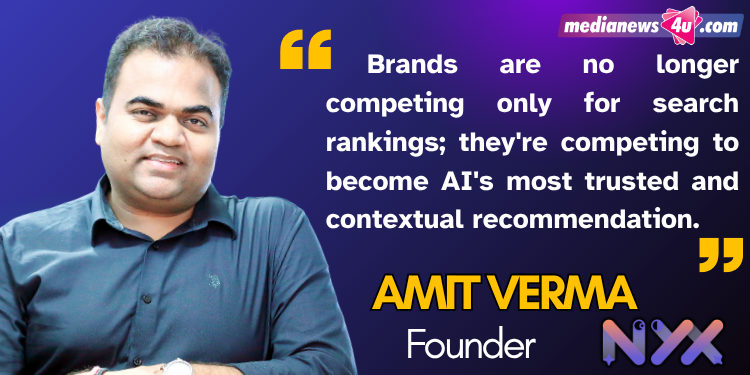
In many ways, brands are now not just competing for search rankings — they are competing to become the most contextually trusted answer inside AI ecosystems.
Q. Is it now important for marketers to optimise for GEO that is backed by first-party data?
Yes. GEO — Generative Engine Optimisation — is becoming increasingly important.
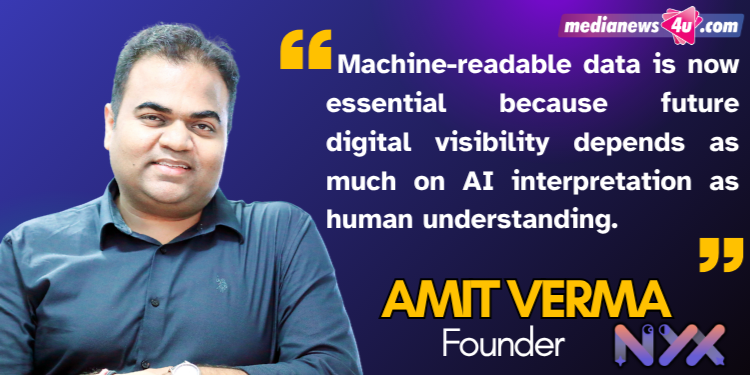
As consumers move from traditional search to AI-assisted discovery, brands need to ensure their digital presence is optimised for machine interpretation as much as human interpretation.
First-party data becomes extremely valuable because it helps AI systems understand authentic consumer behaviour, preferences, trust signals, and engagement quality.
In many ways, first-party data is becoming the fuel layer for intelligent marketing systems.
Q. Do brands now need to ensure that their data is machine-readable?
Absolutely.
Machine-readable data is becoming foundational for visibility in AI ecosystems.
AI systems interpret structured, contextual, and semantically rich information far more effectively than fragmented or inconsistent datasets. Brands that organise their information architecture properly will have a significant advantage in discovery, targeting, attribution, and personalisation.
The future of digital presence is not just human-readable. It is AI-readable.
 Q. Are people-based truth sets important for measurement?
They are becoming critical.
The industry is moving away from cookie-based tracking and probabilistic assumptions toward more durable, privacy-conscious identity frameworks.
People-based truth sets help brands measure real consumer journeys across devices, channels, and touchpoints with greater accuracy.
As AI systems become more autonomous, the quality of the underlying truth set becomes even more important because AI is only as effective as the data environment it learns from.
The next era of measurement will be built on clean, consent-driven, first-party intelligence ecosystems rather than fragmented attribution models.