Mumbai: Brands relying heavily on social and creator marketing risk limiting long-term growth unless they combine it with broader emotional brand-building strategies, according to new research released by WARC.
The report, The Pace Principle 2.0 – From Social Sprint to Sustained Growth, finds that while social marketing delivers strong short-term engagement, it encounters structural limitations that prevent brands from achieving sustained growth when used in isolation.
Building on WARC’s 2025 study The Pace Principle, which argued that successful brands balance performance marketing with long-term brand building, the latest edition examines the rise of social-first marketing across Asia—one of the world’s most socially engaged regions—and its implications for marketers globally.
The research highlights that aligning the target audience with the appropriate creative strategy can improve campaign effectiveness by up to 70%. It also found that broad emotional campaigns deliver 2.1 times greater brand and business impact than broad social campaigns, while targeted social campaigns are 2.4 times more effective than targeted emotional campaigns. However, neither approach generates strong long-term results when narrowly targeted.

Commenting on the findings, Rica Facundo, Managing Editor, WARC APAC, said, “Since publishing the Pace Principle last year, what has become clear is that with investment pouring into social and creator marketing, marketers risk getting trapped into a social sprint loop whereby brands are producing more content for virality, optimising for the algorithm rather than enduring memory and customer resonance. Virality is not a strategy, it’s an unpredictable outcome for growth.
“The loop challenge doesn’t require a new playbook but reinterpreting proven principles through a new media ecosystem. If there’s one idea to take from this report, it’s understanding the three ceilings of social. That’s what separates a social sprint from sustained growth.”
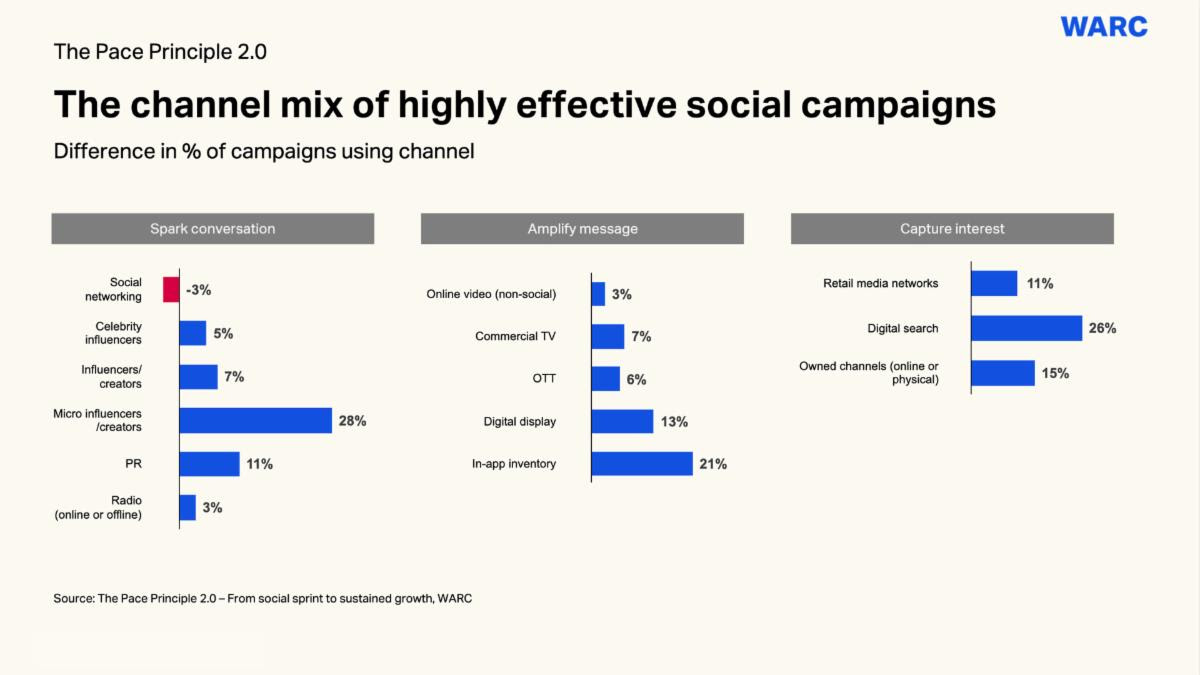
According to the report, marketers often confuse social media with social strategy. While social media refers to platforms and formats, WARC argues that social strategy is fundamentally a creative approach designed to encourage participation, conversation and sharing around a brand. The study notes that many of the most effective campaigns rely less on social platforms themselves, with successful ideas extending across creators, public relations, search and wider cultural conversations.
The report recommends that brands combine two complementary creative approaches. Social strategy is best suited to driving participation and engagement among targeted audiences, while emotional marketing builds long-term memory structures and brand preference across broader audiences. Together, the two approaches enable brands to build equity at different speeds and support both immediate and sustained business growth.
WARC also introduces a “three ceilings of social” framework, identifying the key barriers limiting the scalability of social-first marketing.
The first, the platform ceiling, highlights how content rapidly loses momentum once paid promotion ends, requiring marketers to create ideas that travel beyond individual platforms and across multiple touchpoints.
The cultural ceiling refers to campaigns built around short-lived cultural moments that fade quickly, with WARC advising brands to anchor campaigns in deeper cultural themes that have greater longevity.
The third and most difficult barrier, the self-sustaining ceiling, is achieved only when creators and communities continue amplifying a brand’s message organically without ongoing brand intervention, something the report says can only be earned over time through credibility and consistent brand building.
The research is based on an analysis of 210 advertising case studies from Southeast Asia, Greater China and India, alongside responses submitted by campaign authors. WARC said a complimentary sample of the report is now available, while subscribers can access the full study. A podcast discussing the findings will be released on August 13, followed by a global webinar on September 2.