Ashish Mishra has positioned Interbrand India as a leader in the Indian market, managing high-profile assignments such as Godrej, Jio, Mahindra Global Brand, Britannia, and Infosys. He has built strong relationships with a third of the top 40 Best Indian Brands, including Reliance, Bajaj Auto, Tata, HCL, and Union Bank.
An author, columnist, and Culture Branding exponent, Ashish has driven some of India’s most acclaimed brand transformations—from repositioning Infosys and rebranding Godrej and Britannia to shaping Jio’s brand journey and Mahindra’s global ambitions.
After leading Strategic Planning at DDB Mudra for a decade and founding Water (now Interbrand India), he is now expanding into Sri Lanka and the Middle East.
In this exclusive conversation with MediaNews4U, Ashish Mishra shares his insights on building brands that are future-ready, culturally resonant, and economically impactful.
Q) You’ve had an incredible journey—from building ‘Water’ as an independent consultancy to leading Interbrand India to the top tier of the market. What personal philosophy or inflection points shaped your approach to brand leadership?
Ashish Mishra: Before focusing on branding, I spent nearly 15 years in advertising—10 of which were devoted to building and leading the Strategic Planning function at DDB Mudra Group. That experience helped me see how strategy could drive greater value for clients and command more respect within organisations.
During that time, I worked on the Godrej rebranding exercise—Interbrand’s first large project in India—and being part of its global core team was transformative. It showed me how brand strategy, rooted in business context, could influence leadership thinking and organisational transformation. The respect this function drew from CEOs and promoters stood in sharp contrast to the creative commoditisation I was seeing in advertising.
That realisation shaped my philosophy: true brand building is holistic and multi-stakeholder. A brand isn’t just for customers—it also embodies the corporate, employee, investor, and community dimensions. It’s about creating sustainable value across all these touchpoints.
For a strategist, this is far more rewarding than producing one-off creative brilliance. Branding allows you to contribute upstream—aligning business strategy, design, and experience into a coherent system that delivers long-term impact. That belief continues to guide my work at Interbrand India.
Q) You’ve led brand transformations across categories—from FMCG to technology to BFSI. What patterns or principles remain constant regardless of industry?
Ashish Mishra: Across categories, certain foundational principles remain consistent in every brand transformation. At Interbrand, we see them as enduring tenets.
The first is that brands must be built for where they want to go, not where they are today. A future-backward perspective frees decision-makers from current constraints. Brands like Google exemplify this—they rarely define themselves by existing businesses such as Search or Gmail, but by future-facing innovations like AI, Gemini, or autonomous technologies.
The second principle is anchoring the brand in human truths rather than transient consumer insights. Consumer insights serve short-term campaigns, but brands endure over time and across multiple stakeholders—employees, investors, partners, and communities. Rooting them in human truths ensures long-term relevance and emotional depth.
The third is adopting a touchpoint-agnostic view of brand experience. Many marketers still view brands primarily through communication. We encourage them to see brand as an ecosystem—spanning culture, talent, product design, digital and retail experiences—united by a consistent experience.
Finally, every transformation must have a business and economic lens. We call this Brand Economics: linking brand strategy to value creation. Positioning, for instance, isn’t about a clever tagline—it’s about identifying a credible, high-impact driver of customer choice that the brand can own better than competitors.
When brand decisions are guided by these principles—future orientation, human truths, experience design, and economic impact—they create enduring transformation and measurable value.
Q) How have Indian clients evolved in their understanding of brand valuation and long-term equity over the last decade?
Ashish Mishra: It’s been a fascinating journey to witness—and contribute to—the evolution of how Indian businesses perceive brand valuation and long-term brand equity. When we established Interbrand India in 2013, we were a small office, born out of Omnicom’s acquisition of the Mudra Group. Having earlier experienced Interbrand’s global approach during the Godrej rebranding project, I strongly felt that unless we framed branding within a business and economic context, the market would continue to equate it merely with advertising or logo design.
That conviction shaped our foundation. From day one, we positioned Interbrand India around the belief that brands create measurable economic value. Despite initial hesitation from our global leadership, I was determined to launch the Best Indian Brands ranking in our very first year. We needed to establish a new narrative—that brand strength and financial performance are deeply intertwined.
Globally, Interbrand pioneered the concept of brand valuation over 25 years ago, but at the time, it was still a nascent idea in India. Through consistent efforts—our annual Best Indian Brands study, multiple valuation assignments, and thought leadership initiatives—the concept of brand value gradually entered the vocabulary of Indian marketers, CEOs, and investors.
Today, while not every company applies brand valuation in its truest technical sense, there is a clear and growing recognition that brands are financial assets that drive shareholder value and business growth. Over the past decade, I believe Interbrand has played a meaningful role in shaping that understanding and embedding brand value thinking into India’s marketing and corporate lexicon.

Q) As someone who’s both an author and strategist, how do you balance analytical frameworks with cultural intuition when defining brands in India?
Ashish Mishra: Brand building, in my view, relies on three key perspectives: human truths, experience, and economics.
Human truths involve understanding socio-cultural trends, behavioral insights, and societal dynamics. By recognizing early signals in culture, brands can address latent societal needs. Sociology, anthropology, and human insight form the foundation here.
Analytics comes through the economics lens. We examine both consumer and competitive contexts:
- Consumer context: Role of Brand analysis quantifies how a brand influences category drivers and business outcomes.
- Competitive context: Brand Strength Audits assess a brand’s performance against local and global best-in-class competitors, integrating qualitative, quantitative, and predictive insights.
Experience, the creative lens, defines touchpoint-agnostic experience principles and metaphors that guide brand expression across all interactions.
By integrating cultural insight, analytics, and creative experience, we create brands that are both culturally relevant and strategically robust.
Q) Many CMOs struggle to justify brand investments in the boardroom. What metrics or frameworks help demonstrate the ROI of brand building in measurable business terms?
Ashish Mishra: This is a critical question. While performance marketing provides short-term, campaign-level metrics, brand investment operates on a broader and longer-term construct. To evaluate the ROI of brand building, it is essential to use metrics specifically relevant to brand impact.
At Interbrand, having pioneered brand valuation, we use a structured framework that combines financial modeling, Role of Brand analysis, and Brand Strength assessment.
- Role of Brand analysis quantifies the extent to which a brand influences business outcomes. For example, if a brand currently contributes 25% to purchase decisions, targeted brand investments could increase this by one to two percentage points, translating directly into measurable value.
- Brand Strength assessment evaluates a brand’s position relative to competitors across multiple dimensions, such as presence, engagement, and on-ground visibility. Investments—whether in digital, broadcast, social media, or retail activation—can be linked to improvements in these factors.
By mapping investments to specific improvements in brand strength and role of brand, we can demonstrate a clear business case, showing how brand building translates into tangible value and competitive advantage.
Q) The Interbrand BGB 2025 Report suggests that in an AI-mediated world, brands that aren’t indispensable risk becoming disposable. How can businesses future-proof themselves against algorithmic invisibility and build human relevance when customer journeys are collapsing into seconds?
Ashish Mishra: Our 2025 Best Global Brands report focused precisely on this challenge. The increasing influence of AI and technology on decision-making—both in B2B and B2C contexts—creates a real risk of commoditization. As decisions become algorithmically mediated, brands must ensure they remain relevant and meaningful.
The key insight from our analysis is that brands need a radical, almost brutalist approach: making sharp, uncompromising choices that stand for something meaningful and non-replicable. This involves building strong, iconic connections with stakeholders and expanding the scope of engagement.
We see leading brands moving beyond single-category focus into “arena play”, where the brand defines categories rather than fitting into them—examples include Apple, Amazon, and Jio. By doing so, they serve multiple customer needs while maintaining a consistent, differentiated promise.
Brands must also be bold, agile, and innovative, not incremental. Legacy brands, burdened by historical business and customer expectations, often struggle to transform quickly and risk declining relevance. In contrast, brands that adopt a sharp, expansive, and courageous strategy—staying meaningful, engaging, and adaptive—future-proof themselves in an AI-mediated world.

Q) Interbrand’s data shows a 1% rise in the Role of Brand Index correlates with a 2.3% increase in share price. What does this reveal about the financial value of brand equity today—and how should CMOs balance short-term performance gains with long-term brand indispensability?
Ashish Mishra: CMOs today operate under significant pressure from short-term business imperatives, particularly in organizations accountable to shareholders and global investors. This environment often prioritizes immediate performance metrics—promotions, campaigns, and quarterly results—over long-term brand building.
The challenge lies in demonstrating that brand value translates into economic value, which resonates with CFOs, CEOs, and investors. By quantifying the financial impact of brand equity, CMOs can communicate the long-term benefits of brand investments in a language that business stakeholders understand.
The key is integration: short-term objectives need not be isolated from long-term brand strategy. When CMOs design initiatives that link short-term activations with broader brand presence across geographies, touchpoints, and channels, they not only achieve immediate results but also enhance long-term efficiency and value creation.
Ultimately, mature brand leadership involves balancing the imperatives of short-term performance with sustained investment in brand equity, ensuring that every action contributes to both immediate business outcomes and enduring brand indispensability.
Q) Interbrand’s Best Global Brands and Best Indian Brands studies have become industry benchmarks. What are some of the most striking shifts you’ve noticed in brand leadership post-pandemic?
Ashish Mishra: Post-pandemic, we are witnessing several significant shifts in brand leadership.
Firstly, value creation is moving from legacy conglomerates to new-age tech brands. In India, for instance, Jio has entered the top five brands, and TCS is emerging as a standalone, major value creator within the Tata Group. Globally, brands like Booking.com, Shopify, and BYD are rising, while some traditional players, such as Tesla, have experienced volatility.
Secondly, within the luxury sector, brands that diversify beyond limited product lines are sustaining growth, whereas those dependent on a narrow portfolio face pressure from reduced purchasing power.
Finally, media and entertainment brands have seen significant growth, driven by increased at-home consumption patterns—Netflix, Amazon Prime Video, and Spotify being prime examples.
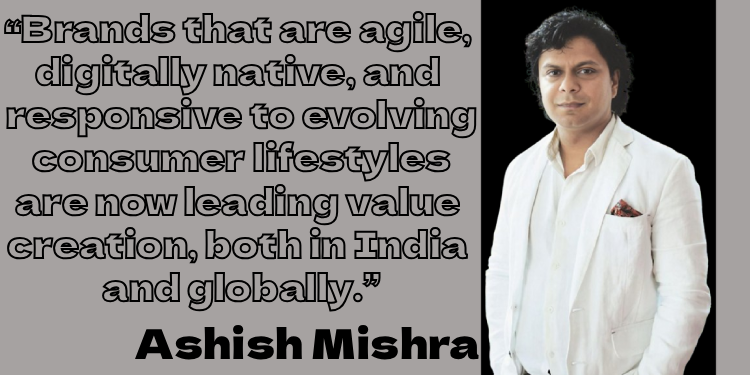
These trends highlight a broader post-pandemic shift: brands that are agile, digitally native, and responsive to evolving consumer lifestyles are now leading value creation, both in India and globally.

Q) As someone who’s built and rebuilt brands, what’s the single biggest misconception about what “branding” really means?
Ashish Mishra: The most common misconception is equating branding solely with external communication—advertising or logos. While the market has made progress in understanding this, many organizations, particularly in India, still hold a narrow view of the role brands can play.
In reality, brands are interfaces. They connect internal culture and values with customer experience, link businesses with communities, and translate investment into growth. At their core, brands embody the intersection of culture, values, and experience.
Put simply, brand strategy is business strategy brought to life. It mirrors the organization’s objectives and ambitions, guiding interactions both internally and externally. The more businesses recognize branding in this holistic way, the more effectively they can leverage it as a driver of long-term value, beyond mere marketing campaigns.