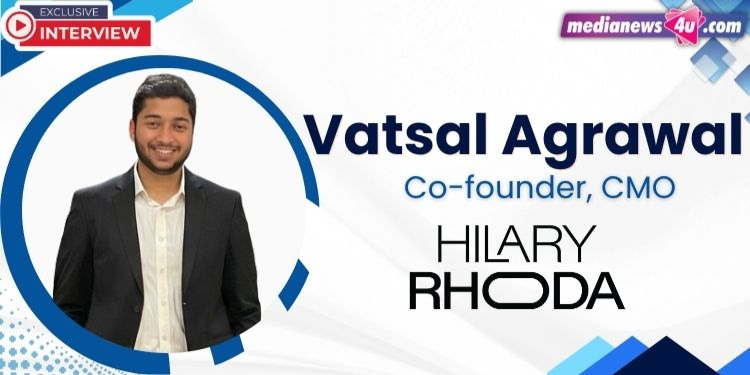
Hilary Rhoda, is a Gurugram-based beauty brand founded in 2008 by second-generation entrepreneur Vatsal Agrawal. Built on the belief that beauty should be approachable, trustworthy, and empowering, Hilary Rhoda focuses on creating high-quality yet affordable makeup products that support young women as they step into their first beauty experiences.
With a strong presence across both B2B and B2C channels, the brand has steadily built credibility in India’s value-driven beauty segment. Its diverse portfolio spans face, lip, eye, and personal care categories, catering to women starting from the age of 18. Over the years, Hilary Rhoda has gained significant traction in Tier 2 and Tier 3 markets, where accessibility, reliability, and affordability play a key role in shaping consumer trust.
At the helm of the brand’s marketing and growth strategy is Vatsal Agrawal, Co-Founder and CMO, who combines formal management training from NMIMS with hands-on experience in scaling distribution networks and building consumer trust in a highly competitive and largely unregulated beauty landscape. Under his leadership, the brand is now focusing on expanding its digital footprint and building direct relationships with young, first-time beauty consumers across India.
Medianews4u.com caught up with Vatsal Agrawal Co-founder, CMO Hilary Rhoda
Q. Hilary Rhoda launched in 2008 when there was less competition in the beauty space. What tactics has the company followed since then to stay ahead of the competition as lots of players entered the space?
Our strategy since Hilary Rhoda’s launch has been to ensure we remain relevant, not just react to competitors. Instead, we chose to position ourselves as offering high-quality products at pocket-friendly prices for young women who are exploring makeup for the first time.
Being a digital-first, bootstrapped beauty brand has allowed us to make quick decisions, which has helped us improve our products, not only focusing on quality, long-lasting, and high-pigment formulas, but also aligning with the shift towards cruelty-free beauty. Additionally, our cultural connections through our festive campaigns have allowed us to ensure that we remain relatable.
Q. Is building credibility and quality in India’s competitive cosmetics space the big challenge for the company and industry?
I think the biggest challenge we face today is credibility and quality. I think this is the biggest challenge not only for us at Hilary Rhoda but also for the entire industry. With the rise of so many brands coming into this space, consumers are more aware and more careful. It’s no longer just a question of being affordable; it’s a question of delivering on performance and safety.
For us, the biggest challenge is balancing price and quality while delivering long-term credibility. Credibility does not come from one campaign; it comes from delivering reliable products over and over again.
Q. For 2026 what goals have been set and what is the gameplan to get there?
As for what we plan for 2026, at Hilary Rhoda, we are clear about what we want, and we want to grow sustainably, keeping our customer-centric approach at the heart of everything we do. We are working on expanding our portfolio, especially in trendy segments, and also on consolidating our D2C platform.
A major part of our growth plan is data-driven marketing, for which we keep a keen eye on metrics like CAC and ROAS. So, it is a mix of performance marketing and engagement.
Q. How is Hilary Rhoda adapting to the D2C era?
We’ve really leaned into the whole direct-to-consumer movement with Hilary Rhoda by putting the consumer at the center of all that we do. Social media is a huge factor for our brand, not only for marketing but also for dialogue and discussion. We work with influencers who believe in our vision and keep the content very authentic.
Of course, we’re also developing a “phygital” presence that will allow us to be available online and also build trust through our physical presence. Being available on all marketplaces and quick-commerce platforms is also a big factor for us so that we’re where our consumer is.
Q. Hilary Rhoda focuses on creating high-quality yet affordable makeup products that support young women as they step into their first beauty experiences. Is AI playing an increasingly important role in this regard?
I think AI can be a great enabler for brands like Hilary Rhoda. It can help us further demystify the beauty experience, especially for new users. With the use of AI-based tools, we can help them try out products virtually and build more confidence around their purchase decisions.
On the other side, we can leverage AI to monitor trends and consumers. behavior, which can help us innovate while keeping costs under control. In a sense, we can offer premium-like experiences without compromising on the affordable side of the equation.
Q. How are value-driven brands reshaping India’s makeup market?
From where I’m sitting, value-driven brands are certainly changing the way the beauty market looks in India. We are shifting away from the notion that good makeup should cost a lot of money. Now, we want good performance, whether that’s color or wear, at a reasonable price point.
And also, because of the way that social media and online content are changing the way we think about beauty, we are making more skincare products for people in India. And then, of course, there’s the whole notion of hybridization, where we are seeing a lot of skincare and makeup coming together in a way that makes sense for the consumer.
Q. From a marketing perspective will the priorities and focus areas in 2026 revolve around ensuring that beauty and the company’s products are approachable, trustworthy, and empowering?
As we look forward to the year 2026, our marketing strategy at Hilary Rhoda is to ensure that our customers see us as approachable, trustworthy, and empowering. In this case, our customers should feel comfortable and not intimidated by the idea of beauty.
In addition, it is important to ensure that our customers trust us. In this case, our marketing strategy is to ensure that our customers see the results rather than the claims. On the other hand, our marketing campaigns promote empowerment and self-expression. In this case, makeup is not about covering up, but rather it is about being unique.
Q. What marketing campaigns and innovations can we expect in the coming months?
In the coming months, we plan to continue with the momentum of the digital-first approach for Hilary Rhoda. Expect to see more of our empowerment, festive, and wedding content, which are topics that really resonate with our audience. Influencer and short-form video content will continue to be important for us.
In terms of products, we are focusing on innovation that can fit within a person’s daily routine, for example, compact palettes and long-wearing hybrid products. We are also working on making a stronger offline presence for the brand so that we can have a stronger omnichannel presence.
Q. A lot of beauty brands use Bollywood celebrities some of whom have stake in companies like Kay Beauty. Does Hilary Rhoda have plans in terms of roping in celebrities?
While celebrity partnerships are certainly a big influencer in the beauty space, at Hilary Rhoda, the focus has always been on creating connections with the consumer by keeping things real, and that has really worked well for us.
We are more about the micro influencers and the real voices that really connect with our consumers, as that means a lot to us, but yes, we are open to celebrity partnerships as well, as long as it makes sense for the brand and feels authentic to the consumer.
Q. Gen Z prioritises authenticity. As a result are marketers in this category rethinking the playbook?
I think Gen Z has changed the game for Hilary Rhoda’s marketing, shifting away from a very polished approach toward a more authentic one.
I think that consumers are looking for honesty these days; they are looking for reviews, they are looking for user-generated content, and they are looking for creators that are speaking in their voice, and so marketing is no longer about selling; it’s about creating a conversation.
Q. Gen Alpha is growing up inside the Internet not along with it. Will this generation force beauty brands to adopt a more pragmatic approach to digital marketing in the coming five years?
Definitely. The younger generations are much more interested in actual problem-solving and actual conversation rather than just aspirational marketing. It’s not about them, really; it’s about how they want to engage with a brand in a way that feels very natural and relatable.
One of the main reasons for this is that they have grown up in a digital age where they have seen everything, and they will very quickly see through anything that is considered performative. What really works for them is honesty and brands that talk in a raw, real, and unfiltered way.
Q. What trends are being seen in Tier 2 and Tier 3 markets, where accessibility, reliability, and affordability play a key role in shaping consumer trust?
Tier 2 and Tier 3 markets are a huge opportunity for us at Hilary Rhoda. What is interesting to note is that consumers in these markets are no longer looking for price alone; they are also looking for quality. Social media and regional influencers seem to be impacting their buying behavior.
Also, accessibility through quick commerce and COD seems to be contributing to this. Another interesting aspect is that there is a huge market for products for Indian skin tones. This is an evolving market, and we are trying to adapt to these changing consumer behaviors.