A few weeks ago, this column looked at what happens when a country’s television ratings system goes dark, who benefits from the silence, and who pays for it. The response made one thing clear: measurement is not a side issue for Indian broadcasting. It’s the issue underneath every other one.
So it’s worth sitting with a number that got far less attention than it deserved. The FICCI-EY Media & Entertainment Report 2026, released in March, shows Indian television households climbing from 186 million in 2023 to 193 million in 2025, on course to cross 200 million within two years. Linear TV’s weekly reach held near 745 million viewers, a scale most global broadcasters would kill for. And in the same period, television advertising revenue fell for the fourth straight year.
More homes. Steady reach. Falling revenue. Anyone selling the “television is dying” story has to explain that gap, because the audience data doesn’t support it. What the industry actually has is a much harder problem to admit to: it cannot yet prove, with numbers everyone trusts, what all that reach is worth.
Where the Gap Actually Sits
Three things are true at once in Indian television right now, and none of them get discussed together often enough.
First, the measurement infrastructure itself is under strain, not a footnote, but the foundation everything else in this piece rests on. A ratings blackout doesn’t just inconvenience planners; it removes the one shared reference point that lets buyers and sellers agree on what they’re transacting.
Second, television’s structural strengths, vernacular depth, live sport, festival and election moments, Free TV and FreeDish reach into homes no platform has fully penetrated, remain genuinely intact. Non-Hindi content alone still accounts for over half of all television viewership. That is not a legacy asset. It is India’s actual competitive advantage, and it deserves to be defended as strategy, not nostalgia.
Third, digital has been allowed to claim the accountability high ground almost by default, without facing the same scrutiny television has always had to survive. Nearly two-thirds of India’s total ad spend now runs through digital channels, largely on a promise of superior measurability that the industry rarely stress-tests the way it stress-tests television.
Put together, that’s not a story about one medium losing to another. It’s a story about an industry that has let the newer channel set easier terms for itself.
What Needs to Change
If Indian television is going to convert its reach into revenue again, four things have to happen, and none of them are about chasing streaming’s playbook.
Rebuild trust in measurement before investing further in the technology around it. Every new dashboard or AI-attribution tool is being layered onto a foundation that buyers and sellers no longer fully agree on. Fix the foundation first, or the tools just produce more confident-looking noise.
Treat vernacular and regional strength as core strategy, not a defensive talking point. This is the one asset that took decades to build and cannot be replicated by any platform overnight. It should be leading every pitch television makes to advertisers, not trailing behind digital’s targeting story as an afterthought.
Stop letting digital’s accountability claims go unexamined. If linear has to prove every rupee of reach, programmatic and digital owe the same proof, not a pass because the dashboards look modern. Parity in scrutiny is the only honest starting point for comparing the two.
Build genuinely joint planning across linear and connected screens, instead of treating them as rival budgets. Free TV, Pay TV, and Connected TV are increasingly the same households moving across the same evening. Advertisers already think this way. The buying infrastructure hasn’t caught up.
None of this requires television to imitate digital. It requires the industry to finally measure itself with the same rigour it has always been forced to accept from others.
“India’s television problem was never that people stopped watching. It’s that the industry stopped being able to prove it and stopped insisting that everyone else prove their numbers too.”
A Model Worth Studying
India is not the only market wrestling with this. Globally, the World Federation of Advertisers has spent the last two years building Halo, an open-source cross-media measurement framework designed to give advertisers a single, deduplicated view of reach across TV, CTV, streaming and digital, something the fragmented, siloed measurement landscape has made almost impossible everywhere, not just here. Early pilots are already live in the UK, through a system called Origin, and in the US, through Aquila. Spain launched its own version, MAPA, earlier this year, explicitly framed by its advertiser association as building a common, audited currency the industry can trust, rather than another proprietary black box.
What’s instructive is not the technology. It’s the posture. These frameworks exist because advertisers, broadcasters, platforms, and measurement bodies chose to build shared infrastructure rather than compete on whose numbers looked better. India’s ratings freeze is, in a sense, the opposite failure mode: a single shared system broke down, and no comparable collaborative alternative was ready to absorb the shock.
That’s the real lesson for Indian television. The fix isn’t a better proprietary dashboard from any one player. It’s a shared, audited standard the whole ecosystem trusts enough to stop arguing about.
The Standard Worth Setting
The FICCI-EY numbers should have been an industry wake-up call, not a footnote in a launch-day press release. A medium with 193 million households and 745 million weekly viewers does not have a relevance problem. It has an accountability gap that four consecutive years of falling ad revenue have made impossible to ignore.
Television doesn’t need permission to defend itself. It needs to set the standard it has always been held to, and hold the rest of the ecosystem to the same one. That is not a plea for sympathy for an old medium. It is a demand for evidence, applied evenly, across every screen advertisers spend on.
That is the conversation Indian television owes its advertisers next.
About the Author
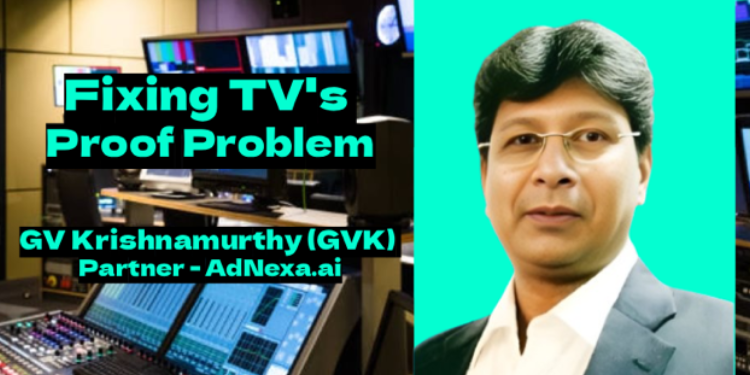
GV Krishnamurthy (GVK) is Partner at AdNexa.ai and a veteran media strategist with over three decades of experience spanning broadcast, print, digital, and advertising strategy across India. A committee member of the Advertising Club Bangalore, GVK writes regularly on media accountability, measurement gaps, and structural shifts in India’s advertising ecosystem. Views expressed are personal.
(Views are personal)